
THE SHORT ANSWER
Clarify what kind of language assistance is being requested, how often it occurs and what work it displaces. Being bilingual does not make every translation task suitable or sustainable.
What to keep in mind
- Describe the actual language task before accepting an open-ended role.
- Agree who reviews sensitive or specialist material.
- Make workload and time visible before discussing recognition or pay.
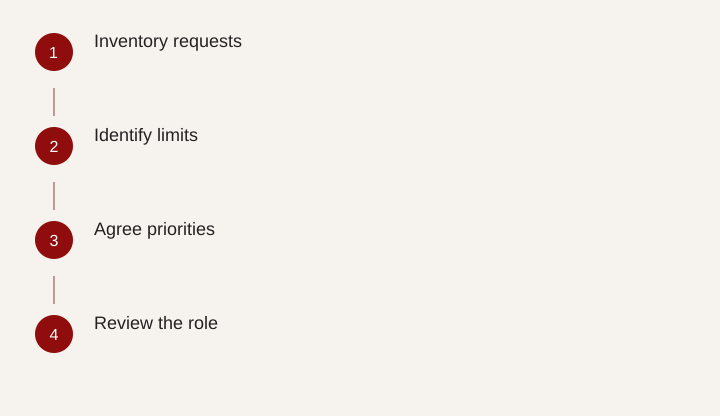
- Inventory requests
- Identify limits
- Agree priorities
- Review the role
Name the task before discussing the favor
“Can you translate this?” may mean helping a visitor locate an office, interpreting a performance meeting, rewriting a technical manual or explaining a medical instruction. Those requests differ in preparation, risk and skill. Start by asking who will use the result, whether a written record is needed and who will check accuracy.
A bilingual employee can be helpful without becoming the default language resource for an entire organization. The problem often develops gradually: a five-minute request becomes a daily interruption, and nobody adjusts the employee's original targets. If you accept every request without clarifying scope, your manager may never see the time involved.
Use a simple question: “What is the purpose, deadline and expected level of review?” It makes the work visible without dismissing the person who needs language access. You can support access while asking the employer to provide an appropriate process.
Distinguish ordinary assistance from specialist work
Conversational fluency is not the same as knowing specialist terminology or being able to interpret neutrally under pressure. You may be comfortable explaining a meeting location but not a disciplinary allegation, consent form or safety procedure. Identify that limitation before someone relies on your words.
For a hypothetical example, an employee who speaks Spanish at home is asked to interpret a technical equipment inspection. They understand everyday conversation but do not know the relevant engineering terms. A responsible response is: “I can help arrange the conversation, but I cannot verify the technical interpretation. Please use an appropriately qualified person for that part.”
Avoid presenting this as a universal credential rule; requirements vary with the task and setting. Ask which standard applies and who is responsible for quality. The employer should not discover your limitations only after an important document has been distributed or a decision made.
Track the work that is being displaced
For a week or another practical sample period, record each request, duration, preparation and follow-up. Include the time needed to find unfamiliar terminology, review a draft or explain a correction. Do not count only the minutes spent speaking.
| Request | Time and preparation | Original work affected | Decision needed |
|---|---|---|---|
| Routine visitor assistance | Brief conversation | Customer queue | Who provides coverage? |
| Written announcement | Drafting and review | Scheduled report | Who approves the translation? |
| Sensitive meeting | Preparation and attendance | Project delivery | Is a qualified external interpreter needed? |
Use actual observations rather than inflating the burden to strengthen a negotiation. If requests are irregular, explain that the sample is not an annual estimate. A manager can make a better decision from “These requests displaced four scheduled tasks” than from “Everyone always uses me.”
Separate working time from a language premium
Two questions are often mixed together. One is whether time spent doing the requested work is accounted for. The other is whether language responsibilities justify additional compensation, a different classification or a revised job description. They require different evidence.
The Department of Labor's hours-worked guidance explains that work an employer suffers or permits is working time for covered nonexempt employees. Follow the applicable timekeeping process rather than treating translation as off-the-clock help. That guidance does not itself establish a particular bilingual pay differential.
For a premium or role change, find the employer's written policy, agreement or compensation process. Ask about required proficiency, frequency of use, qualifying duties and approval. Do not use an anonymous salary claim as proof of what your employer must pay. A proposal can be reasonable even when no automatic premium has been identified.
Propose a workable arrangement
Offer a bounded way to help. Possibilities include routing requests through your manager, limiting assistance to defined tasks, scheduling translation time, using a review partner or referring specialist work to a qualified service. Explain what remains outside your competence.
I am glad to help with routine language questions. The requests now include [tasks] and take approximately [observed time]. They are affecting [assigned work]. Could we agree which requests belong in my role, who sets priority and who reviews accuracy? For [sensitive task], I need an appropriately qualified interpreter or reviewer. If this becomes an ongoing responsibility, I would also like to review the job description and any applicable compensation policy.
The message connects capacity, quality and recognition. It does not frame language access as an inconvenience caused by people who speak another language. Keep that distinction clear when discussing the issue with coworkers or management.
Review the arrangement before it becomes permanent
After an agreed trial, compare the request volume with the original expectation. Did a routing process reduce interruptions? Were specialist tasks referred appropriately? Did your performance targets change to reflect the additional work? An arrangement that sounds modest on paper can still be unsustainable in practice.
Document the final scope in a short message: eligible tasks, priority contact, review responsibility, time allocation and next review date. If a pay or classification request is pending, record its owner and expected next step separately. Do not assume an encouraging conversation equals approval.
If the role remains informal, continue making conflicts visible: “I can complete the translation today or the scheduled report today; which should take priority?” This is a concrete management decision. It is more useful than silently absorbing both tasks until a deadline is missed.
Related questions
Does speaking two languages make me a professional interpreter?
No. Conversational fluency does not establish competence for every technical, medical, legal or high-stakes task. Ask what qualifications and review the organization requires.
Should translation time be invisible because it is a favor?
No. Record work through the employer's proper system and clarify which assignment it replaces. The wage rules depend on coverage and classification, while a language premium is a separate policy or agreement question.
Sources & further reading
Primary references
- Fact Sheet 22: Hours Worked Under the FLSA
- EEOC Enforcement Guidance on National Origin Discrimination
Community questions behind this guide
These discussions informed the question and language. Personal accounts are not verified facts or professional advice. Read our method.