
THE SHORT ANSWER
Match the work rather than the title. Explain private-sector tasks in plain language and connect them to the duties and qualifications of a particular federal vacancy.
What to keep in mind
- Translate internal language into observable work.
- Describe authority and complexity accurately.
- Do not use corporate salary as a substitute for qualification evidence.
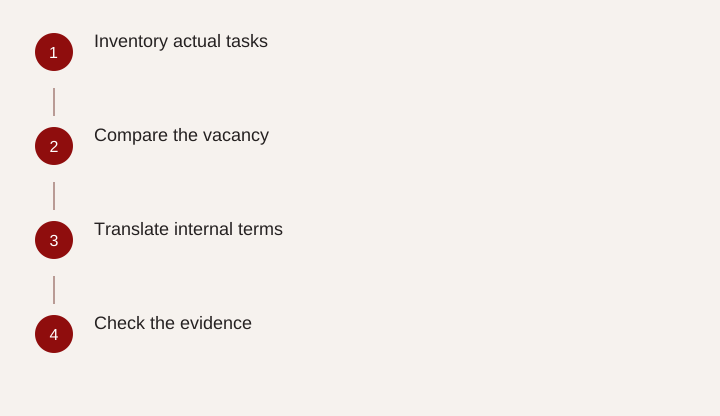
- Inventory actual tasks
- Compare the vacancy
- Translate internal terms
- Check the evidence
Match functions before matching titles
A private-sector title rarely provides a complete map to a federal job. “Operations specialist” might describe purchasing, logistics, customer support or business analysis depending on the employer. Start with the work you performed, then compare it with the qualifications in the announcement.
The USAJOBS explanation of eligibility and qualifications separates the route by which you may apply from the evidence that you can perform the job. Private-sector experience can be relevant to qualifications without giving you the hiring eligibility of a current federal employee. Keep those two questions separate.
Make a list of your recurring tasks, decisions, outputs and stakeholders. Include work that may have been hidden inside a broad title. An employee who organized records, checked supporting documents and resolved exceptions may have useful evidence for a vacancy even if the corporate title contains none of those words. The connection must be explained rather than assumed.
Replace internal vocabulary with its purpose
Company systems, acronyms and project names often obscure otherwise relevant experience. Explain what the tool or process did. An unfamiliar dashboard name is less useful than a description of how you used it to reconcile transactions, track cases or investigate discrepancies.
Keep a technical name when the vacancy specifically requires knowledge of that platform, method or standard. Translation does not mean removing all specialized language. It means helping a reader distinguish the skill from the label your employer happened to use.
A fictional source entry might say, “Owned the weekly Orion queue.” A clearer version could say, “Reviewed the weekly service-request queue, assigned cases using documented priorities and escalated unresolved exceptions to the team lead.” That revision is appropriate only if those actions match the applicant's actual work. Do not add them merely because the clearer version sounds like a federal qualification. Begin with factual notes and translate those notes.
Show the level at which you worked
Federal qualification review may depend on more than whether you have encountered a task. Explain the complexity, independence and responsibility relevant to the announcement. Preparing records for an analyst, conducting the analysis and approving the resulting action represent different levels of involvement.
Use concrete distinctions. Describe whether you followed a fixed procedure, selected among alternatives, interpreted requirements, advised decision makers or supervised other staff. A short example can communicate more than “high-level strategic responsibilities.”
Do not treat a high corporate salary as proof of a federal grade, or a modest salary as proof that your experience is too junior. Compensation and qualification evidence answer different questions. The OPM qualification framework and the applicable vacancy requirements concern the experience needed for the position. Show the work itself. Likewise, years in an industry do not automatically equal years performing each specialized function named in a posting.
Build a translation table
Use this table privately before drafting. The examples are hypothetical and should be replaced with your own duties.
| Internal wording | Function to explain | Evidence to supply |
|---|---|---|
| Handled escalations | Resolved complex service exceptions | Type of issue, personal authority and resolution process |
| Owned month-end | Reviewed and reconciled period-end records | Records reviewed, discrepancies investigated and output |
| Supported compliance | Applied specific requirements to defined work | Requirement, task and documented action |
| Worked with federal clients | Delivered services under a contract | Actual employer, client context and responsibilities |
The middle column is a question to investigate, not permission to upgrade the claim. “Supported compliance” could mean scheduling training rather than interpreting rules. Find out what your own record supports. Then compare that function with the exact qualification, including its required subject matter and level. A useful translation preserves both the strength and the limits of the original experience.
Connect the translated work to an employment entry
Place evidence under the role where you performed it, with accurate dates and weekly hours. A stand-alone skills list can summarize capability, but it does not explain when you gained the experience or how it relates to a required period.
A career changer may need to draw relevant examples from several roles. That is acceptable as a drafting approach, but do not blend those roles into a fictional continuous position. Keep the timeline clear. If the strongest example is older, give it enough space to be evaluated instead of deleting it solely because it is not recent.
The OPM applicant resume guidance calls for concise descriptions aligned with the announcement. Tailoring means choosing relevant facts and explaining them clearly. It does not mean changing an employer's identity, claiming government employment while working for a contractor or replacing the real title with the desired one. You can add a brief functional explanation beside an obscure title while retaining the actual title.
Test the translation before you submit
Give the draft and the announcement to a reader who is unfamiliar with your company. Ask them to identify the sentence proving each key requirement. If they need you to explain an acronym or fill in a missing task verbally, revise the entry.
Next, read the same sentence as the person who would supervise you. Does it accurately represent what you can do independently, what you have only observed and where you would need training? This second check prevents a resume from passing a vocabulary test while creating unrealistic expectations for the interview.
Keep a small library of approved translated entries for related job families. Store the factual source notes with them and update both when your experience changes. For a new vacancy, select and adapt the relevant entries rather than starting from scratch. The goal is a clearer description of your real career, with enough detail for a federal reviewer to make the comparison.
Related questions
Should I give my private-sector job a GS equivalent?
Do not invent a federal grade for a private-sector role. Describe the actual work and show how it meets the experience requirements of the advertised grade.
Does contractor experience count as federal civilian employment?
Working on a federal contract is different from holding a federal civilian appointment. Describe the employer and work accurately and answer service-history questions according to the instructions.
Sources & further reading
Primary references
- OPM applicant guidance on the two-page resume limit
- USAJOBS: Eligibility versus qualifications
- OPM: General Schedule Qualification Policies
Community questions behind this guide
These discussions informed the question and language. Personal accounts are not verified facts or professional advice. Read our method.