
THE SHORT ANSWER
Ask what job task is affected, what specific communication difficulty was observed and how it will be assessed. An accent and an inability to perform the job are different facts.
What to keep in mind
- Ask for examples tied to actual job duties.
- Keep performance evidence and comments about accent separate.
- Evaluate proposed changes against a clear, consistently applied standard.
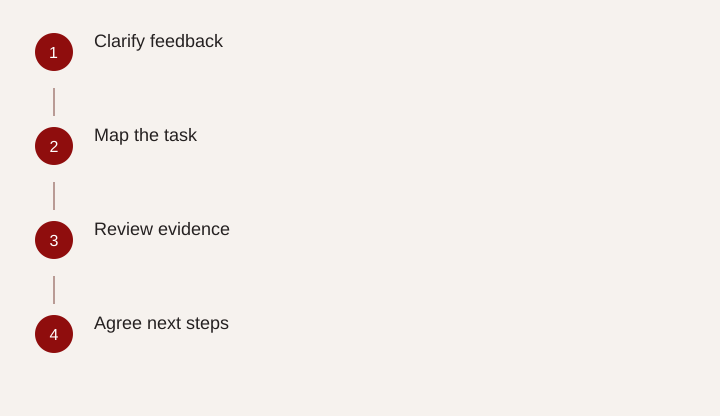
- Clarify feedback
- Map the task
- Review evidence
- Agree next steps
Ask what the feedback actually means
“Improve your communication” can refer to many things: missed handoffs, unclear structure, insufficient technical detail, speaking too quickly or an accent a listener is unfamiliar with. Before responding, ask the manager to identify the task and an example. Without that detail, you cannot tell whether there is a correctable performance issue, a vague preference or possible bias.
Try: “Could you show me a recent situation where my message was not understood and explain what information the listener missed?” This question invites observable evidence. It also avoids an unproductive debate over whether your accent is strong, mild or attractive. The relevant practical question is whether the required message gets through in the conditions of the job. A noisy customer counter, a written research role and a technical presentation impose different communication demands.
Understand the distinction in the official guidance
The EEOC's accent guidance distinguishes a discernible accent from one that materially interferes with communication necessary for job performance. It calls for evidence rather than unsupported assumptions. Customer or coworker preference does not, by itself, answer that analysis.
Use this distinction to frame questions, not to announce a legal conclusion after one conversation. Ask which duties require spoken communication, which messages were misunderstood and whether the employer has examples involving accuracy, safety, service or another actual requirement. If the explanation shifts from task performance to sounding native, preserve that change in your notes.
An employer can offer legitimate communication coaching. An employee can also perform effectively while speaking with an accent. Both points can be true, and a useful review must examine the work instead of treating accent as a substitute for competence.
Build a task-and-evidence matrix
List the duties that prompted the feedback. For each, identify the audience, environment, expected result and available evidence. A successful written project does not necessarily answer a concern about emergency radio communication. Conversely, a general statement that clients dislike accents does not establish that your presentations failed.
| Task | Question to examine | Possible evidence |
|---|---|---|
| Customer call | What information was misunderstood? | Authorized quality review or documented correction. |
| Team handoff | Was the next action clear? | Written handoff, follow-up questions and task outcome. |
| Presentation | Could listeners explain the main decision? | Relevant feedback and resulting work. |
| Safety communication | Was a required instruction conveyed accurately? | Applicable procedure and a specific incident review. |
Collect only material you are allowed to access and retain. Do not independently record conversations where law or employer rules prohibit it. If the employer controls recordings or evaluations, ask that the relevant material be reviewed through an authorized process. Your matrix can identify evidence without containing a copy of it.
Test the explanation with a hypothetical example
Imagine a service employee is told that callers frequently ask for repetition. A reasonable next question is whether the issue occurs on particular equipment, with certain technical terms or across all calls. Poor audio, a rushed script and an unfamiliar accent may interact. A headset change, shorter explanations or confirmation of key details could help without changing how the employee sounds.
Now imagine the same employee receives strong call-quality assessments but is removed from customer work because a manager says customers expect an American voice. That is a different concern. The record should preserve the statement, the reassignment and the existing performance evidence.
Neither example determines your situation. The value of comparing them is to identify the missing fact: an actual communication problem, a preference, or a mixture requiring closer review. Do not let an argument about personal identity obscure an opportunity to clarify the employer's stated reason.
Send a focused clarification email
After a meeting, summarize the point you need clarified. Use a neutral tone while preserving the concern. Avoid writing a long defense of your entire career when the disagreement concerns one duty.
Thank you for discussing communication expectations with me. I would like to understand the concern so I can respond constructively. Please identify the job duties affected, one or two recent examples and the standard used to assess successful communication. I would also appreciate knowing whether the concern involves message accuracy, structure, audio conditions or my accent itself. Could we agree on a practical review method and a date to evaluate progress? I am concerned about the reference to sounding more native and would like that point clarified as part of the discussion.
Adjust the final sentence to reflect what was actually said. Do not insert a discriminatory comment that did not occur. If the meeting was more ambiguous, quote the words you remember and label any uncertainty. A short factual follow-up is usually easier to answer than a message combining accusation, resignation threat and negotiation.
Decide what support or escalation would help
If the employer provides specific examples, consider a measurable improvement plan with a reasonable review point. Ask whether the same standard applies to comparable roles and whether you will receive the tools or training needed. Keep a record of the agreed task and outcome, rather than tracking whether every listener likes your voice.
If the employer cannot explain the concern, repeatedly invokes nationality or changes opportunities despite evidence of effective work, consider the designated reporting route. The EEOC deadline guidance is a starting point for identifying the applicable external process; federal employment follows a separate route.
You do not have to choose between taking all feedback as prejudice and accepting every comment about your accent as fair. Ask precise questions, preserve the response and decide from the resulting evidence. The goal is a clear standard for the work and a fair review of how that standard is being used.
Related questions
Can an employer ever consider an accent?
EEOC guidance allows a job-related decision where effective spoken English is required and the accent materially interferes with that communication. A general preference for a particular sound is different.
Should I take accent coaching?
That is a personal and practical choice. First clarify the communication issue and your own goals. Coaching should not be treated as an admission that an accent makes someone unqualified.
Sources & further reading
Primary references
Community questions behind this guide
These discussions informed the question and language. Personal accounts are not verified facts or professional advice. Read our method.