
THE SHORT ANSWER
Start with what happened, what decision followed and why you believe national origin mattered. A factual record is more useful than choosing a legal label before the facts are organized.
What to keep in mind
- Separate observable conduct from your interpretation of motive.
- Look at employment consequences and patterns, as well as particular words.
- Use the complaint process and timing rules for your employment setting.
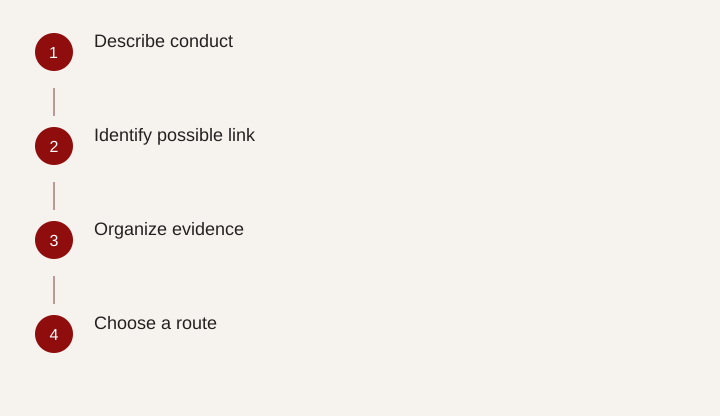
- Describe conduct
- Identify possible link
- Organize evidence
- Choose a route
Begin with the event, not the label
A coworker ridicules your name. A manager gives a visible assignment to someone else. A supervisor describes you as a poor cultural fit. Each situation deserves a clear account, but they do not answer the same question. Start by identifying the particular conduct or decision you want reviewed. “My workplace is discriminatory” leaves a reviewer guessing. “On Tuesday, my supervisor removed me from the client presentation after saying customers prefer someone who sounds American” identifies an event, a statement and a possible connection.
You do not need to settle the legal question before asking for help. You do need to distinguish what you observed from what you suspect. That distinction makes your account more credible and allows a reviewer to identify missing information without treating a gap as dishonesty. It also helps you decide whether your immediate request concerns behavior, a decision, a reporting process or several separate issues.
Identify the possible national-origin connection
National origin can involve actual or perceived ancestry, ethnicity and associated linguistic or cultural characteristics. The EEOC national-origin guidance explains these connections and recognizes that discrimination may involve perceived background or association with another person. A passport is not the only relevant fact.
For your own record, identify what connects the conduct to that subject. Was there an explicit statement about your country, accent or ethnic group? Did the same decision-maker apply a different standard to comparable work? Were you excluded immediately after a conversation about your background? These are questions to investigate, not shortcuts to a conclusion. Avoid treating every disagreement with someone from another group as evidence of bias. Equally, do not erase a specific national-origin comment because the speaker describes it as humor. Preserve the words and the setting so their significance can be assessed.
Separate treatment, harassment and ordinary conflict
Different problems call for different analysis. A denied promotion, an assignment change and repeated ethnic jokes should not be compressed into one vague account. Identify the decision-maker and the consequence for each employment action. For conduct, describe frequency, seriousness, audience and effect on your ability to work.
The EEOC harassment overview explains that federal unlawful harassment involves more than ordinary annoyances, while an extremely serious incident can matter on its own. Do not convert that distinction into advice to tolerate offensive conduct until it becomes legally severe. Workplace rules may prohibit disrespectful behavior earlier.
A manager who is rude to everyone may still need correction. A manager who invokes national origin when allocating desirable work raises a different concern. Your report can ask the employer to address the behavior without claiming that you have already proved every legal element. Concrete facts support either conversation.
Use a facts-and-inferences worksheet
Create a short record with separate columns. This is a working document, not a verdict. Update it when you learn something, and preserve an earlier version if a material detail changes. Do not fill missing dates or quotations with plausible guesses.
| Field | What belongs there |
|---|---|
| Observed event | What you personally saw or heard, with date and setting. |
| Source | Your observation, an identified witness or a specific record. |
| Possible connection | Why you think national origin may be relevant. |
| Alternative explanation | A stated reason or unresolved possibility. |
| Work consequence | Changed duties, lost access, interrupted work or another concrete effect. |
| Question to resolve | What information would clarify the situation. |
For a hypothetical example, “I was left out of a project” is an observed outcome. “The exclusion was because of my accent” is an interpretation unless supported by additional facts. A written selection criterion, a relevant statement or a witness may help connect them. Keeping these items separate prevents your notes from becoming circular: feeling excluded does not itself establish the reason for exclusion.
Ask for an explanation that can be evaluated
A useful clarification request focuses on the decision rather than demanding that a manager confess a motive. Ask what criteria were used, who made the choice, whether the criteria were communicated and what you would need to demonstrate for the next opportunity. Record the response accurately, including an explanation you find unconvincing.
You can also identify the concern directly: “I am concerned that the comment about my accent may have affected this assignment. Please review the decision and explain the criteria.” This communicates the issue more clearly than a broad accusation or a request merely to improve team morale.
Do not secretly gather other employees' personnel records or move confidential company information into a personal account. Keep records you may lawfully retain, and describe the location of other evidence for an authorized reviewer. If access disappears, a contemporaneous note identifying the document is more responsible than an unauthorized copy.
Choose the right next step
Check the employer's reporting policy and identify an alternative contact if your immediate supervisor is involved. Your preferred resolution may be a behavior change, access to an assignment, review of a decision or protection from further mistreatment. State that preference without presenting it as the only acceptable outcome.
Timing deserves separate attention. The EEOC filing-deadline page distinguishes the usual private-sector charge framework from federal employees' agency-counselor process. Do not assume an internal discussion preserves an external deadline. Ask the appropriate office promptly if a decision may involve discrimination.
Finally, keep the scope of your report manageable. Lead with the clearest events and attach a fuller chronology if needed. A reviewer should be able to understand the concern without reading months of unrelated frustrations. You can be candid about uncertainty while still asking for a serious, documented review.
Related questions
Does one offensive remark automatically prove discrimination?
No. Context, the nature of the remark, its connection to a decision and other evidence matter. An employer may address inappropriate conduct even when the available facts do not establish an unlawful practice.
Can someone discriminate against a person from their own ethnic group?
Yes. EEOC guidance does not limit national-origin discrimination to conduct between different groups. The question is whether prohibited considerations affected treatment.
Sources & further reading
Primary references
- EEOC Enforcement Guidance on National Origin Discrimination
- Harassment
- Time Limits for Filing a Charge
Community questions behind this guide
These discussions informed the question and language. Personal accounts are not verified facts or professional advice. Read our method.