THE SHORT ANSWER
Start with the time you already have on campus. Look for repeated contact through daytime activities, course-based study or a manageable group, and ask organizers about access rather than assuming more attendance is possible.
What to keep in mind
- A schedule conflict is a real constraint, not a failure to try.
- Use repeated contact within existing campus time.
- Ask for practical access changes and make specific follow-up invitations.
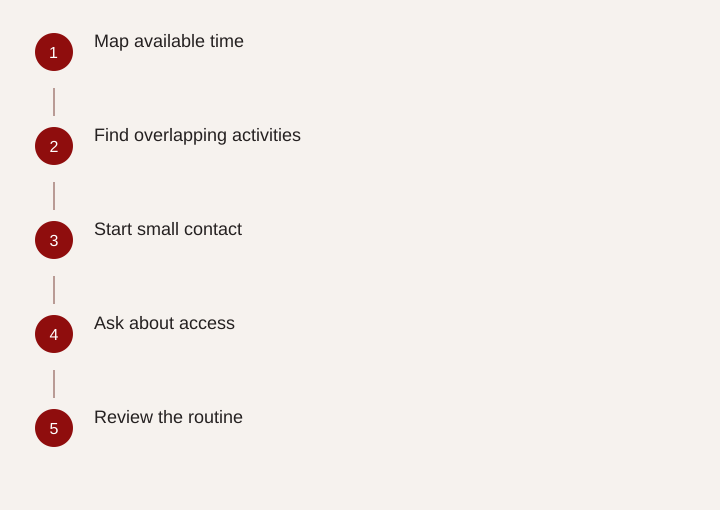
- Map available time
- Find overlapping activities
- Start small contact
- Ask about access
- Review the routine
Treat the schedule as a planning fact
“Join clubs” is incomplete advice when meetings happen after your last bus or during a work shift. Begin with the time and energy you actually have. Include travel between campuses, meal breaks and the practical cost of staying late. A social plan that ignores those constraints is unlikely to last.
Look for windows already present in your week rather than immediately adding another trip. Twenty minutes before a class, a regular lunch interval or a gap between lectures may offer a more dependable opportunity than a distant evening event. The right scale is the one you can repeat.
This does not mean every campus provides suitable activities. It means you can evaluate the available options honestly and ask targeted questions. If a schedule excludes you, that is useful information about access, not proof that you are unwilling to participate.
Make a weekly overlap planner
| Time already available | People or activities nearby | Possible small action |
|---|---|---|
| Before a recurring class | Classmates arriving early | Ask about a reading or assignment |
| A regular lunch break | Student space or daytime event | Sit in the same area and join a relevant activity |
| Between two classes | Course study group | Suggest a short review session |
| One feasible monthly slot | Cultural or first-gen group | Attend a recurring meeting when possible |
| Limited online time | Official course or organization channel | Follow discussion and arrange a specific exchange |
Use your own schedule to fill the table. An empty row is not a problem to solve by sacrificing necessary work or rest. Choose one or two opportunities with the best fit rather than trying to maximize the number of activities.
Start with course-based contact
A shared class provides a topic and a reason to meet again. Ask about a reading, compare understanding of an assignment or suggest reviewing material before the next session. Keep collaboration within the course's rules; friendship does not make unauthorized shared work acceptable.
A specific invitation is easier to answer: “I have half an hour before the next class on Tuesday. Would you like to review the concepts from today's lecture?” This is more practical than “We should hang out sometime,” especially when both people have complicated schedules.
If the first invitation does not work, ask whether another existing gap fits. Do not assume that a classmate who leaves quickly is uninterested in friendship; they may have the same constraints you do. At the same time, respect a lack of interest and avoid making every exchange a repeated request.
Ask organizations how newcomers can participate
Check official campus directories and current calendars for daytime, hybrid or occasional activities. A cultural group, first-generation program or interest-based organization may offer something beyond its main evening meeting. Ask rather than assume.
An example of specific programming appears on American University's first-generation community page. Another example is UC Davis's resource directory. These sources show what to look for at your own institution; they do not establish that your campus offers the same events or access.
An original message could say: “I commute and work during the regular evening meeting. Are there daytime events, online discussions or a small task I could contribute to without attending every week?” A group may have an alternative, or it may honestly say no. Either answer helps you choose where to invest your time.
Build familiarity through modest repetition
One pleasant conversation does not always become a friendship. Repeated contact gives people more opportunities to recognize shared interests and decide whether they want to spend time together. Choose a setting you can return to without creating an unsustainable commitment.
You might attend the same midday discussion, sit with classmates during a regular break or help with one recurring task. Make the contribution clear and bounded. Volunteering to run an entire event because you want to belong can create more pressure than connection.
Keep expectations proportionate. A study partner, friendly acquaintance and close friend are different relationships, and each can have value. You do not need every campus contact to become someone you see outside school. Let the relationship develop through actual interaction rather than measuring it against someone else's residential college experience.
Review what is working and what is not
After a few weeks, look at the pattern. Which activity fits your schedule? Where do conversations continue naturally? Which option consumes travel time without producing a meaningful experience? Use that information to adjust the plan rather than concluding that you must try harder at everything.
If the campus advertises services or activities that are consistently inaccessible to commuters, provide specific feedback through an appropriate channel. “Every meeting is at seven, while the last practical transit connection leaves at six” is actionable. A request for a midday session or an occasional online option gives organizers something concrete to consider.
You can also build community outside campus through a library, neighborhood organization or another interest. College does not have to supply every relationship in your life. The practical aim is to reduce isolation within the time and resources you have, while preserving the education, work and responsibilities that make commuting the right choice for you.
Related questions
Do I need to stay late on campus to make friends?
Not necessarily. Look for daytime or course-linked opportunities that fit your schedule, while recognizing that every campus has different options.
What if a club’s only meeting conflicts with work?
Ask about another way to participate, but do not assume the club can change its schedule. Consider alternatives that fit more reliably.
Sources & further reading
Primary references
Community questions behind this guide
These discussions informed the question and language. Personal accounts are not verified facts or professional advice. Read our method.