
THE SHORT ANSWER
You do not need to understand every campus office before asking for help. Map the most important functions, start with a clear question and track referrals until someone confirms the next action.
What to keep in mind
- Identify offices by function, since names vary across campuses.
- Ask about eligibility and availability instead of assuming access.
- Track the owner and deadline of each unresolved question.
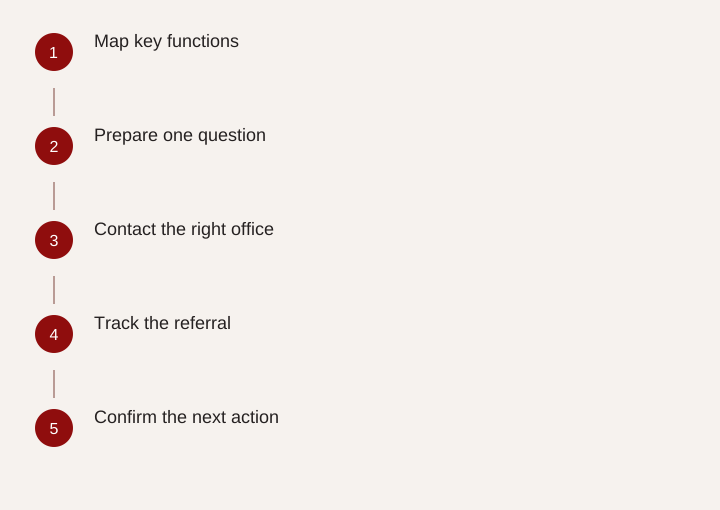
- Map key functions
- Prepare one question
- Contact the right office
- Track the referral
- Confirm the next action
Map functions before memorizing office names
Universities use different names for similar services. One campus may have a student success center, another an academic support office and another a collection of smaller programs. Start with the problem each function handles rather than trying to memorize the organizational chart.
Academic advising helps you understand a degree plan and course choices. Financial aid explains the aid process and offers. Billing handles charges and payments. Tutoring supports learning in particular subjects. Accessibility services explain accommodation procedures. Student-support offices may help connect you with additional resources. Verify the actual responsibilities at your campus, because the boundaries can differ.
A directory such as UC Davis's first-generation student resources illustrates how one institution connects students with named programs. Use it as a model for building your own map, not as a promise that your school offers the same services under the same terms.
Build a first-week support directory
| Need | Function to locate | What to record |
|---|---|---|
| Choosing classes | Academic advising or department advising | Appointment link, degree-audit access and deadlines |
| Understanding an aid offer | Financial aid | Official contact and required documents |
| Explaining a charge | Student accounts or billing | Secure portal and payment questions |
| Learning course material | Tutoring, writing or learning center | Subjects, hours and booking process |
| Access arrangements | Accessibility or disability services | Intake process and appropriate contact |
| First-gen support | First-gen program, EOP or TRIO if available | Eligibility, application and current services |
| Personal difficulty | Student support or appropriate campus service | Contact route and available help |
Add the official URL and the date you checked it. Avoid relying on an old screenshot or a social-media recommendation when a deadline or requirement matters. You do not need to contact every office immediately; the map should make it easier to find the right place when a question arises.
Ask about first-generation and TRIO support directly
A first-generation program may provide community events, peer support, workshops or advising, but the actual offerings vary. Ask what is available this term, how students join and whether there are capacity limits. A promotional page may describe a program's purpose without explaining the next step for a particular student.
The federal Student Support Services description includes institution and participant requirements. Being first-generation alone should not be presented as a guarantee of admission to a program or a cash award. Ask the campus program to evaluate your circumstances under its current process.
If you missed orientation or an early application, ask whether there is a later entry route or another service you can use. Do not assume that one missed event means every resource is permanently closed. Equally, accept a confirmed eligibility limit and request an appropriate alternative rather than relying on a stranger's assurance that everyone qualifies.
Prepare a question that another person can act on
Write three short items before contacting an office: what is happening, what you have already checked and what decision you need. For example: “My degree audit lists this course as elective credit. The department page suggests it may satisfy a requirement. Who can confirm which applies to my catalog year?”
Include a relevant deadline and your student identifier only through the institution's appropriate channel. Attach the exact notice or form if requested, but do not send passwords or unnecessary financial records in an ordinary message. Staff can often help faster when the question is precise and the documents are relevant.
You can also say, “I do not know which office handles this.” That is a legitimate starting point. Ask the first contact to identify the responsible function and the best next action, rather than expecting yourself to know every campus convention already.
Follow referrals until the question is owned
A referral is a step, not always a resolution. Record the person or office, date, question, promised response and next action. If you are sent elsewhere, ask what information should accompany the referral and whether someone has authority to make the decision.
An original follow-up message might read: “Thank you for directing me to the department. I contacted them on Tuesday and am waiting for clarification. Registration opens Friday. Is there an interim step I should take, or another official contact for this deadline?” The message shows what happened and why the timing matters without blaming the first person for every delay.
When you receive an answer, confirm your understanding in plain language. “My next step is to submit this form by Thursday, and the department will decide the equivalency” is more useful than leaving with a vague sense that something is being handled.
Create a small support network around the map
Identify one adviser or staff contact and one peer who can help you navigate ordinary questions. They do not need to know everything. A useful network includes people who can say where to ask and who encourage you to verify consequential advice.
Update the directory when you learn a better contact or discover that a service has changed. Keep personal notes private, and separate official instructions from a friend's experience. A peer may describe how something worked last year while the current procedure is different.
The map's purpose is to reduce the effort required to ask for help. A successful first term does not mean you never need assistance; it means you can recognize a question, find the responsible office and follow through before the uncertainty becomes an avoidable problem.
Related questions
Is TRIO available at every college?
Do not assume so. Check whether your institution operates a relevant program and how it currently determines access.
What if I contact the wrong office?
Ask for the specific office or person responsible, what information to send and whether there is a deadline you should know about.
Sources & further reading
Primary references
Community questions behind this guide
These discussions informed the question and language. Personal accounts are not verified facts or professional advice. Read our method.