THE SHORT ANSWER
An academic mentor can help you interpret a field, choose learning opportunities and develop your work. Build the relationship around a real question rather than asking one person to replace an entire college support system.
What to keep in mind
- Match the mentor to an academic question or interest.
- Ask for a first conversation before assuming an ongoing relationship.
- Keep advising, tutoring and mentoring roles distinct.
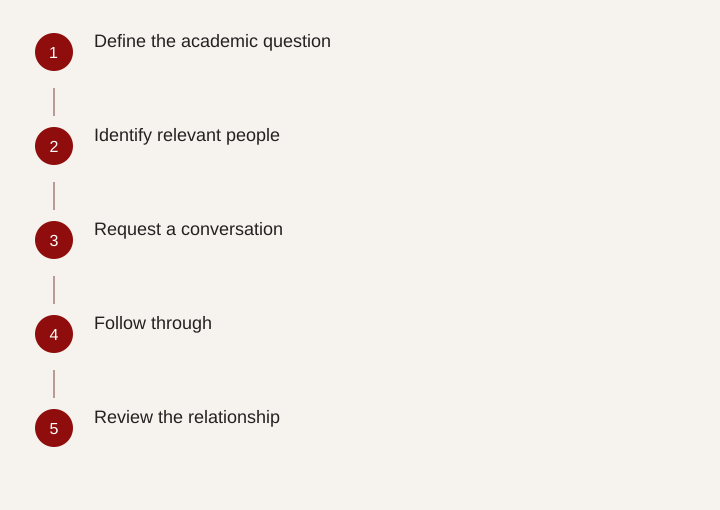
- Define the academic question
- Identify relevant people
- Request a conversation
- Follow through
- Review the relationship
Decide what kind of academic guidance you need
An academic mentor is not necessarily the person who answers every college question. You may want help understanding a discipline, choosing a research direction, interpreting feedback or deciding which intellectual opportunity to pursue. Name the question before searching for a person.
Keep the roles distinct. An adviser may interpret degree requirements. A tutor may help with course material. A faculty mentor may discuss how questions are developed in a field. A more experienced student may explain how a laboratory or seminar works. One person can occupy several roles, but you should not assume that they do.
For a first-generation student, the lack of a family college network can make these distinctions less visible. The UC Davis first-generation initiative highlights faculty and staff with first-generation experience partly to make academic conversation and asking for help more approachable. Look for comparable connections at your own institution.
Build a small mentor map
| Current question | Possible person | A reasonable first request |
|---|---|---|
| Is this subject a good academic fit? | Instructor or department adviser | Discuss one course or reading |
| How do researchers approach this topic? | Faculty member or research staff | Explain a project or suggest an introduction |
| How do I improve this kind of work? | Instructor familiar with your work | Discuss feedback and a practice direction |
| What is this program like in practice? | Experienced student or peer mentor | Share the program's routine and expectations |
| Which official requirement applies? | Responsible academic office | Clarify the policy, not provide informal speculation |
List two or three people rather than searching for a single perfect mentor. Different relationships can answer different questions. This also reduces the pressure on an initial conversation and makes it easier to seek another perspective when a decision is consequential.
Find a real connection to the person's work
Start with instructors whose classes interest you, department pages, public talks or campus research descriptions. Read enough to identify a specific connection, but do not pretend to understand a technical paper you have not actually read. A thoughtful beginner's question is more credible than borrowed jargon.
Stanford's faculty-connection guide recommends looking at courses, faculty profiles and talks, then making a short individualized request. That approach works because it gives the recipient a reason to understand why you contacted them.
For example, you might say that a class discussion made you curious about how historians compare conflicting accounts. That is more useful than “You are successful, please mentor me.” The first request concerns an academic practice; the second leaves the person to define the entire relationship.
Ask for a conversation, not an unlimited commitment
An original message could read: “I am a first-year student considering this field. Your course discussion about neighborhood archives raised a question for me about how researchers choose sources. Could I visit your office hours or arrange a short conversation about where to begin learning more?”
Include relevant context, one clear question and a manageable request. Follow the person's stated contact or office-hours process. If you receive no answer, one polite follow-up after a reasonable interval may be appropriate. Do not repeatedly contact someone who has declined or indicated they are unavailable.
The first meeting does not have to establish a formal mentor title. Ask your question, listen and clarify one next step. At the end, you can ask whether it would be appropriate to return after trying the suggestion. That lets an ongoing relationship develop with mutual understanding.
Prepare and follow through
Before the conversation, write a short agenda: what you are exploring, what you have tried and what you hope to understand. Bring a sample of your work only if it is relevant and the person has time to discuss it. A mentor is not automatically agreeing to review a long document because you attached it.
Afterward, act on an appropriate suggestion and report what you learned. “I read the introductory chapter you recommended and now understand the basic distinction, but I am curious about this example” gives the next conversation substance. You do not have to agree with every recommendation, but you should explain your reasoning if you choose another route.
Keep a private note of advice, actions and questions. Separate a mentor's opinion from an official policy decision. If a suggestion affects degree progress, funding or program eligibility, verify the applicable rule with the responsible office.
Evaluate the relationship over time
A useful mentoring relationship should make academic thinking more accessible, even when the feedback is demanding. Notice whether the person explains expectations, responds within realistic boundaries and treats your questions respectfully. Shared background can help, but it is not the only measure of fit.
You also have responsibilities: prepare, keep appointments, respect limits and communicate changes. If the relationship is not working, identify the specific problem. You may need a different academic specialty, more structured support or a person with greater availability. Changing the arrangement does not require declaring the other person a bad mentor.
Continue to use other support routes. A faculty conversation cannot replace tutoring, academic advising or a campus service when that is what the problem needs. The strongest outcome is not dependence on one well-connected person. It is a growing ability to ask better questions, recognize who can help and participate more confidently in the intellectual work that brought you to college.
Related questions
Does my mentor have to share my background?
Shared experience can matter, but relevant knowledge, availability and respectful engagement also matter. You can learn from more than one person.
Can a peer be an academic mentor?
A peer can offer valuable navigation and experience, while official policy and degree decisions should still be verified with responsible staff.
Sources & further reading
Primary references
Community questions behind this guide
These discussions informed the question and language. Personal accounts are not verified facts or professional advice. Read our method.