
THE SHORT ANSWER
Office hours are time set aside for students. Bring a specific point of confusion or academic interest, show what you have tried and ask what to do next.
What to keep in mind
- Check whether the instructor uses appointments or drop-ins.
- Bring an attempted problem, passage or focused question.
- Use the meeting to learn a next step, then follow through.
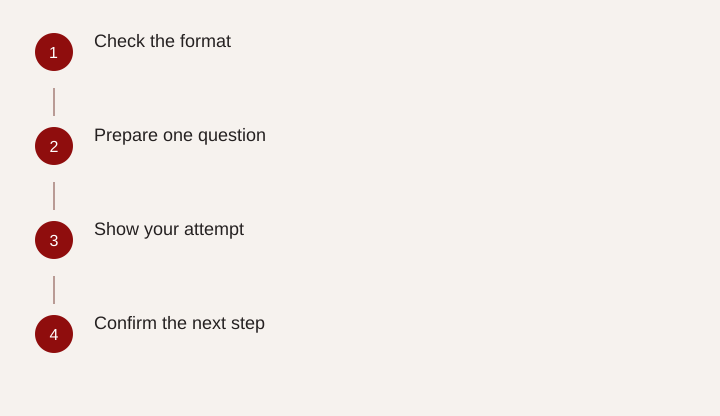
- Check the format
- Prepare one question
- Show your attempt
- Confirm the next step
Understand what office hours are for
Office hours are not a warning that a professor wants to be left alone. They are time reserved for meeting students. You can use them to discuss course material, clarify feedback or explore an academic interest. The exact format and scope depend on the instructor and institution.
Stanford's faculty-connection guide describes office hours as time specifically set aside for talking with students. It also notes that some faculty use appointments, some use drop-ins and some combine both. Check your own syllabus or course page rather than assuming that every instructor follows the same arrangement.
You do not need an impressive question. A clear account of where your understanding stops is enough. “I can follow the example until this line, but I do not understand why the method changes here” gives the instructor something useful to work with.
Check the logistics before you arrive
Find the time, location and booking instructions. If the meeting is online, verify the link and whether you need an appointment. If the information conflicts across pages, send a short clarification. Arriving prepared includes knowing how the meeting is supposed to happen.
If the time conflicts with work, commuting or another class, ask whether there is an alternative. An original message could say: “I would like to discuss a question about the second assignment, but your posted office hours overlap with my work shift. Is there another appointment option this week?” Do not assume an alternative exists, but do not silently conclude that help is unavailable either.
For a drop-in session, bring something to work on if there is a wait. Respect the queue and the stated ending time. If several students are present, ask whether the question is suitable for the group or should be discussed individually.
Prepare a small evidence packet
Bring the relevant assignment, your attempt, feedback or passage. Mark the exact point you want to discuss. A professor can respond more effectively to a specific example than to “I do not understand any of this,” even when that sentence accurately describes how overwhelmed you feel.
Use a three-line note: the task, what you tried and where you got stuck. For a reading, identify the paragraph and your current interpretation. For a quantitative problem, show your steps rather than only the final answer. For feedback, point to the comment you want to understand and explain how you read it.
Choose one or two priorities. If the meeting is short, you should know which question matters most. Keep broader concerns on a separate list so you can ask whether another conversation would be appropriate rather than trying to fit an entire semester into one visit.
Start with a simple opening
An original course-help opening might be: “Hi, I am in your Tuesday class. I tried the second problem using the method from the lecture, but I get stuck at this step. Could we look at what I am misunderstanding?” It identifies you, the context and the question without a long apology.
For an academic interest, try: “I enjoyed the part of the course about this topic and would like to learn more. Is there an introductory reading or next course you would recommend?” You do not need to claim a lifelong passion or pretend to have read work you have not read.
If you are nervous, it is fine to use your written note. You can say, “I wrote down the question so I would explain it clearly.” The meeting is about learning, not performing effortless confidence.
Ask for an explanation you can use
Listen to the response, then test your understanding by restating it or applying it to a small example. “So I should first identify this condition, then choose the method?” is a useful check. Nodding through an explanation you do not understand leaves the original problem unresolved.
Ask what to practice next and how you will know whether you are approaching it correctly. Avoid asking the instructor to complete the assignment for you or tell you exactly what will appear on an exam. The goal is to understand the process and expectations while doing your own academic work.
If the issue concerns a grade, begin with the criteria and feedback rather than a demand for points. Ask which part did not meet the standard and what a stronger approach would involve. Follow the course's actual review procedure if you believe there is a factual grading error.
Use a first-visit checklist
| Before | During | After |
|---|---|---|
| Confirm appointment or drop-in rules | State the question briefly | Write the next action |
| Bring the relevant work | Show the attempted reasoning | Try the suggested method |
| Mark the confusing point | Ask a clarifying question | Note what remains unclear |
| Choose a priority | Restate your understanding | Follow up only if needed |
| Allow enough travel or connection time | Respect the available time | Keep the useful notes |
A hypothetical student might leave with three actions: reread a particular section, retry one problem and compare the result with a worked example. That is a productive outcome even if the entire topic is not mastered during the meeting. Office hours begin a learning cycle; they do not replace the work that follows.
When you return, report what you tried. “I used the approach we discussed and now understand the first part, but this case still confuses me” creates continuity. Over time, these focused conversations can also help an instructor know your interests and work. You do not need to manufacture a relationship by visiting without a purpose; ordinary curiosity and reliable follow-through provide a sound starting point.
Related questions
Can I attend if I am not failing?
Yes. Office hours can support understanding, academic interests and planning. Check the instructor’s stated scope and availability.
What if the posted time conflicts with work?
Ask whether another meeting option is available, explaining the schedule conflict briefly.
Sources & further reading
Primary references
Community questions behind this guide
These discussions informed the question and language. Personal accounts are not verified facts or professional advice. Read our method.