
THE SHORT ANSWER
A useful recommendation depends on what the writer can say about your work. Check the destination’s requirements, ask early enough for a considered response and provide a focused information packet.
What to keep in mind
- Choose relevant knowledge of your work over a famous name alone.
- Ask whether the professor can write a supportive recommendation.
- Provide requirements, deadlines and submission instructions together.
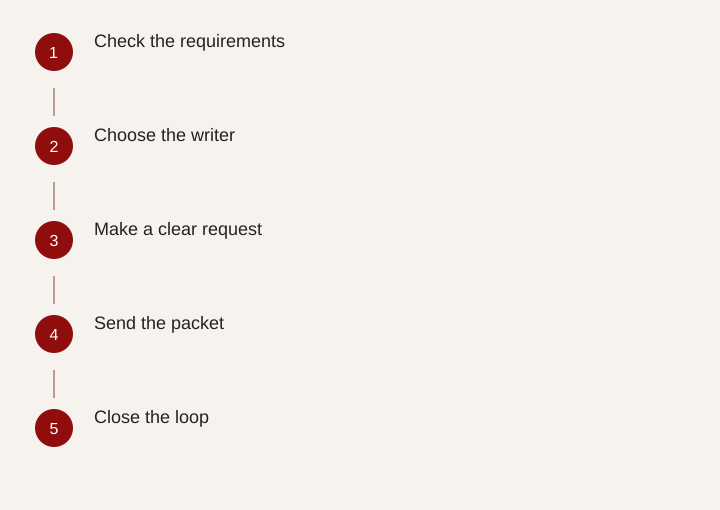
- Check the requirements
- Choose the writer
- Make a clear request
- Send the packet
- Close the loop
Read the destination's instructions first
Before asking anyone, confirm how many letters are required, who may write them and what the destination wants the writer to address. A scholarship, research program and graduate application may ask for different evidence. Do not assume a general letter can be reused unchanged for every purpose.
Record the deadline, time zone if stated, submission method and any special instructions. Check whether the system sends an automated request after you enter the recommender's details. Ask the person before triggering that request whenever the process allows; an unexpected automated email is a poor introduction to the task.
If the instructions use unfamiliar terms, ask the destination's official contact. Your professor should not have to guess whether a particular format or type of recommender is acceptable. Clarifying the requirement first protects both your application and the writer's time.
Choose someone with evidence to discuss
A strong choice is someone who knows your relevant work and can describe it specifically. They may have taught you, supervised a project or seen how you respond to feedback. A well-known professor who only recognizes your name may have less useful material than a less prominent instructor who knows your thinking.
Stanford's recommendation guidance emphasizes building and maintaining relationships through coursework, research and office hours. The point is not to perform friendliness for a future letter. It is to participate in work that allows another person to observe your abilities.
Make a shortlist that matches the application. If the program asks about research preparation, identify someone who can address that preparation. If it asks about community work, check whether a relevant supervisor is permitted rather than assuming an academic title is always required.
Make a request that allows an honest answer
Ask with enough lead time for the destination's schedule and the writer's workload. There is no single lead-time rule that fits every institution or season, so explain the deadline and ask whether it is feasible. Last-minute urgency should be acknowledged rather than disguised.
An original request might read: “I am applying to [program], which asks for a recommendation about [relevant qualities]. I took your [course] and completed [specific work]. Would you be comfortable writing a supportive letter based on that experience? The deadline is [date], and I can send the requirements, my work and a short update.”
This wording gives the professor room to decline or suggest a better person. A reluctant or poorly informed recommendation is not improved by pressure. If they cannot help, thank them promptly so you can make another plan.
Assemble a focused information packet
| Item | Purpose |
|---|---|
| Program description and official link | Shows what the application is for |
| Letter requirements | Identifies the evidence or criteria requested |
| Deadline and submission route | Makes the logistics clear |
| Relevant work sample | Refreshes the writer's memory with actual evidence |
| Short academic update | Explains developments since the course or project |
| Brief goals statement | Connects past work to the opportunity |
| Application status | Identifies any pending items that affect submission |
Keep the packet proportionate. A clear page of context and a relevant work sample may be more useful than an unorganized folder of everything you have ever done. Label files and identify which parts matter. Do not include sensitive personal information unless it is relevant, wanted and handled through an appropriate process.
You can mention accomplishments accurately, but do not write exaggerated claims for the professor to repeat. If a detail is uncertain, verify it before including it. The packet should support the writer's judgment, not script a fictional version of your record.
Manage logistics without micromanaging the letter
After the professor agrees, confirm when you will send the materials and whether they have a preferred reminder process. Watch the application system for a status update if it provides one. Do not assume the writer receives every change you make to an application.
If a reminder is needed, keep it factual: “Thank you again for supporting my application. The system lists the recommendation as pending, and the deadline is Friday. I have included the submission link and instructions below. Please let me know if anything else would help.” Avoid daily messages or a tone that treats an agreed favor as an immediate demand.
If the deadline changes or you decide not to apply, tell the writer. If a technical problem appears, contact the application's official support route and share the relevant information. A professor cannot resolve an inaccessible submission portal simply by writing faster.
Build the relationship beyond the transaction
Thank the writer after submission and let them know the outcome when you receive it. A short update is enough. If the application is unsuccessful, you can still thank them for the time and support without implying that the letter caused the result.
For future opportunities, maintain academic contact when there is a real reason: a new project, a question arising from their course or a meaningful development in your studies. Stanford's faculty-connection guidance offers ways to start such conversations through specific interests and office hours.
If you are early in college and have no obvious recommender yet, focus on doing work and asking useful questions now. You do not need to collect influential names. You need opportunities for instructors to see how you think, learn and follow through. Over time, that gives a future recommendation something concrete to say.
Related questions
Should I choose the most prestigious professor?
Choose someone who can provide relevant, specific evidence about your work, while following the destination’s requirements.
What if the professor declines?
Thank them and approach another appropriate person. A decline may reflect availability or limited knowledge of your work rather than a judgment of your potential.
Sources & further reading
Primary references
Community questions behind this guide
These discussions informed the question and language. Personal accounts are not verified facts or professional advice. Read our method.