THE SHORT ANSWER
These labels overlap, but they answer different questions and are not used identically by everyone. Use precise descriptions for places and sources, and ask individuals how they prefer to be described.
What to keep in mind
- Heritage, nationality, citizenship and language are distinct.
- A broad event label does not define every attendee’s identity.
- Follow a form’s own instructions when an administrative category is required.
- Identify the context
- Separate the concepts
- Ask the person
- Use precise wording
Start by asking what the label is doing
A label in a museum exhibit, a personal introduction and an application form may serve different purposes. Before deciding which word is correct, identify the context. Are you describing a person's chosen identity, a geographic region, a language connection or an administrative category? Many arguments begin when people answer different questions without noticing.
The National Museum of the American Latino explains that people understand and use Hispanic and Latino differently. The museum uses Latino for US residents with cultural or ancestral ties to Latin America or the Caribbean. That is an institutional explanation of its language, not a demand that every person adopt the same term.
In ordinary communication, specificity often solves the problem. If you mean a particular Mexican American artist, say that when supported by the source. If you mean Spanish-language books, say Spanish-language books. A broad identity word should not carry information it does not actually establish.
Keep several concepts separate
| Concept | What it can describe | What it does not automatically establish |
|---|---|---|
| Heritage or ancestry | Family and cultural connections | Citizenship or language proficiency |
| Nationality | A relationship to a nation in a particular context | One uniform ethnicity or experience |
| Citizenship | A legal status | Cultural interests or preferred identity |
| Language | A language used or learned | Ancestry, nationality or fluency in another language |
| Self-identification | How a person describes themselves | Permission to generalize about everyone sharing the label |
These distinctions help with apparently simple questions. Someone may be born in the United States, have family connections to several countries and use English more comfortably than Spanish. Another person may speak Spanish fluently without identifying as Hispanic or Latino. A surname alone does not resolve either case.
Do not turn the table into a rigid formula for deciding who belongs. It is a tool for preventing one fact from being mistaken for another. Where a legal status or official eligibility category matters, use the applicable official definition rather than an informal identity discussion.
Why Brazil and Spain expose the overlap
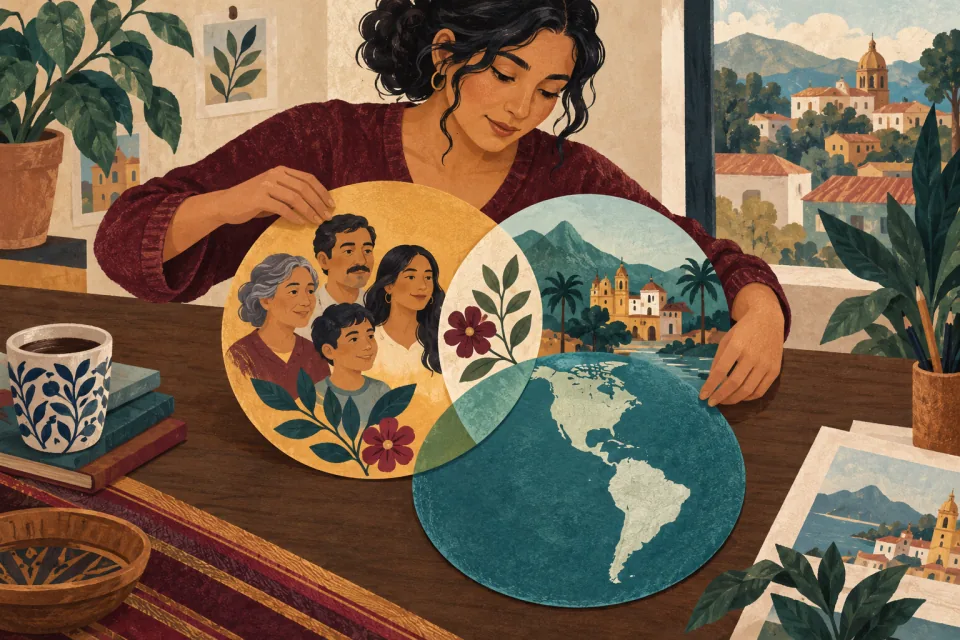
The terms Hispanic and Latino are often used interchangeably in casual US speech, but that habit can hide distinctions. A connection to Spain or Spanish is different from a connection to Latin America. Brazil is an important example because it is in Latin America and is not primarily Spanish-speaking. Spain is another example because it is not in Latin America.
Those examples help explain concepts; they do not authorize you to tell an individual what they must call themselves. A Brazilian person may prefer a national label, a broader regional label or a description shaped by their experience in a particular country. Listen to that preference rather than treating a dictionary distinction as the end of a personal conversation.
For an event, explain the chosen scope directly. A program might examine Hispanic and Latino histories in the United States while including a specific session about Brazilian American experiences. The title and description should make that choice visible instead of silently treating every term as equivalent.
Treat identity as more than a language test
The Smithsonian's Latino identity exhibit describes identities shaped by geography, heritage, race, gender and other factors. It also describes cultural expression through language, religion, art, music and foodways. No single characteristic captures the whole person.
That matters when someone says, “I do not speak Spanish, so I am not sure I belong.” You can discuss language learning as a practical goal without turning it into a condition for acknowledging family connections. Similarly, fluency does not make someone an expert on every Spanish-speaking country's history or cultural practices.
Avoid assuming an explanation for another person's language background. Family decisions, education, movement between places and opportunities to practice differ. A respectful conversation leaves room for the person to describe what matters to them, including the possibility that they do not want to discuss the subject at all.
Ask a small, useful question
When wording is relevant, ask directly and briefly: “How would you like me to describe your background in this introduction?” For a written profile, show the sentence rather than asking for a general declaration of identity. The person can then correct the actual wording in context.
If you make a mistake, a short correction is usually more useful than a long defense of your intentions. “Thank you for clarifying. I will use Brazilian American in the caption” keeps attention on the requested change. Do not ask the person to settle a debate about what everyone else should call themselves.
When referring to a source's historical language, distinguish quotation from your own wording. A document may use a term that requires explanation. Preserve enough context to analyze it accurately, while choosing clear contemporary language for your own description where appropriate.
Handle forms and public descriptions deliberately
An application, survey or scholarship may define categories for a specific administrative purpose. Read those instructions. If your circumstances do not fit clearly, ask the responsible office how to answer and retain the response. Do not assume that a museum's vocabulary or a Reddit comment determines the form's rules.
For public materials, write a terminology note only when it helps the audience. Explain the scope, identify the institution's chosen terms and acknowledge individual variation. Avoid a long glossary that distracts from the subject or implies that every reader needs to defend their identity before participating.
A practical final check is to ask whether a more specific noun would improve the sentence. “This source documents a Puerto Rican community in a particular city” tells the reader more than “This shows Latino culture.” Clear wording can welcome a broad audience while preserving the particular people, places and histories that make the material worth studying.
Related questions
Is Brazilian the same as Hispanic?
Do not treat the terms as identical. Brazil illustrates why Latin American geography and a connection to Spanish are different concepts; individuals’ preferred labels still matter.
Can someone identify as Latino without speaking Spanish?
Language proficiency is not a reliable test of someone’s heritage or self-understanding. Avoid assigning identity based on fluency.
Sources & further reading
Primary references
Community questions behind this guide
These discussions informed the question and language. Personal accounts are not verified facts or professional advice. Read our method.