
THE SHORT ANSWER
Heritage learners often arrive with uneven skills. Choose a course by the tasks you want to perform and the support it provides, rather than assuming that family exposure places you at one fixed level.
What to keep in mind
- Assess listening, speaking, reading and writing separately.
- Ask how placement works before choosing a course label.
- Evaluate correction style and practical access as well as content.
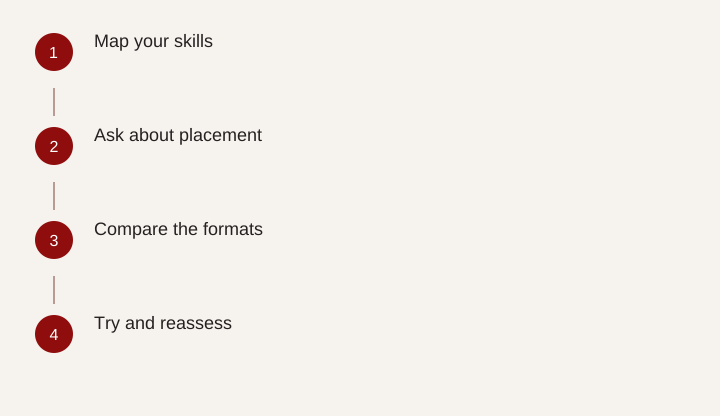
- Map your skills
- Ask about placement
- Compare the formats
- Try and reassess
Describe what you can do, not what you should know
Family exposure to Spanish can leave a learner with strong listening comprehension and limited writing, or comfortable conversation in one setting but difficulty with unfamiliar subjects. A single label such as beginner or fluent may conceal those differences. Begin with concrete tasks instead.
Can you follow a familiar conversation at normal speed? Explain a problem without switching languages? Read a short article? Write a message that someone outside your family understands? Record examples and uncertainties separately. This is preparation for placement, not a substitute for a program's assessment.
The UCLA National Heritage Language Resource Center offers resources tailored to heritage speakers and families. Its existence is a useful reminder that heritage learning has specific contexts. It does not mean every person with family ties to Spanish needs the same course or begins at the same level.
Write a goal the course can address
Choose one or two outcomes for the next term. “Speak better Spanish” is understandable but difficult to evaluate. “Take part in a ten-minute conversation about everyday plans” or “Read and discuss a short story with support” gives you a clearer basis for comparing courses.
Include a practical constraint: weekly time, travel, cost, schedule or the need for online access. A class can be academically appropriate and still fail because you cannot attend it regularly. Do not compare only the advertised level while ignoring the conditions under which you would actually study.
Keep cultural connection and language proficiency related but distinct. You may want both, but a grammar course may not provide a community space, and a social conversation group may not teach literacy systematically. Identifying those differences helps you choose a combination rather than blaming one format for not doing everything.
Ask how placement handles uneven skills
Contact the instructor or program before enrolling if the course description leaves you uncertain. Explain your exposure and give task-based examples. Ask whether placement considers listening, speaking, reading and writing, and whether there is a trial session or an adjustment period.
An original inquiry could read: “I grew up hearing Spanish and can follow familiar family conversations, but I have limited experience reading or writing it. My goal is to become more comfortable speaking with people outside my family. How do you place learners with this profile, and what would the weekly work involve?”
Do not hide gaps to avoid embarrassment. Accurate information helps the instructor assess fit. Equally, do not minimize abilities simply because your accent differs from an imagined standard. Ask what the course expects students to do and how it supports skills that are less developed.
Compare instruction, feedback and dialect expectations
A course description should tell you something about the actual work: conversation, reading, writing, projects, listening activities or formal grammar. Ask how those components are balanced. If your main goal is speaking, find out how much supported speaking time learners receive rather than assuming a language class automatically provides enough.
Ask how correction works. Does the instructor interrupt every error, select a few priorities or provide notes afterward? Which approach helps you participate without becoming so cautious that you stop speaking? You do not need a correction-free class, but you do need a clear and respectful feedback process.
Also ask how the course handles dialect variation and informal family language. A useful explanation can distinguish audience, register and regional usage without portraying a family's speech as evidence of personal failure. You may need additional forms for school or work while retaining familiar ways of speaking in other settings.
Use a course comparison sheet
| Criterion | Course A | Course B | Question still unanswered |
|---|---|---|---|
| Placement | Assessment or instructor conversation | Assessment or instructor conversation | Are all four skills considered? |
| Main work | Speaking, literacy or mixed | Speaking, literacy or mixed | Which tasks will I practice weekly? |
| Feedback | Stated correction method | Stated correction method | Can I discuss feedback preferences? |
| Access | Schedule, travel and format | Schedule, travel and format | What happens after a missed class? |
| Commitment | Fees and expected study time | Fees and expected study time | What are the actual withdrawal terms? |
| Community | Group interaction and participation norms | Group interaction and participation norms | Are heritage learners welcomed? |
Fill this table with verified details from the provider. Do not assume that “heritage,” “immersive” or “conversational” has the same meaning everywhere. A clear answer to a specific question is more useful than an appealing program label.
Reassess after real participation
After an initial session or the permitted adjustment period, compare the experience with your goals. Were the tasks challenging but workable? Did you get a chance to practice the skill you came to develop? Could you ask for clarification? Was the pace compatible with the time you could devote outside class?
If something is wrong, describe the problem concretely to the instructor. “I understand the discussion but cannot complete the written assignment without much more support” is actionable. “I do not belong here” may reflect the feeling, but it does not identify the adjustment that could help.
A different class, a tutor or a community practice group may fit better. Treat a change as a placement decision rather than a verdict on your identity or ability. The goal is a learning arrangement you can use consistently, with enough challenge to grow and enough support to keep participating.
Related questions
Am I a beginner if I understand family conversations?
You may be a beginner in some skills and more experienced in others. Describe those differences to the instructor and use the program’s placement process.
Is a heritage course always better than a general Spanish course?
No. The best fit depends on your goals, the curriculum and the support available in the specific class.
Sources & further reading
Primary references
Community questions behind this guide
These discussions informed the question and language. Personal accounts are not verified facts or professional advice. Read our method.