
THE SHORT ANSWER
You can accept useful feedback without accepting humiliation. Name the behavior you want changed, choose a proportionate response and move practice to a more supportive setting when needed.
What to keep in mind
- Ask for a specific correction style instead of debating every joke.
- Use short boundaries that fit the relationship.
- A practice partner’s behavior is separate from your identity or potential.
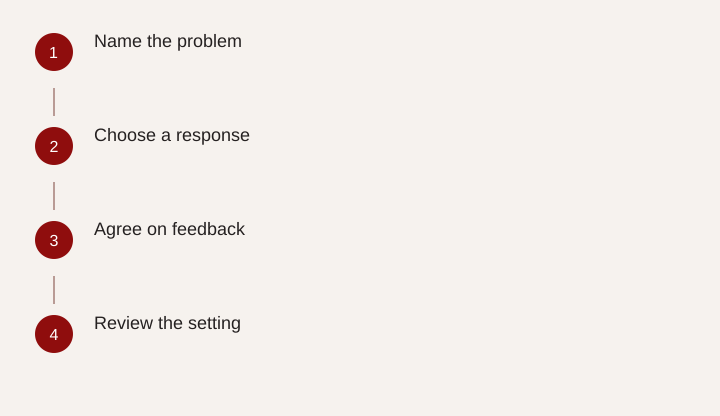
- Name the problem
- Choose a response
- Agree on feedback
- Review the setting
Identify the behavior before choosing the response
The phrase “no sabo” can appear in mutual joking, a discussion of heritage learning or an unwanted insult. The words alone do not tell you how a particular exchange feels or functions. Notice the behavior: are people laughing with you, repeatedly correcting you in public, questioning your identity or refusing to let you finish a thought?
You do not have to prove that the speaker intended harm before asking for a change. Equally, not every awkward comment needs a major confrontation. A brief request may be enough when the relationship is otherwise respectful. The useful question is what response could make the interaction more workable for you.
The Smithsonian's identity exhibit describes varied and layered Latino experiences. It does not offer a fluency test for belonging. Keep language practice focused on the communication skill you want to develop rather than accepting every conversation as a trial of authenticity.
Choose a short response you can remember
Long explanations can invite a debate you did not want. Prepare one or two sentences that state what you need. You can be warm, direct or firm without insulting the other person's English or turning the exchange into a competition about whose mistakes are worse.
| Situation | Original response example |
|---|---|
| A joke has stopped being enjoyable | “I know you may mean it as a joke, but I would like you to stop calling me that.” |
| Corrections interrupt every sentence | “Please let me finish the idea, then tell me one thing to improve.” |
| Someone questions your identity | “I am working on my Spanish. I am not looking to debate my family background.” |
| A person assumes you understand everything | “I understand a lot, but I need you to slow down for this part.” |
| The conversation turns into public testing | “I would rather practice privately than be quizzed in front of everyone.” |
| The behavior continues | “This is not a useful practice setting for me, so I am going to stop here.” |
Adapt the words to sound like you. You are not required to deliver a script verbatim or use a stronger response than the situation warrants.
Separate useful correction from ridicule
Useful feedback points to something you can change: a word, meaning, pronunciation or sentence pattern. It gives you a chance to try again. Ridicule often leaves you with a general message that you should already know better, without a practical next step.
Ask for a feedback arrangement before a planned practice session. You might choose correction only when meaning breaks down, notes at the end or one repeated issue per conversation. Different tasks call for different approaches. Preparing a formal presentation may need detailed feedback; chatting about the weekend may need space to keep speaking.
The UCLA heritage-language resource directory can help you explore instructors, community programs and learning materials. A relative who speaks Spanish is not automatically a language teacher, and a family relationship can add pressures that a structured learning setting handles differently.
Explain once, then look at what changes
If the relationship matters and the other person seems open, briefly explain the effect: “When every mistake becomes a joke, I stop trying to speak.” Follow it with a specific request. That gives the person something observable to do differently.
Then evaluate the next interaction. Do they let you finish? Do corrections become more useful? Do they stop using the label after you ask? A respectful response may be imperfect at first, but it should show an effort to understand the request. Repeatedly arguing that you are too sensitive while continuing the behavior is a different pattern.
You do not need to keep supplying increasingly personal explanations. A boundary can remain simple even when someone disagrees with it. Choose whether to change the topic, shorten the conversation or practice elsewhere based on what you can realistically control.
Make a practice-partner agreement
Before a ten-minute practice exchange, agree on the topic, approximate length and kind of support. For example: “Let's talk about weekend plans for ten minutes. Please correct misunderstandings immediately, but save other corrections until the end. I will ask when I need a word.” This is an original example, not a rule every learner must use.
Also agree that either person can pause. A willing partner may be tired or short of time, and the learner may need to clarify something in another language. Respect goes both ways. Do not treat a friend, colleague or service worker as permanently available practice support.
Afterward, ask one concrete question: “Was there a point where my meaning was unclear?” Choose one item to practice next. This keeps the session focused on communication rather than on a general judgment of whether your Spanish is good or bad.
Keep a wider view of progress
A difficult interaction can feel larger than the actual language task. Write down what you managed to say, what you understood and what you want to practice next. That record helps separate the learning information from the other person's reaction. It also prevents a single awkward exchange from becoming the only evidence you consider.
If a particular group repeatedly makes learning unpleasant, try a setting with clearer norms or a facilitator. Ask prospective instructors how they work with heritage learners and uneven skills. A different environment is not an admission that you cannot handle real conversation; it is a practical choice about where to practice.
Language can deepen relationships and open new interests, but it cannot guarantee universal approval. You can pursue stronger Spanish while deciding that some arguments about identity are not worth your time. The next useful step may be one calm boundary, one better practice partner or one conversation completed on terms that allow you to keep learning.
Related questions
Should I always confront a no-sabo joke?
No. You can ignore it, redirect, state a boundary or leave, depending on the context and your preference.
Does setting a boundary mean refusing correction?
No. You can request helpful correction while asking people to stop mockery or interruptions.
Sources & further reading
Primary references
Community questions behind this guide
These discussions informed the question and language. Personal accounts are not verified facts or professional advice. Read our method.