
THE SHORT ANSWER
A welcoming practice group needs more than a Spanish-language name. Ask how sessions work, try one when possible and judge whether the setting supports the kind of participation you want.
What to keep in mind
- Separate language instruction from social conversation.
- Check meeting times, fees and expectations before committing.
- Look for respectful correction and room for different proficiency levels.
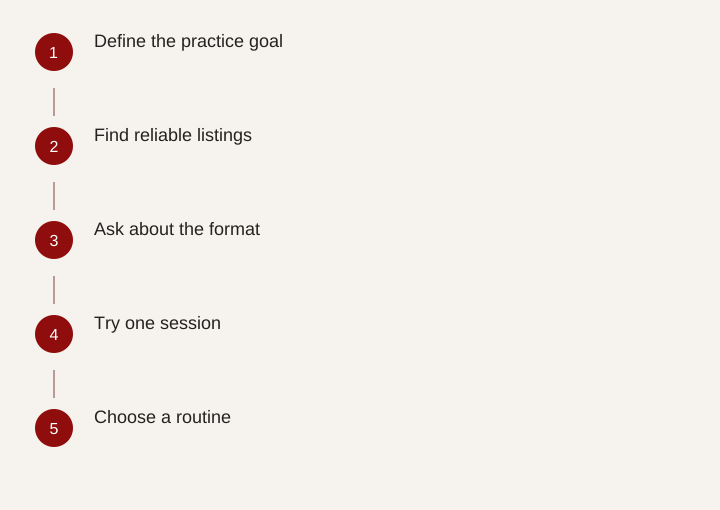
- Define the practice goal
- Find reliable listings
- Ask about the format
- Try one session
- Choose a routine
Decide whether you want practice, teaching or community
A conversation group, a class and a cultural organization can overlap, but they are not the same service. A class may provide structured instruction and feedback. A conversation group may offer time to speak without a formal curriculum. A community organization may focus on service, arts or friendship rather than language learning at all.
Write down your main purpose before searching. You might want weekly speaking practice, a place to meet heritage learners or help reading Spanish. Add what would make the group usable: a daytime meeting, online access, a nearby location or a predictable cost. This reduces the temptation to join something appealing that does not fit your needs.
The UCLA heritage-speaker resource directory includes community-based language resources. It is a starting point for research, not a guarantee that a listed organization has a current class in your location or a suitable opening.
Search through organizations you can verify
Check official campus, library, community-center and language-program listings. Look for a current date, named host, location or meeting platform, contact route and description of who the session serves. A reposted flyer may refer to a past event, so follow it back to the organizer before making plans.
For a group found through social media, verify the host independently when possible. Read the actual meeting details rather than relying on an enthusiastic recommendation from a stranger. You do not need to provide extensive personal information merely to ask about the format.
Make a shortlist of two or three options. A large spreadsheet of uncertain possibilities can become another barrier to attending. Prioritize groups whose basic logistics and purpose are clear, then spend your research time on the questions that determine fit.
Ask how a session actually works
A useful inquiry describes your learning profile without apologizing for it. For example: “I understand familiar Spanish but need more speaking practice. Do your meetings include facilitated activities, and are heritage learners with uneven skills welcome?” Add a question about the next meeting or trial options.
Ask whether participants work in pairs, rotate topics or hold one large discussion. Find out whether a facilitator supports quieter people and how corrections are handled. A large free-form discussion may be enjoyable for experienced speakers but difficult for someone who needs a little preparation time.
Also ask about attendance expectations, fees, materials and cancellation terms. “Free” may describe one introductory session rather than the ongoing program. An informal group may have no instructor, which is not necessarily a problem if conversation is what you want. The important thing is to understand the arrangement before expecting more from it.
Use a comparison card
| Dimension | What to check | A sign of fit |
|---|---|---|
| Purpose | Class, conversation or cultural activity | Matches the skill or connection you want |
| Level | Entry expectations and placement | You can participate with manageable challenge |
| Facilitation | Pair work, turn-taking and support | Newcomers have a way into the discussion |
| Feedback | When and how corrections happen | Corrections help without taking over |
| Access | Time, transport, online format and cost | Attendance is realistic more than once |
| Culture | Treatment of accents and backgrounds | Differences are discussed respectfully |
| Commitment | Registration and attendance rules | Obligations are clear before joining |
Do not require every group to score perfectly. Decide which conditions are essential and which you can work around. A modest nearby group that meets consistently may serve you better than an ambitious program you can attend only occasionally.
Treat the first session as information
Arrive with a small goal: introduce yourself, ask one question or take part in one short exchange. Notice how the host welcomes newcomers and whether the advertised format matches what happens. You are evaluating the setting as well as participating in it.
The Smithsonian's discussion of Latino identity emphasizes variation in experience. In practice, a group should not require every participant to share the same ancestry, accent or life story to take part in an advertised language activity. If its purpose is more specific, that scope should be communicated clearly rather than enforced through surprise social tests.
Distinguish normal first-meeting awkwardness from a persistent mismatch. You may need more than one visit to feel comfortable. But repeated ridicule, unclear fees or a format that never lets you speak are concrete reasons to reconsider. You do not owe a group an extended commitment simply because you hoped it would work.
Build a routine without making everyone a tutor
If the group fits, choose a realistic attendance pattern and prepare a little for each meeting. Bring a topic, review useful vocabulary or note one question from the previous session. Small preparation makes it easier to contribute without demanding that other members carry the conversation.
Ask before arranging additional practice with someone. A specific invitation such as “Would you like to discuss this short article for fifteen minutes next week?” is easier to answer than “Can you help me become fluent?” Accept a decline and avoid sharing another person's contact details without permission.
After several sessions, review whether you are getting the practice you wanted. You may decide to keep the social group and add formal instruction, or switch to a format with more speaking time. The objective is a sustainable place to participate, not loyalty to the first option you found. Choose from observed experience and let the arrangement change as your goals develop.
Related questions
Can I use a social event as language practice?
You can converse naturally, but do not assume other attendees have agreed to teach or correct you.
Should I join the most advanced group available?
Choose a group where you can participate meaningfully and receive suitable support, not the most impressive label.
Sources & further reading
Primary references
Community questions behind this guide
These discussions informed the question and language. Personal accounts are not verified facts or professional advice. Read our method.