
THE SHORT ANSWER
Start with a conversation you want to have, not a promise to become fluent quickly. Prepare useful language, practice a short exchange and measure what you could communicate.
What to keep in mind
- Understanding and producing speech can feel very different.
- Practice a specific task with a willing partner.
- Track successful communication rather than demanding a perfect accent.
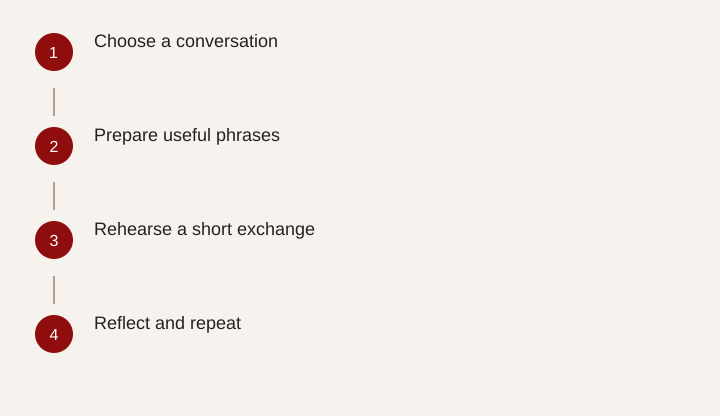
- Choose a conversation
- Prepare useful phrases
- Rehearse a short exchange
- Reflect and repeat
Choose a conversation that matters to you
If you can follow Spanish but struggle to answer, begin with one familiar situation. Perhaps you want to ask a relative about the weekend, explain what you study or arrange a meeting. A specific situation gives you a limited set of words and decisions to practice. “Speak about anything” creates much more pressure.
Write the task in one sentence: “I want to ask two questions about a family photograph and understand the main answer.” Define a small success condition. You might aim to ask the questions, request one clarification and summarize what you understood. That is more useful than judging whether you sounded like a different person.
The UCLA National Heritage Language Resource Center provides resources for heritage learners and families. Use its directory to explore structured support if you want it. The exercise below is an original practice design, not a research-backed promise about how quickly every learner will progress.
Prepare phrases you can actually reuse
Collect a few expressions relevant to the task rather than a long vocabulary list. Include an opening, a question, a way to ask for clarification and a closing. Check unfamiliar language with a reliable learning resource or a teacher instead of memorizing a phrase whose meaning you are unsure about.
For example, “¿Puedes hablar un poco más despacio?” asks someone to speak a little more slowly. “¿Qué significa esa palabra?” asks what a word means. “Déjame intentarlo otra vez” gives you a way to try again. These phrases help keep a conversation going when you do not understand everything.
Add words that belong to your own situation. If the conversation concerns a photograph, names of people, places and ordinary activities may be more useful than vocabulary from an unrelated lesson. Practice saying a complete thought with those words, not just recognizing them in a list.
Rehearse without making rehearsal the destination
Say the opening aloud, then change one detail. Ask about yesterday instead of next week, or describe a different class. This prevents the preparation from becoming a single memorized speech that collapses as soon as someone answers unexpectedly.
You can record a short practice attempt for yourself if that feels useful. Listen for whether the intended meaning is understandable and where you stop, rather than inspecting every sound for imperfection. Write down one issue to work on next time. Trying to correct every feature at once can leave you without a clear priority.
Move to a brief exchange with a willing person when ready. Explain the task and ask for a manageable kind of help. “Let me finish the thought, then correct one thing that made it hard to understand” is more specific than “Correct my Spanish.” A practice partner should agree to the role rather than being recruited by surprise.
Use conversation repair instead of disappearing
Getting stuck does not require ending the exchange. You can describe a missing word, ask a simpler question or confirm what you think you heard. If the other person switches languages, explain your preference while leaving room for the practical needs of the situation.
An original request might be: “I would like to try this part in Spanish. If an important detail is unclear, can we check it in English afterward?” That is appropriate for a willing practice conversation. It may not fit a rushed service encounter, where the other person is trying to complete a task rather than teach.
For important information, accuracy comes first. Do not pretend you understood a medical instruction, contract detail or travel arrangement to protect your pride. Request clarification in the language or format that lets you understand. Language practice and consequential decisions do not have to happen at the same time.
Try a seven-day task log
| Day | Suggested task | What to record |
|---|---|---|
| One | Pick one real conversation | Purpose and a small success condition |
| Two | Prepare a few relevant phrases | Which meanings still need checking |
| Three | Rehearse aloud with one variation | Where you pause or lose the idea |
| Four | Ask a willing partner for a short exchange | What support you agreed on |
| Five | Complete the exchange | What you communicated successfully |
| Six | Revisit one difficult moment | One phrase or structure to improve |
| Seven | Repeat or choose a related task | Whether the routine fits your life |
This schedule is flexible. You can spread it over several weeks or repeat the same task. The point is to create a cycle of preparation, interaction and reflection. Completing a conversation imperfectly provides different information from silently understanding a program or recognizing words in an app.
Decide what kind of support comes next
Review the log for patterns. If you need more vocabulary for everyday topics, choose materials connected to those topics. If you can speak but struggle to organize sentences, a teacher may help identify priorities. If the main obstacle is a partner's constant teasing or interruption, changing the practice setting may be more useful than adding another worksheet.
A heritage-focused class, a general language course, tutoring and a conversation group can serve different needs. Ask about placement and feedback before committing. Avoid assuming that the most advanced label is the best fit; a setting that targets your actual gaps can be more productive.
Keep the goal connected to your own interests. You may want stronger Spanish for family conversation, reading, work or enjoyment. None of those goals requires using each practice session as a test of whether your heritage is legitimate. Measure the task you chose, notice what helped and make the next attempt small enough that you can actually do it.
Related questions
Does understanding Spanish mean speaking should be easy?
Not necessarily. Treat speaking as a skill to practice and describe your particular needs to a teacher or partner.
Will this plan make me fluent in a week?
No. It is a short experiment for finding a workable practice routine, not a fluency guarantee.
Sources & further reading
Primary references
Community questions behind this guide
These discussions informed the question and language. Personal accounts are not verified facts or professional advice. Read our method.