THE SHORT ANSWER
A focused exhibit can connect heritage learning with sustained community participation. Agree on a small product, assign the work and document sources and sharing choices before collecting material.
What to keep in mind
- Choose one local question and a manageable exhibit size.
- Assign responsibility for research, permissions, design and hosting.
- Return useful copies and records to contributors and the partner.
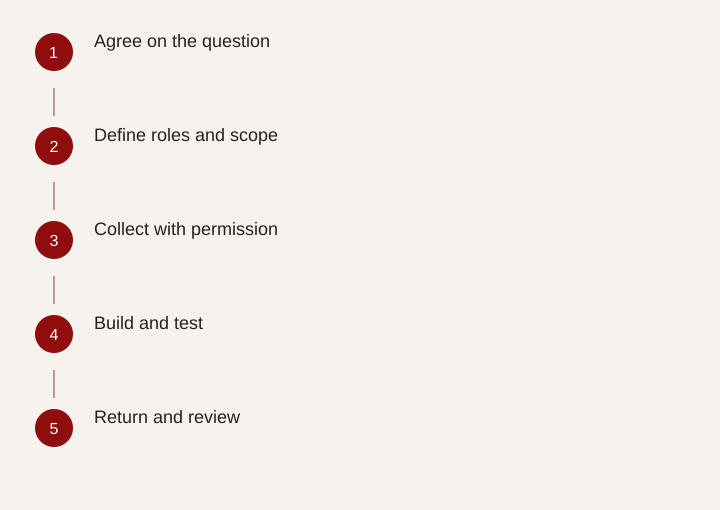
- Agree on the question
- Define roles and scope
- Collect with permission
- Build and test
- Return and review
Choose a local question before proposing an exhibit
Begin with a question that a library or community partner's audience might want to explore. It could concern a neighborhood gathering place, a local tradition, a group of photographs or the history of a particular activity. Avoid proposing an exhibit that promises to represent all Hispanic or Latino culture.
A small question makes the work manageable and gives contributors a clear reason to participate. “How has this community space been used across generations?” points toward objects, accounts and records. “Celebrate diversity” does not tell anyone what evidence to collect or what visitors will learn.
The Smithsonian Folklife education resources include community-research and exhibition materials for classrooms, libraries and cultural centers. Use that approach as a model for inquiry and collaboration, while adapting the scale to the people and resources actually available.
Approach a partner with a concrete brief
Before contacting the partner, prepare a one-page proposal stating the question, audience, proposed product and approximate workload. Identify what you can contribute and what you are asking the partner to provide. A venue, staff review, promotion and long-term storage are different requests and should not be bundled invisibly.
An initial project might contain four images, two short accounts and a visitor question panel. That is a hypothetical scope, not a required format. The point is to define something that can be completed and reviewed rather than presenting an open-ended collection project with no stopping point.
Ask whether the idea fits the partner's priorities and procedures. They may have display standards, accessibility requirements, collection policies or a calendar that changes the proposal. Treat those details as design information, not obstacles to be discovered after the exhibit has already been produced.
Assign responsibility before collecting material
| Work area | Decision to make |
|---|---|
| Research | Who verifies names, dates and contextual claims? |
| Contributor contact | Who explains the project and records participation choices? |
| Rights and permissions | Who checks images, recordings and intended uses? |
| Editing | Who drafts labels and handles factual review? |
| Design and access | Who prepares readable layouts and alternative formats? |
| Hosting | Who installs, opens and maintains the exhibit? |
| Handoff | Who stores files, returns copies and answers later questions? |
Give each area a named owner and realistic time allowance. A partnership does not mean every participant shares every task equally, but the division should be explicit. Avoid relying on an enthusiastic community volunteer to absorb all unassigned work because the project concerns their heritage.
Collect stories with a clear sharing plan
Explain why you are collecting material, how it may appear and who the audience will be. Participation, recording and public sharing should be discussed separately. Use the partner's relevant permission procedures, especially when minors or institutional collections are involved.
The Smithsonian oral-history guide includes interview guidance, preservation ideas and sample forms. It recognizes that ordinary community members hold valuable knowledge. That does not make every story public property or oblige someone to discuss a painful event.
Offer choices about what to contribute and what to leave private. Keep the scope small enough that contributors can understand the final use. If the project changes from a temporary room display to a public online archive, revisit the sharing plan rather than treating the first conversation as unlimited permission.
Select and label evidence carefully
For each item, record its source, creator if known, date, context and rights information. Distinguish a personal memory from an independently verified historical fact. Both can belong in the exhibit when their roles are clear. Do not silently turn one person's recollection into a statement about the whole community.
For images, check the exact asset record. The Smithsonian Open Access FAQ explains the use of CC0-designated assets and the existence of limitations on other material. A museum or government website does not make every hosted image freely reusable. Keep a provenance log with the chosen credit and permission basis.
Write labels around a claim the item can support, then include a question or limitation. If a date is unknown, say so. If a source describes only one period or family, preserve that scope. Accuracy often improves the exhibit more than adding another decorative object.
Build, test and close the project responsibly
Test the draft with someone who does not already know the story. Can they identify the exhibit's question, read the labels and understand the relationship between objects? Check the path through the space and provide suitable alternatives for media, such as transcripts or readable text. Use the partner's accessibility guidance rather than assuming a single design works for everyone.
Before opening, review credits, permissions, spellings and the final selection with the responsible people. Confirm who handles a correction request and how long the exhibit will remain available. A small event or discussion can introduce it, but attendance should not require contributors to perform their identity publicly.
At the end, return copies or agreed materials to participants and provide the partner with organized files, source notes and permission records. Ask what visitors learned and what the partnership could realistically continue. The best next project may be another small question, not an immediate expansion into a permanent archive. A completed, well-documented first exhibit gives everyone a sound basis for deciding what comes next.
Related questions
How large should a first partnership project be?
Small enough to finish with the available staff, time and permissions. A few well-documented items can form a useful first exhibit.
Can community stories be published as soon as they are collected?
No. Explain the intended use and follow the agreed permission and review process before sharing them.
Sources & further reading
Primary references
- Smithsonian Folklife Education
- The Smithsonian Folklife and Oral History Interviewing Guide
- Smithsonian Open Access FAQ
Community questions behind this guide
These discussions informed the question and language. Personal accounts are not verified facts or professional advice. Read our method.