THE SHORT ANSWER
Start with the units you already teach. Add carefully chosen sources and recurring inquiry methods, then check whether students encounter varied Latino experiences beyond a single commemorative month.
What to keep in mind
- Integrate sources into existing objectives rather than adding disconnected activities.
- Include ordinary life, ideas and institutions as well as struggle and achievement.
- Review both representation and the quality of student reasoning.
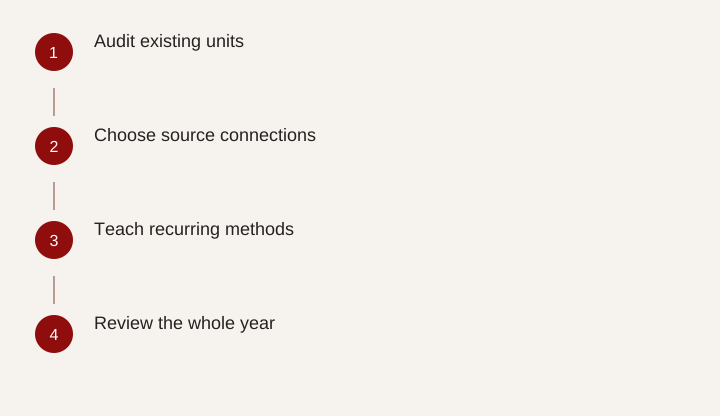
- Audit existing units
- Choose source connections
- Teach recurring methods
- Review the whole year
Begin with the curriculum that already exists
Keeping Latino history visible after October 15 does not require a separate course hidden inside every subject. Start by listing the units you already teach and the questions they ask. Look for genuine connections: migration, civic participation, artistic interpretation, scientific inquiry, language change, neighborhood life or the use of public space.
An addition is worthwhile when it helps students understand the existing question more fully. A source about Mexican American community life may strengthen a unit on urban development. A literary work may deepen a discussion about voice and audience. An unrelated celebrity fact at the start of class may attract attention, but it will not automatically produce a lasting curricular connection.
The Library of Congress teaching resources provide an entry point through primary sources. Use the observance to discover materials, then file them under the relevant learning objectives so they remain available when the calendar changes.
Audit what students currently encounter
Review readings, examples, illustrations and assignments across the year. Ask who appears, in what role and at what level of complexity. A curriculum may mention Latino people often while depicting them only as immigrants, victims or exceptional achievers. Those experiences matter, but they do not cover the full range of human activity.
Look for ordinary life, intellectual disagreement, institutions, creativity, work, family practices and collective action. Also notice whether the same country or period supplies nearly every example. Do not try to repair every gap with one lesson; identify a few changes that you can teach well and verify with appropriate sources.
Keep an audit note that distinguishes absence from a weak treatment. “No source about this topic” calls for research. “A source exists but is used only as decoration” calls for a different task. The remedy should follow the actual problem rather than a general desire to add more names.
Build a modest integration map
| Existing unit | Possible connection | Student task | Evidence needed |
|---|---|---|---|
| Community change | A documented neighborhood history | Compare maps and accounts | Place, dates and source perspective |
| Reading images | A photograph of public life | Separate observation from inference | Creator and collection description |
| Civic participation | A particular community initiative | Trace actors, goals and constraints | Reliable accounts of the initiative |
| Language and voice | A selected text or oral account | Examine audience and expression | Text context and speaker information |
| Public memory | Historical commemorative artwork | Analyze choices and omissions | Issuer, year and intended purpose |
This is a planning example, not a ready-made claim about specific events. Fill it with sources appropriate to the grade and course. Limit the first revision to a few strong connections. A small set taught thoughtfully is easier to sustain than a large list that teachers cannot prepare adequately.
Reuse methods while changing the evidence
Students benefit from a familiar inquiry routine. They can identify a source, observe details, ask what it supports and name what remains uncertain. Repeating that method is different from repeating the same content. It allows the intellectual work to become more demanding as students encounter new material.
For example, early in the year students might distinguish a photograph's visible details from an inferred event. Later they could compare the photograph with a written account and explain why the sources emphasize different things. By the final term, they might select their own sources and defend the limits of an interpretation.
The Mexican American Migrations and Communities collection explicitly states that its selections do not cover every aspect of the history. That acknowledgment provides a useful model for students: a good source set can be valuable and incomplete at the same time.
Give students choices without assigning identities
Invite students to investigate a question or source that interests them. Do not assume that a Latino student wants to research family heritage, speak Spanish in front of the class or explain a national tradition. The same student may prefer another subject entirely. Academic participation should not depend on personal disclosure.
Offer comparable routes to the learning goal: a public archive item, a documented local place or a voluntarily shared family object. If interviews are involved, explain the purpose, consent and sharing process through the school's applicable procedures. Provide a public-source alternative that is equally valued and equally manageable.
The Smithsonian Folklife education materials include community-research and exhibit formats that can help turn student choice into a structured project. The point is to give choices within a clear method, not to send students out with the vague instruction to “bring culture.”
Assess the reasoning and review the pattern
Use the same criteria you would use elsewhere in the course: a clear claim, relevant evidence, accurate context, source identification and acknowledgment of uncertainty. A student's personal connection can be meaningful, but it should not substitute for the assignment's intellectual work or become something the teacher grades for authenticity.
At the end of a term, inspect the pattern rather than only the individual lesson. Did students see more than one kind of experience? Did later activities build on earlier methods? Which sources required too much explanation, and which generated useful questions? Keep those notes with the unit plan so the next revision is based on classroom evidence.
You can still use Hispanic Heritage Month as a moment of focused attention. The difference is that it becomes one point in a continuing sequence. The sources remain in the course, the questions return in new settings and students learn that the histories under discussion are part of the subject itself, not a decorative interruption every autumn.
Related questions
Does year-round integration make heritage month unnecessary?
The approaches can coexist. The month can introduce sources and questions that return in later units.
Must every unit include a Latino example?
No. Choose meaningful connections supported by sources; forced references do not improve the lesson.
Sources & further reading
Primary references
- Celebrating Hispanic Heritage Month with Primary Sources
- Mexican American Migrations and Communities
- Smithsonian Folklife Education
Community questions behind this guide
These discussions informed the question and language. Personal accounts are not verified facts or professional advice. Read our method.