
THE SHORT ANSWER
A useful role-model display gives students a way to explore a person’s work, context and choices. Familiar celebrities can open the door, but they should not determine the whole selection or substitute for verified biographies.
What to keep in mind
- Choose a learning purpose before choosing famous names.
- Separate real people, fictional characters, nationality and heritage.
- Write labels that connect a specific contribution to evidence.
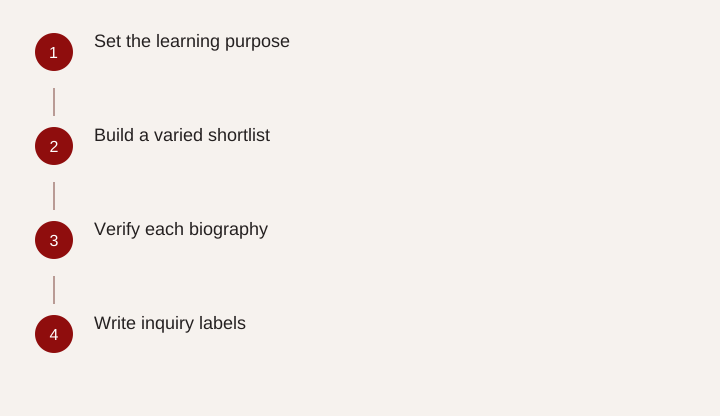
- Set the learning purpose
- Build a varied shortlist
- Verify each biography
- Write inquiry labels
Begin with what students will learn
A classroom display should do more than demonstrate that famous Hispanic people exist. Decide what students will learn from meeting the people you select. They might explore how scientists ask questions, how artists make choices, how public servants solve problems or how community members organize around a shared need. That purpose gives the display coherence.
Recognizable figures can attract attention, especially for younger students. Include some if they fit the objective, then pair them with less familiar people whose work opens a new question. A student who knows an actor may be ready to investigate a playwright, costume designer or documentary maker. The connection comes from the work rather than from a demand that every child already know the name.
Avoid turning the board into a contest about who is the most important representative. The Smithsonian's Latino identity exhibit emphasizes that there is no single Latino experience. Your selection can acknowledge variety while openly admitting that a small display is only a beginning.
Separate categories before selecting names
Check whether each proposed subject is a real person, a fictional character or a family depicted in entertainment. Those categories can all support learning, but they require different labels. A fictional family can help students discuss representation; it cannot supply a historical biography. An actor's role does not establish the actor's own identity either.
Distinguish nationality from the particular heritage focus of your display. If the assignment is about Hispanic Americans, a famous person living elsewhere may need a different explanation from a US-born person with family ties to Latin America. Do not quietly change the scope whenever a recognizable name appears. Adjust the title if your actual subject is broader.
Use the terminology the person uses when a reliable public source provides it. Do not infer heritage from a surname, appearance or a character they played. For a living person, avoid making unsupported statements about private family history. If the necessary information cannot be verified, select a better-documented subject.
Build a shortlist with a purpose
Create a small matrix before collecting pictures. It should reveal accidental concentration, such as selecting only entertainers, only people from one country or only people from the distant past. The matrix is a planning aid, not a quota system or a claim that one person represents everyone sharing a category.
| Candidate | Work students can examine | Context to verify | Why include this person? |
|---|---|---|---|
| Scientist | An experiment, mission or research question | Institution and documented contribution | Connect to the current science unit |
| Artist | A painting, performance or written passage | Creator, date and interpretation | Practice close observation |
| Community organizer | A documented local initiative | Place, participants and outcome | Explore collective action |
| Public servant | A specific project or decision | Role, dates and reliable account | Discuss civic responsibility |
These are selection categories, not invented biographies. Fill the rows with documented people. Notice whether your sources present individuals as lone heroes when their work involved teams, institutions or community members. A brief label can honor a contribution without erasing collaborators.
Verify the claim, not just the name
For each selected person, identify one contribution that can be supported by a credible biography, museum record, institutional profile or primary source. Replace sweeping superlatives with specific descriptions. “Worked on this mission” is a different claim from “invented space travel.” Firsts and records need particularly careful checking because the category or date may be narrower than a popular summary suggests.
Keep a source record containing the name as published, source organization, URL, date accessed and the exact factual point you plan to use. Separately document the image's rights and required credit. A reliable biography does not automatically supply a reusable photograph. If the rights are unclear, use a text-based label or a student-created visual that does not copy protected artwork.
The Library of Congress classroom approach treats historical images as evidence to examine. Bring that habit to the board: ask who made an image, why it was made and what it leaves outside the frame.
Write labels that invite investigation
A useful label contains a name, a specific contribution, a relevant context and a question. Keep vocabulary appropriate to the class and explain unfamiliar job titles. A younger reader needs to understand what the person actually did before being asked to admire the achievement.
Here is an original label structure, with placeholders rather than a fabricated person: “[Name] worked as a [role] in [place and period]. In [documented project], they [specific action]. The source beside this label shows [observable detail]. What questions might someone doing this work need to ask? What other people or resources would the project require?”
For older students, add a short source disagreement or limitation. Perhaps two biographies emphasize different parts of the person's work. That creates an opportunity to discuss how public reputations are constructed. The display becomes an invitation to research rather than a set of sentences to memorize.
Invite contributions without assigning cultural labor
Ask all students for suggested subjects and questions. Do not ask a Hispanic student to approve the whole display or explain every country represented. Students may have extensive knowledge, little interest in the selected topic or a preference to keep family identity private. Participation should follow the academic task, not an assumed obligation.
Offer a consistent submission form: proposed name, reason for inclusion, one reliable source and one question classmates could investigate. You can then evaluate suggestions by the same standards. If a student recommends someone outside the agreed scope, acknowledge the idea and explain whether the scope should change or whether the person belongs in another unit.
Before displaying the final board, review names, dates, accent marks, image credits and the relationship between the title and the actual selections. Leave room for additions. After a few days, ask students which person's work they want to investigate further and why. That response tells you more about the board's educational value than whether every picture was immediately recognizable.
Related questions
Can fictional characters appear?
They can appear in a clearly labeled media discussion, but should not be presented as real historical people or substitutes for verified biographies.
Should every student recognize every person?
No. A display should include approachable entry points and discoveries; recognition is a starting point, not the learning outcome.
Sources & further reading
Primary references
Community questions behind this guide
These discussions informed the question and language. Personal accounts are not verified facts or professional advice. Read our method.