THE SHORT ANSWER
A historical poster and a reusable image are different things. Track the item’s creator, date, source and rights before changing it or placing it in a new announcement.
What to keep in mind
- Check the specific asset record rather than relying on the host domain.
- Preserve the original year and issuer of historical posters.
- Record permission conditions before downloading a production file.
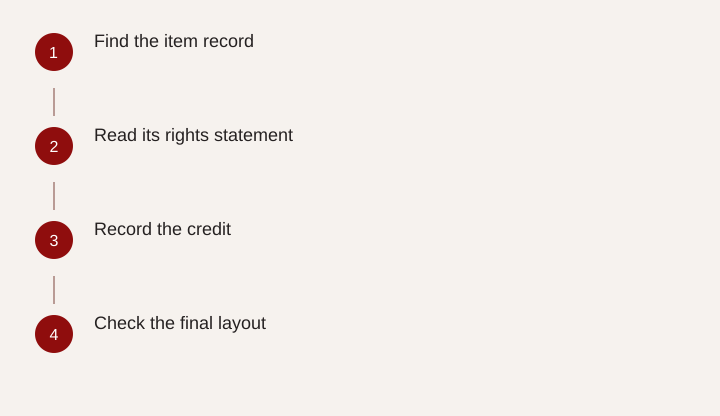
- Find the item record
- Read its rights statement
- Record the credit
- Check the final layout
Start with the use you actually intend
Before downloading an image, write down where it will appear: a classroom slide, a printed hallway display, a public website, a social post or an event handout. Note whether you want to crop it, add text or distribute an editable version. These details matter when interpreting permission conditions. “For education” is too broad to answer every reuse question.
Then locate the original item record. An image-search thumbnail, a repost on social media or a file someone emailed may omit the creator and rights statement. Follow the image to the collection or publisher that describes it. If you cannot trace it, treat the missing information as a research task, not as permission.
This workflow is a practical way to document decisions, not a legal ruling about a particular use. When the proposed use is substantial or the conditions are ambiguous, ask the rights holder or the institution's appropriate staff with a concrete description of your project.
Read the asset's designation
The Smithsonian Open Access FAQ explains that assets marked CC0 may be reused without Smithsonian copyright permission. It also explains that some collection objects have limitations and therefore have metadata available without a downloadable media file. A searchable collection record is not itself a promise that its image is unrestricted.
Look for the designation attached to the exact image you intend to use. Save the record URL and the wording you relied on. Do not assume that a different photograph of the same object has identical conditions. Similarly, a government-hosted page can contain material supplied by another creator. The host's domain is not a substitute for the item's rights information.
Even where copyright permission is not required, consider context and attribution. A clear credit helps viewers find the original record and understand what they are seeing. Avoid presenting a museum image as an endorsement of your event, and do not substitute an institution's logo for a textual source credit.
Keep historical posters in their original context
A poster's theme, year and issuing organization are part of the historical object. Removing the year can make an old campaign appear current. Replacing the issuer with your own name can obscure who created the artwork. An archive should preserve those distinctions even when a design is attractive enough to reuse.
If the poster is the subject of a lesson, describe it as an example from its documented year. Students might compare its imagery, wording and intended audience with another source. If the purpose is simply to advertise a new meeting, design a new announcement and link to the historical material separately. That often reduces both attribution confusion and production work.
An archived download or submission form also does not establish that a current organization accepts submissions through the old process. Keep historical navigation and present-day event instructions separate. Verify a current contact or process at its current official source before directing someone to use it.
Build a small provenance log
Use one row per asset. The log should be understandable to another organizer who did not do the research, especially if that person later changes the layout or publishes it in another channel.
| Field | What to record | Example of a useful note |
|---|---|---|
| Asset | Exact title or descriptive filename | Photograph of the documented event |
| Creator and date | Information from the original record | Unknown creator; date supplied by collection |
| Source | Stable item URL and collection | Link to the item, not a search results page |
| Rights | Exact designation and conditions | CC0 shown on this asset record |
| Proposed use | Format, audience and modifications | Public event handout; resized without crop |
| Credit | Required or chosen credit wording | Creator, title, year, collection |
| Verification | Date checked and unresolved issue | Awaiting reply about an unmarked file |
“Unknown” is acceptable when the collection genuinely does not identify something. Inventing a creator or date to complete the row is not. If a required permission remains unresolved, choose a different asset or a text-only design while continuing the inquiry.
Check what the layout does to the meaning
Permission is one part of responsible use. Cropping can remove context, a caption can misidentify a place, and decorative placement can turn a historical scene into a stereotype. Review the final layout alongside the original record rather than checking the image in isolation.
The Library of Congress teaching guidance treats historical images as sources to analyze. Apply the same discipline to your caption. Describe what is documented, distinguish interpretation and avoid assigning a person's identity or motive from appearance alone. If the record gives only a broad date range, keep that range.
A source line should remain readable in print and on a phone. Put detailed provenance in a linked source list if the design cannot hold it all. Do not hide a necessary credit inside a file name that the audience will never see.
Make the final handoff usable
Before releasing the design, compare the final asset list with the provenance log. Check that the exported file uses the approved versions and that later edits did not remove credits. Test source links and confirm that historical years are visible. Keep editable files and the log together so the next organizer can understand the decisions.
If a colleague requests a different use later, revisit the conditions rather than treating the earlier check as unlimited approval. A classroom presentation and a public promotional product may differ materially. Record the new decision alongside the old one. This small habit prevents a well-documented educational display from becoming an unexplained asset collection that circulates without its source information.
Related questions
Are all museum images free to reuse?
No. Check each asset’s rights statement; a museum may publish both open-access and restricted material.
Can I use an old theme on a new event poster?
You can discuss the historical theme with its year and source. Adapting its artwork requires checking permissions and avoiding misleading current attribution.
Sources & further reading
Primary references
Community questions behind this guide
These discussions informed the question and language. Personal accounts are not verified facts or professional advice. Read our method.