THE SHORT ANSWER
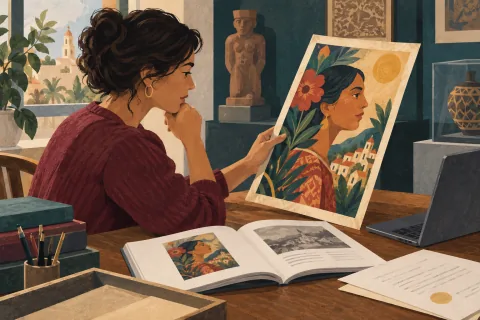
A limited timetable can still support a coherent heritage unit. Choose one question, revisit a small source set and let students produce a modest evidence-based exhibit rather than a sequence of unrelated activities.
What to keep in mind
- Start with one inquiry question that fits an existing learning objective.
- Give students a shared method for distinguishing observation from inference.
- Offer a public-source alternative to family disclosure.
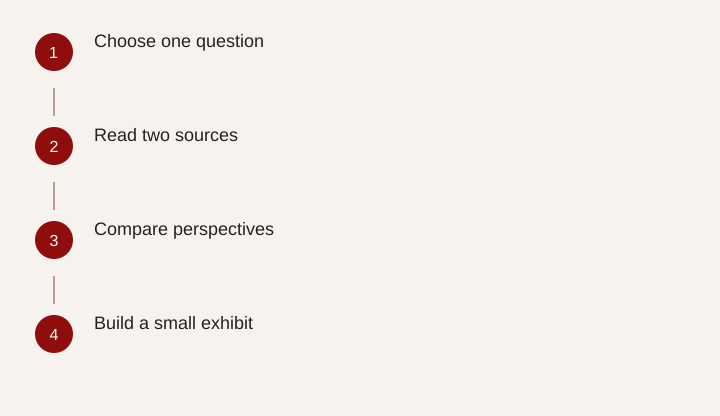
- Choose one question
- Read two sources
- Compare perspectives
- Build a small exhibit
Choose a question small enough to answer
If you have one class a week for Hispanic Heritage Month, begin with a question rather than a list of activities. “What can photographs and personal accounts reveal about building a community?” is manageable. “Learn everything about Hispanic culture” is not. A narrow question allows students to revisit evidence and improve an answer over four meetings.
Connect that question to an existing objective: analyzing sources, supporting a claim, comparing perspectives or writing a clear explanatory label. This makes the work part of the curriculum instead of a competing seasonal assignment. The Library of Congress teaching guidance offers historical images and a primary-source analysis approach that can anchor the sequence.
Select two or three sources before planning the activities. Read their descriptions, dates and rights information yourself. A photograph, a short written account and a map often provide enough contrast. Explain the selection's limits: a source set about one Mexican American community cannot stand for every Hispanic or Latino experience.
Meeting one: notice before explaining
Show the first source without asking students to produce an immediate historical conclusion. Give them time to list visible details. Then ask which statements are observations and which are interpretations. “Five people appear in the photograph” is different from “They are celebrating a holiday.” The latter may be a useful hypothesis, but it needs evidence.
Introduce the source's creator, date, place and collection description after the initial observations. Ask what changed when that information became available. Students should see metadata as part of reading a source, not as fine print that can be skipped. Model one uncertainty yourself: “The caption names the location, but it does not tell us why this person was there.”
End with a short exit ticket: one observation, one possible interpretation and one question. Collect these to decide what needs clarification in the next meeting. Do not grade students on whether their families already know the topic.
Meeting two: compare without forcing agreement
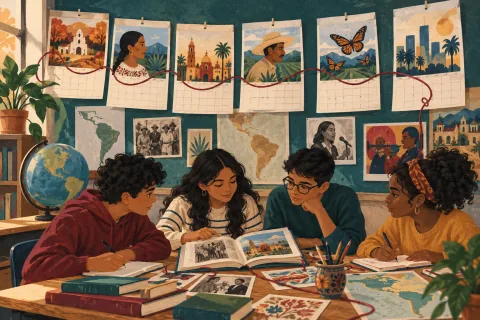
Add a second source that offers a different perspective or format. Students might compare a photograph with an account of neighborhood life. Ask what each source can show particularly well and what remains outside its view. A personal account may explain meaning and memory; a photograph may preserve details the speaker does not mention.
The Mexican American Migrations and Communities source set explicitly acknowledges that it does not cover every aspect of the subject. Use that limit as a teaching point. A curated collection is a selection, not the whole history. Students can identify whose experiences are absent without inventing those experiences themselves.
Have pairs write a tentative claim supported by one detail from each source. If the sources appear to disagree, preserve the disagreement as a question to investigate. The objective is a defensible interpretation, not a perfectly smooth story.
Meeting three: research a connection with choice
Let students choose a manageable connection: a local place, a family object voluntarily discussed, an artist's work or another item from a public collection. The choice should serve the inquiry question. It should not become an assignment to prove ancestry, translate for the class or disclose an immigration story.
Provide an equivalent public-source route from the beginning. A student may prefer it because of privacy, availability, language, family circumstances or simple curiosity. They should not need to explain why. If students speak with someone, explain the project and obtain the person's agreement before recording or sharing their words; use the school's own procedures for minors and public display.
Ask for a small research record: source title, creator, date, link or location, relevant detail and one limitation. Keep the deliverable modest enough that students can complete it with the access they actually have. A well-understood source is more valuable than ten copied facts.
Meeting four: make an exhibit, then revise it
Each student or pair prepares one exhibit label answering the shared question. Give a length range appropriate to the grade, a clear requirement for evidence and a space for a remaining question. An original model might read: “This photograph shows a gathering outside a neighborhood building. The collection record identifies the place and year. Together with the interview, it suggests that the building supported repeated community contact. We still need to learn who could use it.”
Allow a gallery walk or small-group exchange. Readers underline the claim, point to the evidence and identify a sentence that goes beyond the sources. The authors then revise. This final revision is the part most easily lost when a heritage activity focuses only on decoration, yet it makes the learning visible.
Use the same assessment criteria for every topic. Students are evaluating the quality of research and explanation, not judging whether a classmate's heritage contribution is sufficiently authentic.
A planning grid and a realistic assessment
| Meeting | Student action | Evidence of learning | Short-session version |
|---|---|---|---|
| One | Observe and question | Observation/inference exit ticket | One image and three notes |
| Two | Compare sources | Claim with two supporting details | One paired comparison |
| Three | Investigate a connection | Source record with a limitation | One approved public item |
| Four | Explain and revise | Exhibit label plus revision | A paragraph and peer feedback |
Assess four things: whether the claim answers the question, whether evidence supports it, whether the source is identified, and whether limits are acknowledged. A visually elaborate display should not outrank a simpler one with better reasoning. Offer accessible formats such as enlarged text, a typed transcript or an audio explanation when appropriate to the class.
After the unit, save the most useful sources with your existing curriculum materials. Note the misconceptions that appeared and the time each activity actually took. Next year's improvement should come from those observations, not from finding a larger pile of unrelated worksheets.
Related questions
Can this work with only fifteen minutes per week?
Yes, if the source set and final product are reduced: one observation, one comparison, one label draft and one revision.
Must students interview relatives?
No. A public-source option should meet the same learning objective without requiring family participation.
Sources & further reading
Primary references
Community questions behind this guide
These discussions informed the question and language. Personal accounts are not verified facts or professional advice. Read our method.