
THE SHORT ANSWER
Ask which criteria mattered, what evidence was missing and what a credible path would require. A useful development plan records actions and review points without pretending to guarantee promotion.
What to keep in mind
- Separate strong performance in your current role from evidence for the next role.
- Ask for examples and decision criteria instead of general reassurance.
- Set a review point and evaluate whether the proposed path is credible.
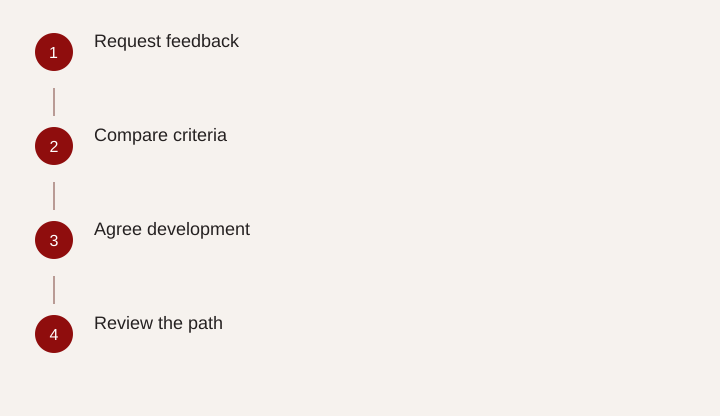
- Request feedback
- Compare criteria
- Agree development
- Review the path
Request a conversation after the immediate reaction
Being passed over can feel especially painful when you have handled difficult work, trained colleagues or received strong reviews. Give yourself enough space to prepare a useful conversation, then ask for specific feedback. The goal is information you can act on, not an argument that the decision must be reversed because it hurt.
A short request can say: “I would like to understand the selection criteria and what evidence I would need to demonstrate for a future opportunity. Could we schedule a discussion focused on that?” This gives the manager a clear purpose and reduces the chance of another vague exchange about continuing to do good work.
Do not assume you know everything about the selected candidate. Their qualifications, interview or experience may include information unavailable to you. You can still ask for a serious explanation of your own candidacy without making the conversation a comparison of personalities.
Distinguish current performance from next-role evidence
Strong performance in the present role is valuable, but a promotion may require different responsibilities. Ask which capabilities were decisive and how the selection process assessed them. The next role might involve judgment under uncertainty, broader coordination or a different technical depth rather than simply more hours of the same work.
If the manager says you need more leadership, ask for a concrete example of leadership in that role. Does it mean deciding priorities, developing others, handling conflict or owning a particular outcome? A label without examples is difficult to turn into a development plan.
For a hypothetical employee who consistently resolves customer problems, the next role may require designing a process that reduces those problems across the team. That does not diminish the employee's current contribution. It identifies the different evidence that a future application may need.
Ask questions that produce usable answers
Prepare a short agenda rather than a long list of grievances. You can acknowledge disappointment and still keep the discussion focused on decisions and evidence.
- Which criteria had the greatest weight in this selection?
- Where did my application or interview provide strong evidence?
- Which important area lacked evidence or did not meet the expected level?
- What would a convincing example of that capability look like?
- What assignment could let me demonstrate it within my current capacity?
- Who would evaluate the result, and when?
- What conditions besides my development affect whether another opportunity will exist?
If the answer is “Keep doing what you are doing,” ask how that will produce different evidence at the next decision. Avoid accepting endless encouragement as a plan. The manager may not know when a vacancy will exist, but they can be honest about that uncertainty instead of implying a promotion is imminent.
Build a development record with observable milestones
The OPM individual development planning resource offers a useful model: record goals, learning activities and review with a supervisor. Its federal context does not make it a universal promotion procedure, but the structure can help in many workplaces.
| Goal | Evidence-building activity | Support and capacity | Review |
|---|---|---|---|
| Capability to develop | A defined project, assignment or learning activity. | Time, resources and work to deprioritize. | Evaluator, success indicators and date. |
Choose one or two meaningful activities rather than volunteering for every extra task. An assignment should produce relevant evidence and have an owner who will review it. If the project simply adds work with no connection to the stated criteria, ask how it supports the goal before committing.
Confirm the conversation without inventing a promise
Send a brief summary of the criteria, agreed activity and review date. Distinguish what the manager approved from what remains uncertain. A development assignment is not the same as an approved promotion, a salary commitment or a guaranteed vacancy.
You might write: “My understanding is that the main development area is [capability]. I will undertake [defined activity] with [support], and we will review [evidence] on [date]. Future promotion will still depend on [conditions discussed]. Please correct anything I have misunderstood.”
This record helps both sides remember the actual agreement. It also gives you a basis for the next conversation if the criteria shift. If new expectations arise, ask how they relate to the original plan rather than assuming either that all change is unfair or that the goal can move indefinitely without explanation.
Decide whether the path remains credible
At the review point, examine what actually happened. Did you receive the assignment and support? Was the work evaluated against the agreed criteria? Can the manager explain the remaining gap? Is there a realistic opportunity, or only another indefinite request to wait?
Your decision may be to continue, seek an internal move or explore external roles. Consider the work you enjoy, development available, compensation, location and personal constraints. Do not let sunk effort alone determine the choice. Equally, do not make an irreversible decision solely during the first wave of disappointment.
A useful feedback process leaves you with evidence and options, even if a promotion does not follow. You should understand what the next role requires, what you can demonstrate and what the organization can realistically offer. If those answers remain unavailable after repeated clear requests, that absence is itself relevant to planning your next move.
Related questions
Should I ask why the selected person was better?
Ask about the criteria and your own evidence rather than demanding another person's confidential assessment. You may not know their full qualifications or selection factors.
Does a development plan mean a promotion is promised?
No. A development plan can clarify work and learning goals, but an opening, selection process, budget or other conditions may still be required.
Sources & further reading
Primary references
Community questions behind this guide
These discussions informed the question and language. Personal accounts are not verified facts or professional advice. Read our method.