
THE SHORT ANSWER
Ask management to identify the dependency, propose a bounded transition and connect it to a real decision. Becoming replaceable in one workflow should not require doing two full jobs indefinitely.
What to keep in mind
- Turn a vague dependency claim into a list of specific responsibilities.
- Assign handoff ownership and reduce current work as transition duties increase.
- Set a decision checkpoint; a transition plan is not a guaranteed promotion.
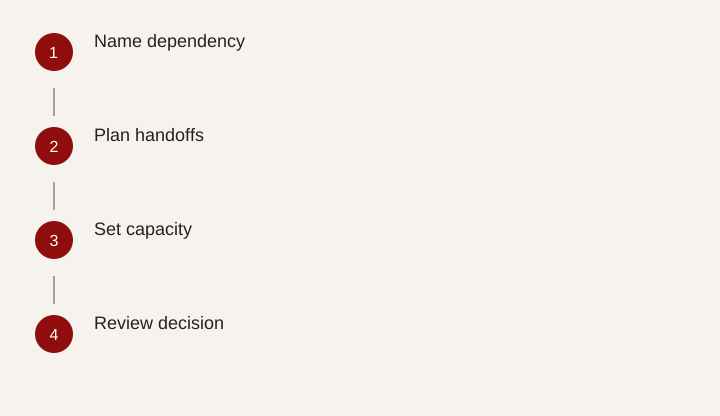
- Name dependency
- Plan handoffs
- Set capacity
- Review decision
Ask what operational dependency blocks the move
Being told you are too essential to promote can sound like praise while functioning as a barrier. Ask the manager to identify the specific responsibilities that prevent a move. Which task would fail, who currently depends on you and what would need to change?
A broad statement such as “The team cannot lose you” is difficult to act on. A list of three processes with no trained backup is more useful. It reveals whether the issue is missing documentation, staffing, authority, access or management's unwillingness to make a change.
Do not assume that every promotion rejection is caused by dependency. Ask whether you meet the next role's requirements and whether an actual opening or selection process exists. Operational coverage and readiness for a different job are separate questions. A transition plan should not be used to avoid discussing either one honestly.
Inventory responsibilities without turning them into a monument
List recurring duties, urgent exceptions, decision rights and knowledge that currently sits with you. Identify frequency, consequence of failure, existing documentation and potential backup. The purpose is to transfer work, not prove that nobody could ever replace you.
For a hypothetical operations specialist, the list might include a weekly reporting process, a client escalation route and a system permission only they hold. Each dependency needs a different solution. A procedure document may address the report; a manager may need to assign escalation authority; an administrator may need to provide appropriate access.
Avoid producing a huge manual before anyone agrees who will use it. Start with the highest-risk dependencies and ask management to choose owners. Documentation without a recipient, training time or authority may preserve information without creating real coverage.
Propose a bounded transition
A transition proposal should identify the work, recipient, training method and completion test. Use a period appropriate to the role; a ninety-day outline is a planning example, not a universal requirement.
| Period | Work | Completion evidence |
|---|---|---|
| First month | Confirm owners, document critical steps and resolve access. | Recipients can locate instructions and perform a supervised run. |
| Second month | Recipients perform the work while you review exceptions. | Routine tasks complete without you acting as the primary operator. |
| Third month | Test coverage, close gaps and transfer escalation ownership. | Manager accepts the handoff and identifies remaining support limits. |
The OPM development-planning model is useful for recording goals, activities and review. It does not turn a handoff plan into a promotion commitment. Keep the operational plan and the career decision connected but explicitly separate.
Protect capacity during the handoff
Training a backup takes time. Ask which current work will be reduced, delayed or reassigned while you document and coach. Otherwise, the transition can become another layer of invisible work on top of the responsibilities that already made you difficult to move.
Define support after the handoff. Will you answer questions during scheduled office hours, handle only unusual exceptions or provide a limited review period? Who decides when a question belongs to the new owner? Without those boundaries, the nominal transfer may leave you doing the work behind the scenes.
A practical sentence is: “I can complete this transition if the receiving owners have time and authority, and if we reduce my current load by the agreed amount. I cannot operate the old role and the new role at full capacity indefinitely.” This states a resource requirement rather than threatening to let the team fail.
Connect milestones to an actual career decision
Ask what happens when the agreed dependencies are resolved. Will you be eligible to apply, interviewed for a specific opening, considered at a scheduled review or simply released from some duties? Those are different outcomes.
Confirm who owns the decision and what conditions remain outside your control. A manager may support your development but lack authority to approve a move. If so, identify the actual decision-maker and process. Do not treat encouraging language as an approved transfer or salary change.
A written recap can say: “We agreed that the transition addresses the coverage concern. On [date], we will review the handoff evidence and decide [specific next step], subject to [stated conditions].” This makes it harder for an undefined dependency to move indefinitely without explanation, while avoiding a promise the organization has not made.
Evaluate progress rather than waiting without limits
At each checkpoint, examine whether owners were assigned, access provided and training completed. If management has not supplied the necessary resources, identify that as a blocked organizational decision rather than a personal failure to make yourself replaceable.
If the plan progresses, use the evidence in the next career conversation. If the requirements keep expanding or no opportunity exists, consider internal alternatives and external options alongside your personal constraints. You can maintain professional standards while deciding that the organization does not offer the path you need.
Do not destroy documentation, withhold necessary information or manufacture a crisis to demonstrate your value. The stronger position is a clear record of contribution, a reasonable transition proposal and an honest assessment of the response. A good plan should either enable a credible move or reveal why the proposed path is not currently real.
Related questions
Should I stop helping so the team realizes my value?
Deliberately creating failures can damage colleagues and your own position. A documented transition and a clear discussion of career options are more useful than sabotage or abrupt withdrawal.
What if management never provides someone to take over?
Treat that as a decision the organization has not made. Ask for a concrete owner and date, then consider whether the internal path remains credible rather than accepting an unlimited transition.
Sources & further reading
Primary references
Community questions behind this guide
These discussions informed the question and language. Personal accounts are not verified facts or professional advice. Read our method.