
THE SHORT ANSWER
A useful review request identifies one disputed requirement and points to specific evidence already submitted. It asks the agency to check a determination without assuming a right to reversal.
What to keep in mind
- Distinguish an eligibility decision from a qualifications decision.
- Review the actual submitted package, not a newer resume.
- Use a precise evidence table and the announcement's contact instructions.
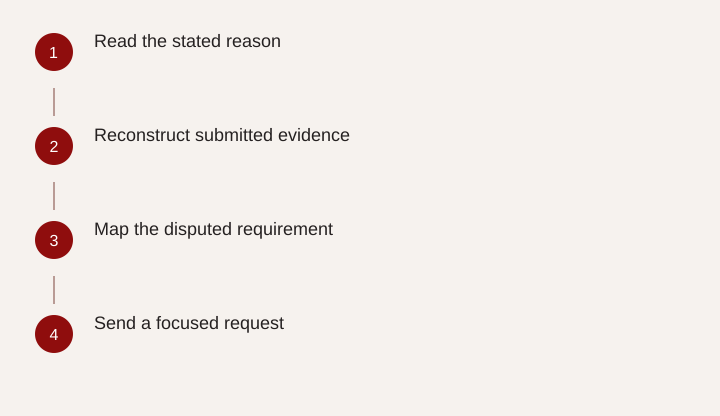
- Read the stated reason
- Reconstruct submitted evidence
- Map the disputed requirement
- Send a focused request
Identify what the notice actually decided
A disappointing result can describe several different problems: the hiring path did not apply, a required document was missing, education did not meet a requirement or the resume did not establish specialized experience. Begin with the notice's exact language. “Not eligible” and “not qualified” should not be treated as interchangeable explanations.
The official distinction between eligibility and qualifications separates permission to compete through a hiring path from meeting the job's requirements. An applicant may have excellent experience but lack eligibility for a restricted announcement. Conversely, eligibility alone does not prove the required experience. Save the notice and compare its grade, location and announcement number with your application. If the agency evaluated several grades separately, a result at one level does not necessarily describe every level you selected.
Reconstruct the package the reviewer received
Locate the submitted resume, questionnaire, attachments and confirmation record. Use the versions selected for that announcement. A revised resume in your current account may contain evidence that was absent when the vacancy closed. That difference matters when deciding whether you are identifying an overlooked fact or trying to supply a missing one.
Check basic details before arguing the conclusion: employment dates, hours per week, grade selections, transcripts and required eligibility documents. Read the specialized-experience paragraph word by word, including any required combination of tasks or level of responsibility. The OPM qualification policies explain how qualifying experience and education are evaluated across covered occupations, while the specific announcement states the vacancy's requirements. Do not replace its wording with a broader assumption that your general years of work should be enough.
Make a requirement-to-evidence table
A short table can reveal whether you have a focused issue worth raising. Use exact page or section references so the reviewer can find the material quickly.
| Disputed requirement | Submitted evidence | Question for the agency |
|---|---|---|
| Required type of analysis | Resume page 1, analyst role, named task | Was this experience considered against that requirement? |
| Duration at the required level | Dates and weekly hours in the submitted entry | Was the period credited as shown? |
| Education route | Selected transcript and relevant coursework | Was this attachment available and evaluated? |
| Hiring-path eligibility | Required status document submitted | Which eligibility condition was not established? |
These rows are examples, not grounds for every request. Keep only the row or two relevant to your notice. If your evidence consists of a job title with no description of the required task, acknowledge that weakness. The table is valuable even when it shows that the next application needs clearer evidence rather than a challenge to this one.
Write a narrow, neutral review request
A useful message might read: “I am requesting clarification of the not-qualified determination for announcement ABC-123, GS-9. The notice states that my resume did not establish experience reconciling program data. My submitted resume, page 1 under Program Assistant, describes monthly reconciliation of the listed records from March 2023 through June 2025 at 40 hours per week. Would you please confirm whether that entry was considered and explain which part of the requirement was not met?”
The example is hypothetical. Replace its facts with accurate references and use the announcement's listed contact or review procedure. Attach the original notice or package only as appropriate for the channel. Avoid accusations, threats or claims that a referral is owed. Clear writing makes it easier for the agency to identify the issue. A long career narrative can obscure the single factual question you need answered.
Keep requests within the available procedure
Follow any deadline and instructions provided in the notice. A general request for clarification is not automatically a formal appeal, and different hiring circumstances can involve different procedures. If the notice identifies a specific review route, use that route rather than relying on an unrelated online template. The USAJOBS status guidance points applicants to the agency for application-specific information.
Do not assume that sending new supporting material after closing will make an incomplete application complete. Ask whether additional information is permitted and distinguish it from evidence already submitted. If the agency confirms the determination, read its explanation for the precise shortfall. If the response is unclear, one focused follow-up may be useful. Repeatedly sending the same argument without new clarification is unlikely to improve the record or your understanding.
Turn the outcome into a better application
Whether the determination changes or stays in place, record what you learned. A dates-and-hours omission calls for a different repair than selecting an inapplicable hiring path. A missing required course cannot be fixed by stronger adjectives. A resume that describes relevant work too broadly may need a concise example of the task, responsibility and duration.
For future vacancies, use the specialized-experience evidence method before submitting. Preserve a requirement map with the final package so you can reconstruct the application later. Continue applying to suitable opportunities while a review request is pending; the request does not create a predictable hiring timeline. The practical objective is an accurate decision based on the submitted record and a clearer understanding of how to demonstrate qualifications in the next application.
Related questions
Can I demand that an agency reverse a not-qualified result?
A request for clarification or review does not guarantee reversal. Follow the agency's stated procedures and any applicable deadlines; do not assume every notice creates the same formal review rights.
Should I send a rewritten resume with my review request?
Identify evidence in the package submitted by the deadline first. Ask the agency whether additional material is permitted rather than assuming a new resume can cure an incomplete application.
Sources & further reading
Primary references
- USAJOBS: Eligibility versus qualifications
- USAJOBS: Application and job status
- OPM: General Schedule Qualification Policies
Community questions behind this guide
These discussions informed the question and language. Personal accounts are not verified facts or professional advice. Read our method.