
THE SHORT ANSWER
Specialized experience must be demonstrated through actual work at the required level. A familiar job title or a long career does not explain every required task.
What to keep in mind
- Break requirements into individual evidence questions.
- Connect duties to a role, dates and level of responsibility.
- Use a matrix to expose gaps before applying.
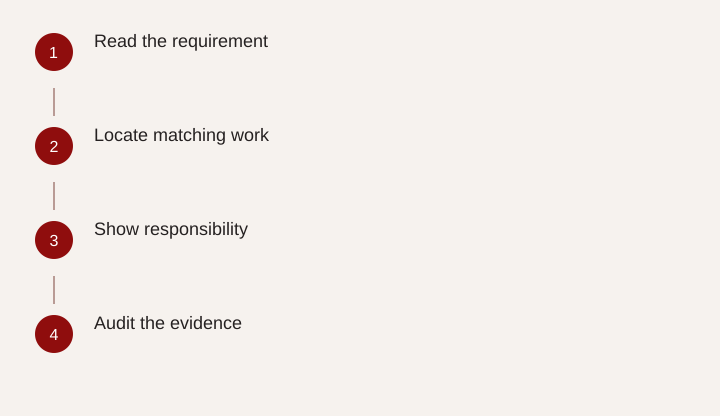
- Read the requirement
- Locate matching work
- Show responsibility
- Audit the evidence
Make the required work visible
To prove specialized experience, explain where, when and how you performed the required work. Do not assume a reviewer will infer a task from your title, license, employer or general professional reputation. Someone who understands your profession may recognize the connection immediately; a qualification review still needs evidence in the application.
The OPM applicant resume guidance asks applicants to address all required qualifications and demonstrate their ability to perform the stated tasks. The OPM qualification policies provide the broader framework, but the applicable occupation standard and announcement determine what you must demonstrate.
Start with the exact grade you are applying for. A posting covering several grades may describe different experience at each level. Keep those requirements separate. Evidence sufficient for one grade does not automatically prove another, even when the job title is identical. Your task is to make the comparison possible, not to declare yourself qualified without showing why.
Break the paragraph into evidence questions
A specialized-experience paragraph can hide several separate elements. Look for the tasks, subject matter, scope, decision-making responsibility and required duration. Pay attention to connectors such as “and” and “or”; they can change whether the announcement describes a combined requirement or alternative routes.
Suppose a hypothetical announcement requires reviewing program expenditures, identifying discrepancies and preparing recommendations. Three useful questions follow: What expenditures did you review? What kinds of discrepancies did you investigate? What recommendations did you prepare, and for whom? A bullet saying “supported financial operations” leaves all three unanswered.
Do not replace the actual announcement with this example. Some vacancies use different structures, selective factors or education requirements. Copying the requirement into a private working sheet preserves the wording while you analyze it. If the meaning remains unclear, ask the listed agency contact a narrow question before relying on an interpretation that determines whether you apply.
Connect evidence to time and responsibility
Each relevant work entry should allow the reviewer to connect the experience to dates and weekly hours. A separate skills block saying “budget analysis” does not show when that work occurred or how long you performed it. Place substantive evidence under the role where it happened.
Also explain the level of responsibility. Did you gather documents for someone else's review, perform the analysis independently, recommend a decision or have authority to approve it? These are different contributions. None needs to be embellished, but the distinction matters when the announcement describes work at a particular level.
A hypothetical applicant might accurately write that they analyzed monthly expenditure reports, investigated mismatches with program staff and drafted corrective recommendations for a supervisor. If the supervisor made the final determination, do not change “drafted recommendations” to “directed policy.” Specificity strengthens the record while preserving the boundary of the applicant's actual authority.
Build the requirement-to-evidence matrix
Use a small table before drafting the final resume. It is a working tool, not an attachment that automatically belongs in the application.
| Requirement | Actual example | Where and when | Gap to resolve |
|---|---|---|---|
| Review expenditures | Compared program transactions with approved categories | Program assistant role, documented dates and hours | Clarify the type of program |
| Identify discrepancies | Investigated mismatched amounts with submitting staff | Same role | Explain personal responsibility |
| Prepare recommendations | Wrote proposed corrections for supervisor review | Same role | Distinguish recommendation from approval |
The entries above are hypothetical. Replace every cell with facts from your own history. If an entire row is blank, better wording cannot create the missing experience. You may need a different grade, a permitted education route or a different vacancy. A visible gap is useful because it prevents hours of polishing an application that cannot support the stated requirements.
Write for a reader outside your specialty
Translate internal shorthand into the function it served. An employer's proprietary system name may mean little outside that organization. Explain whether you used it to track cases, reconcile transactions, analyze laboratory results or maintain inventory. Retain a technical name when the vacancy specifically requires it.
Use the announcement's terminology when it accurately describes your work. Matching language is different from copying a claim you cannot support. The purpose is to remove ambiguity, not to produce an artificial keyword score. Avoid suggesting that a hidden automated system will accept a resume simply because a phrase appears enough times.
Quantification can help when it explains scale, frequency or outcomes. It is not mandatory to invent a percentage for every bullet. A truthful description of independently handling recurring work, addressing a defined problem or documenting a decision can be more useful than an unsupported numerical accomplishment. Keep confidential or sensitive information out of the example.
Perform a skeptical final review
Read the draft alongside the requirement matrix and ask what a reviewer would still have to guess. Check whether the dates support the claimed period, whether hours are visible, whether the task belongs to the named role and whether the responsibility is clear. Resolve contradictions between your resume and questionnaire responses before submitting.
Then ask a second reader to point to the sentence supporting each requirement. If they identify only the job title or your summary, the evidence may need a more concrete work example. The aim is not maximum detail; it is enough accurate detail to support the determination within the page limit.
Retain the matrix with the submitted resume. It becomes an interview preparation aid and a reference if you receive a qualification notice that seems inconsistent with the package. A later inquiry should identify the requirement and the evidence already submitted, rather than rely on the claim that your background speaks for itself.
Related questions
Should I copy the specialized-experience paragraph?
Use accurate terms where they describe your work, but copying a requirement does not establish that you performed it. Add the context and evidence from your actual role.
Does a senior title prove the next lower grade?
A title alone does not describe the complexity, independence or scope of the work. Compare your documented responsibilities with the announcement.
Sources & further reading
Primary references
Community questions behind this guide
These discussions informed the question and language. Personal accounts are not verified facts or professional advice. Read our method.