
THE SHORT ANSWER
Treat an AI rewrite as an unverified draft. Compare it sentence by sentence with your own work history before anything reaches an application.
What to keep in mind
- Give the editor a factual source record.
- Verify every number, responsibility and credential.
- Keep application-specific assessment rules separate from resume editing.
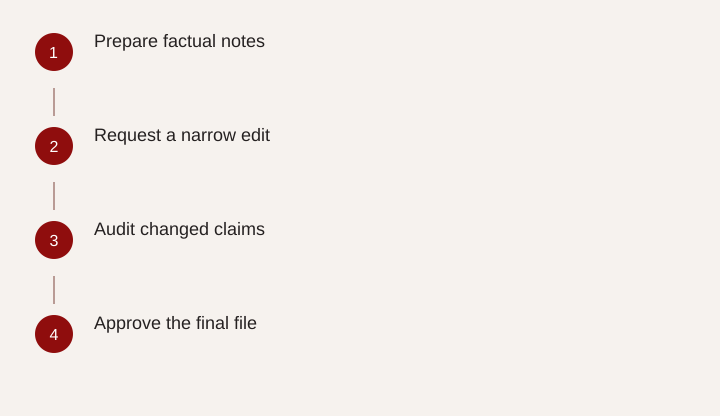
- Prepare factual notes
- Request a narrow edit
- Audit changed claims
- Approve the final file
Choose an editing task you can verify
AI can help reorganize or shorten a resume, but you remain responsible for what the application claims. A polished sentence is not evidence that the work occurred. The safest use is a bounded editing task whose result you can compare with a factual record: shorten a paragraph, explain an acronym or identify unclear wording.
The OPM applicant resume guidance makes the purpose of the document clear: it must demonstrate the qualifications for the announcement. An editing tool cannot create missing experience or determine your eligibility merely by rewriting a title. Keep that distinction visible throughout the process.
Begin with a small section rather than uploading an entire application package. Remove information that the tool does not need, particularly sensitive personal identifiers, confidential employer information and protected project details. You can describe the kind of task without sharing private records. The output should be useful even when identifying information is replaced with neutral placeholders.
Create a source record before prompting
For each role, collect the title, employer, dates, weekly hours and the duties relevant to the vacancy. Add accomplishments only when you can explain the basis for the claim. If a number is an estimate, record how you estimated it before deciding whether it belongs in the final resume.
Keep responsibility boundaries explicit. Write down whether you assisted, performed independently, recommended, approved or supervised. Those distinctions are easily lost when a tool substitutes more forceful verbs. “Coordinated with a manager” should not become “managed a department” unless that accurately describes the work.
Save the original text alongside the revised text. Version history makes comparison much easier than trying to remember the previous wording. The private source record can be longer than the application resume; OPM's two-page guidance concerns the submitted resume, not the amount of factual preparation you keep for yourself.
Use a prompt that limits the transformation
A narrow prompt gives you a useful editing boundary. This sample is a workflow aid, not a guarantee that a model will follow every instruction:
Edit the following resume entry for clarity and concision. Use only the facts supplied. Preserve dates, hours, role, tools and level of authority. Do not add metrics, credentials, responsibilities, results or experience. Flag any qualification that is unsupported instead of filling the gap. Return the revised entry and a list of changes that could affect meaning.
Then supply the relevant qualification and your actual work entry. Ask for one revision at a time so you can inspect what changed. A request to “make me the perfect candidate” creates pressure toward an outcome you cannot verify. A request to explain a specific task in fewer words gives you a concrete comparison.
If the tool suggests a stronger claim, treat that suggestion as a question. Verify it from your records or discard it. Never turn a plausible-sounding sentence into a fact simply because it fits the vacancy.
Audit the claims, not just the grammar
Read every revised sentence with a claim ledger. The example below is fictional and illustrates the kinds of changes that require attention.
| Draft change | Question | Action |
|---|---|---|
| Assisted became led | Did I have leadership responsibility? | Restore the accurate role if not |
| Added a 25% improvement | Where is the measurement? | Delete unsupported metric |
| Named a software platform | Did I actually use that platform? | Verify or remove |
| Combined two employers | Does this imply continuous employment? | Separate dates and roles |
| Removed weekly hours | Is required information now missing? | Restore it |
Check implications as well as explicit words. A sentence can be technically composed of familiar facts yet imply that you personally delivered a result achieved by a larger team. Explain your contribution. Also check that a shortened description has not removed the only evidence for a required task.
Run a qualification and readability review
Once the facts are sound, compare the edited entry with the announcement. The revised language should help a reviewer understand the work, not merely repeat terms from the posting. Ask whether the sentence identifies the task, the context and your responsibility.
For example, a fictional source note says that you checked a recurring report and sent errors to a supervisor. A helpful edit could clarify what you checked and how you documented discrepancies. An unhelpful edit would claim that you established organization-wide quality controls. Both may sound professional; only one may match your history.
Then inspect the resume as a whole. AI often repeats the same achievement structure across every role, making different jobs sound indistinguishable. Restore meaningful differences. Preserve technical terminology when necessary, but explain unfamiliar internal abbreviations. The experience matrix provides a better factual test than a tool's assertion that the resume is optimized.
Keep the final decision with the applicant
Before submission, reread the entire exported file without the AI conversation beside it. You should be able to explain every statement in an interview, identify the role it belongs to and describe how you know it is accurate. Remove anything you cannot defend from your actual experience.
Check the instructions for any separate essay, writing sample, assessment or certification. Those tasks may have their own requirements about outside assistance. A workflow for editing a resume does not override them. When instructions prohibit assistance, complete the task accordingly rather than repurposing this prompt.
Retain the original entry, the approved revision and the submitted resume. This small record makes later updates faster and prevents an unsupported phrase from becoming part of your permanent work history through repetition. The practical benefit of an editing tool is saved drafting effort; the applicant still supplies the evidence and approves the meaning.
Related questions
Can AI invent details even when I ask it only to shorten?
Yes. Review the output for added numbers, stronger verbs, altered scope and implied authority rather than assuming a shortening request preserves every fact.
Can I use the same workflow for application essays?
Read the instructions for each essay or assessment first. Permission to edit a resume does not establish permission to use assistance on another required task.
Sources & further reading
Primary references
Community questions behind this guide
These discussions informed the question and language. Personal accounts are not verified facts or professional advice. Read our method.