
THE SHORT ANSWER
Start with the job's qualification requirements, choose the work that proves them, and remove repetition before changing the layout.
What to keep in mind
- Select evidence against the actual announcement.
- Keep a full private work history for future applications.
- Inspect the exported two-page file before submitting.
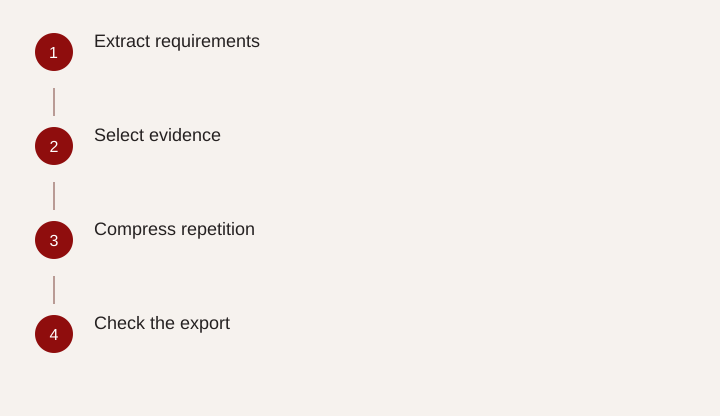
- Extract requirements
- Select evidence
- Compress repetition
- Check the export
Start with proof, not a smaller font
A useful two-page federal resume makes the required experience easy to find. Begin by deciding what the reviewer must be able to verify, then spend the available space on that evidence. Shrinking an old seven-page document without changing its priorities usually preserves the least useful material alongside the essential material.
The OPM agency guidance introduced the USAJOBS two-page limit with a transition ending September 27, 2025. Its instructions also address unsolicited longer resumes submitted through another document category. Read the announcement for the rules that apply to your application and any specifically requested supporting materials. A publication list, transcript or writing sample is useful when requested; it is not a general extension to the resume.
Save your long work history as a private source document. That file can retain every role, project, date and accomplishment. The submitted resume is a selection from that factual record, prepared for one vacancy or a closely related group of vacancies.
Build a qualification inventory
Copy the required qualifications into a working sheet, keeping each distinct requirement on its own row. Separate mandatory education, specialized experience and conditions of employment. Do not give a desirable skill the same space priority as a requirement that determines whether you qualify.
For each experience requirement, identify the role in which you performed the work, the dates, your weekly hours and a concrete example. A requirement that appears only in a skills list may be difficult to connect to a duration or level of responsibility. Put the supporting evidence where the reader can connect it to your actual employment.
The OPM applicant resume guidance asks applicants to align concise work descriptions with the announcement and demonstrate the required level of work. This changes the editing question. Instead of asking whether a sentence sounds impressive, ask whether removing it would leave a qualification unsupported. If two sentences prove the same fact, combine them.
Allocate space by relevance
There is no mandatory universal percentage for each section. A practical starting point is a short contact area, work entries occupying most of the document, and enough space for education, licenses or other required information. Adjust that allocation when the announcement makes education or a credential central to eligibility.
A hypothetical applicant has twelve years of experience across accounting, retail operations and grants administration. The vacancy emphasizes reviewing grant expenditures, documenting findings and resolving discrepancies. Recent grants work deserves the most detail. Earlier accounting work may supply a missing requirement, while unrelated retail duties can be reduced or omitted if the announcement permits.
Do not automatically delete older work. Sometimes the strongest evidence sits in a role from several years ago. Conversely, the most recent job does not deserve a large block simply because it comes first. Preserve chronology and accurate dates while giving detail to the work that makes the application understandable.
Use a keep, compress or remove worksheet
Work through the document once for substance before touching margins. This worksheet gives every block a reason to remain. The examples describe editing choices, not facts to paste into a personal resume.
| Content | Decision | Reason |
|---|---|---|
| Role proving required reconciliation work | Keep | Necessary qualification evidence |
| Repeated description of monthly reporting | Compress | One clear example can replace repetition |
| Unrelated software list from an old role | Remove if not required | No connection to the vacancy |
| Required license and expiration information | Keep | Supports a stated requirement |
| Generic objective about seeking opportunity | Replace or remove | Uses space without proving capability |
After the first pass, check whether every requirement still has support. A document can become shorter and weaker if the editing removes the only date range or example establishing qualifying experience. Keep a separate list of unresolved evidence gaps instead of disguising them with a broad summary.
Compress the writing without enlarging the claim
Start with duplicated introductions and process descriptions. Several bullets beginning with “Responsible for” can often become direct statements of the actual work. Combine closely related tasks when the resulting sentence remains easy to scan. Retain the actor, task and relevant outcome.
For example, a hypothetical draft says that the applicant received invoices, reviewed invoices, checked account codes and contacted staff about invoice discrepancies. A concise revision could explain that the applicant reviewed invoices for coding accuracy and resolved discrepancies with submitting offices. Add scale or a result only when the applicant can support it. An invented savings number creates a factual problem rather than a stronger resume.
Use familiar terms and spell out uncommon abbreviations. Avoid turning the document into a dense collection of keywords separated by commas. A reviewer should be able to understand how the work was performed, not merely recognize words copied from the vacancy.
Verify the file you will actually submit
Export the finished resume and reopen that exported file. Confirm the page count, visible text, line breaks and whether a role heading has been separated from its supporting evidence. A two-page document in an editor can change when printed, converted or uploaded.
Check the required work-entry fields against the announcement: employer, title, dates, hours and applicable federal series and grade. Verify education and credential details where relevant. Then perform a second review using only the qualification inventory. Every material claim should have a visible place in the document.
Ask another reader to locate the evidence for two or three requirements without your explanation. If they cannot, improve the wording or organization. Save a copy named for the announcement and retain the exact submitted version. That record will help with interview preparation and any later question about what the hiring agency received.
Related questions
Should I attach extra resume pages as another document?
Do not use another document category to bypass the limit. Follow any specific instructions for additional materials in the announcement.
Must I include every job I have held?
The resume should establish relevant qualifications and follow the announcement. Other application or background forms may request a fuller history.
Sources & further reading
Primary references
Community questions behind this guide
These discussions informed the question and language. Personal accounts are not verified facts or professional advice. Read our method.