
THE SHORT ANSWER
Ask what information is needed to establish the disability-related work barrier and accommodation need. A focused response is more useful than either sending your entire history or refusing every question.
What to keep in mind
- Relevant documentation may be requested when disability or need is not obvious.
- Ask which functional question an additional document must answer.
- Use a limited, accurate clinician briefing and the designated submission channel.
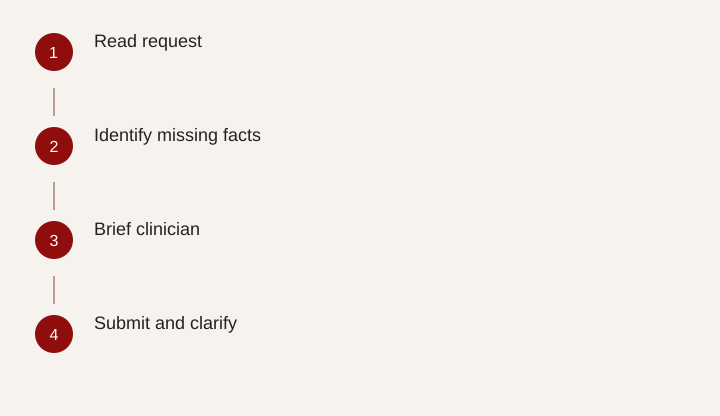
- Read request
- Identify missing facts
- Brief clinician
- Submit and clarify
Ask what the documentation is meant to establish
An employer's request for medical information can feel intrusive, especially when you believe you already explained the limitation. Before responding, identify what is being asked: evidence of a covered disability, the connection to a work barrier, the need for a particular adjustment or clarification of an earlier statement.
The EEOC accommodation guidance allows reasonable documentation when the disability or need is not obvious. It also limits the inquiry to relevant information rather than unrelated medical history. Both parts matter.
Do not assume that every question is improper, and do not assume the broadest possible request must be satisfied without clarification. Ask the contact to identify the information missing from the current record and the functional question it will answer. That makes the next step more precise for you, the employer and the health professional.
Distinguish a diagnosis from a work limitation
A diagnosis can explain the condition, but it may not show how the work is affected. A statement that you have a medical condition and should work from home, for example, may leave unanswered which duties or workplace conditions create the barrier and why the proposed adjustment would help.
Give the clinician an accurate description of the job, including the actual tasks, schedule, environment and current difficulty. Do not ask them to certify duties they have not seen or adopt a legal conclusion about what the employer must provide. Their useful contribution is relevant professional information about limitations and needs.
A hypothetical employee requesting written instructions might explain that rapid verbal directions are difficult to retain and that errors occur when multiple instructions are delivered at once. The supporting information can address that limitation and why written communication may help. It need not narrate every unrelated treatment decision.
Review the scope of the request
Look for requests that are specific enough to answer. “Please clarify whether the limitation affects standing for the required shift” is different from “Send all records from every provider.” If the request is broad, ask whether a focused statement or limited release would supply the necessary information.
EEOC guidance explains that complete medical records are generally inappropriate in this context because they are likely to contain unrelated material. It also describes situations in which the employer already has sufficient information or the disability and need are obvious. Refer to the actual circumstances rather than treating one rule as universal.
If a release is requested, read what information it covers, who receives it and what period it includes. Ask for clarification or appropriate advice if its scope is unclear. Do not sign a document you do not understand simply because the process has become frustrating.
Prepare a clinician briefing sheet
The briefing helps the professional answer relevant questions accurately. It should describe the work rather than tell them what conclusion to reach.
| Information | What to provide |
|---|---|
| Job activities | Essential tasks and typical conditions, using an accurate description. |
| Specific barrier | What is difficult, when it occurs and the effect on work. |
| Current arrangement | Existing adjustments and whether they are effective. |
| Requested option | The change being considered and why you think it may help. |
| Employer questions | The actual request for information, without paraphrasing away important details. |
| Submission method | Designated contact and secure channel, if known. |
If the employer's description of the job is inaccurate, identify the disagreement separately. Do not quietly alter an official form. Ask how the discrepancy should be addressed so the professional and reviewer understand which facts are disputed.
Respond to an insufficient-note explanation
Ask for the missing point in writing. A response such as “The documentation is not adequate” is difficult to act on unless the employer explains why. The next step may be clarification rather than a completely new set of records.
Thank you for reviewing the documentation. Please identify the specific information that remains insufficient and the work-related question it needs to answer. I would like to ask my health professional for a focused supplement. Please also confirm whether the information already provided is sufficient regarding the existence of the condition, and whether the remaining issue concerns functional limitations, duration or the proposed adjustment.
The JAN negotiation guide recommends clarifying requests and providing additional information where needed. Keep the exchange constructive without agreeing that unrelated records are necessary. A precise question often reduces repeated appointments and contradictory paperwork.
Keep the process and information handling clear
Ask where medical documentation should be sent and who is authorized to review it. Avoid attaching it to a broad workplace complaint email or copying people who do not need it. Keep a list of submission dates and the documents provided so you can answer later requests accurately.
If the employer appears to be asking again for information already supplied, identify the earlier document and ask what new question remains. If a condition or limitation has changed, explain that there is updated information rather than assuming the old record answers everything.
Do not abandon the process solely because the first exchange went badly. Clarify the scope, provide relevant support and record unresolved disagreements. If the request remains unusually broad or the process becomes difficult to navigate, seek individualized assistance. The aim is an informed accommodation decision using necessary information, with your unrelated medical history kept out of the discussion.
Related questions
Can HR always demand my complete medical chart?
EEOC guidance says that in most accommodation situations complete medical records are inappropriate because they contain unrelated information. Ask the employer to identify the relevant information it needs.
What if my first doctor's note was not enough?
Ask what is insufficient and give the clinician the specific work-related questions. A focused supplement may resolve the issue more effectively than repeatedly sending the same general note.
Sources & further reading
Primary references
- Enforcement Guidance on Reasonable Accommodation and Undue Hardship under the ADA
- Requesting and Negotiating a Reasonable Accommodation
Community questions behind this guide
These discussions informed the question and language. Personal accounts are not verified facts or professional advice. Read our method.