THE SHORT ANSWER
Build a timeline for the specific announcement. Student eligibility, an expected degree and a completed credential may be evaluated at different points.
What to keep in mind
- Student and Recent Graduates routes differ.
- Read when each qualification must be established.
- Arrange education records before short application windows open.
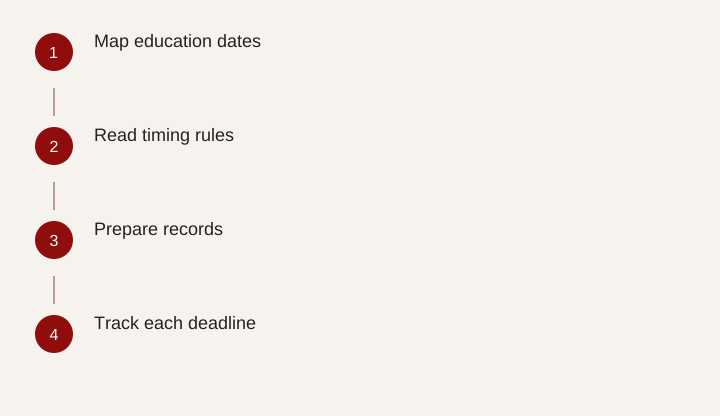
- Map education dates
- Read timing rules
- Prepare records
- Track each deadline
Search early, but apply under the actual timing rule
You can research federal jobs before graduation, prepare your resume and learn which hiring paths fit your situation. Whether you may submit a particular application before completing a degree depends on that announcement's timing requirements. Do not assume every early-career posting accepts future graduates.
The USAJOBS early-careers guidance distinguishes student and recent-graduate opportunities. The OPM program guidance supplies the broader framework. A current enrollment route and a completed-education route are different, even when both appear in a general search for entry-level work.
Start by identifying what must be true at application, closing, selection or appointment. If the announcement provides an explicit allowance for expected completion, record the terms. If it requires a completed qualification by a stated date, compare that date with your actual record. A plan based on those facts is more reliable than a general recommendation to apply several months before graduating.
Put four education dates on one timeline
Record your last planned coursework date, the institution's degree-conferral date, the ceremony date and the expected availability of a transcript showing completion. These dates may differ. Also record enrollment status if you are considering a student appointment.
Ask the institution when the relevant record will be available and what it will show. An unofficial transcript may list courses and grades before it lists the degree. A completion letter may or may not satisfy a particular announcement, so do not assume one document substitutes for another without checking.
A fictional student finishes coursework in May, attends a June ceremony and receives an updated transcript later in June. A vacancy closing in April raises a different question from one closing in July. The timeline makes the uncertainty visible. It does not establish eligibility by itself; it helps you ask the agency the precise question that determines whether the application is appropriate.
Separate student and graduate searches
Maintain distinct searches for student opportunities, Recent Graduates positions and other jobs open to hiring paths you meet. That separation reduces confusion when results use similar titles but different eligibility rules.
For student postings, review the enrollment and program conditions stated in the vacancy. For graduate postings, check the qualifying credential, completion window and position requirements. For an ordinary public announcement, determine whether completed education, experience or another stated route supports the grade.
Do not assume a position advertised as a trainee has no minimum qualifications. Training describes development after appointment; it does not erase the conditions for entering the role. Likewise, do not assume that every job visible through a student search is part of the same appointment program. Save the announcement and identify the actual authority or program described before selecting eligibility answers in the application.
Use an application calendar with evidence deadlines
A useful calendar tracks more than the closing date. Include the dates on which you can prove the facts the application requires.
| Milestone | Date to record | Action |
|---|---|---|
| Vacancy closes | Exact date and time zone | Finish agency submission before the deadline |
| Qualification must be met | As stated in the announcement | Compare with completion or experience record |
| Transcript becomes available | Institution-confirmed estimate | Request and inspect the file |
| Assessment due | Invitation-specific deadline | Reserve uninterrupted time |
| Enrollment or completion changes | Actual effective date | Update records and answer questions accurately |
Add a status column for confirmed, expected or unresolved. That distinction prevents an expected graduation date from silently becoming a completed qualification in your notes. A calendar is most useful when it identifies the next controllable action, such as requesting a record or contacting an agency, rather than merely counting down to a deadline.
Prepare a clear question when the dates do not align
If the announcement's timing is unclear, quote the relevant sentence and describe the education fact concisely. For example: “My coursework is expected to finish on this date, and the institution expects to confer the degree on this later date. Which completion evidence is required by the closing date for this announcement?”
Use the listed agency contact and allow time for a response. Do not assume that asking a question extends the deadline or permits documents to arrive afterward. If the agency provides a specific instruction, retain it with the application record.
The USAJOBS education guidance explains how education information is supplied, including expected completion where relevant. Accurate labeling matters. Do not mark a degree completed because you are confident you will finish it, and do not hide completed coursework merely because the degree is unfinished. Present the actual status and follow the vacancy's permitted route.
Build readiness without relying on a single opening
Prepare a factual resume, inspect transcripts already available and identify examples for interviews. These tasks remain useful even if a particular vacancy closes before you qualify. Keep documents organized so a short announcement window does not become a document-retrieval emergency.
Review searches on a manageable schedule. Record promising job families and common requirements, then refine the resume around your actual education and experience. Avoid planning your entire transition around one application or an assumed offer date.
After graduation, update the source records and verify that the new transcript shows the fact you need to prove. Revisit which hiring paths now apply. Remove obsolete expected dates from documents intended to describe completed education. The result is a transition plan that follows the actual change in your status, while leaving room for agencies' different application schedules and qualification requirements.
Related questions
Can I apply before my graduation ceremony?
The ceremony is not necessarily the relevant date. Check the announcement's qualification timing and the education records that establish completion or enrollment.
Should I wait until every transcript is final before searching?
No. Search early to learn requirements and identify openings, then apply only when you can meet the particular announcement's conditions.
Sources & further reading
Primary references
- OPM: Students and Recent Graduates
- USAJOBS: Find your future in federal service
- USAJOBS: How to supply education
Community questions behind this guide
These discussions informed the question and language. Personal accounts are not verified facts or professional advice. Read our method.