
THE SHORT ANSWER
Recent Graduates eligibility is only the first check. Match the completion date and credential to the program, then verify the qualifications and documents for the position.
What to keep in mind
- A qualifying graduate credential can include more than a bachelor's degree.
- The program window and job qualifications are separate.
- Developmental employment does not guarantee conversion.
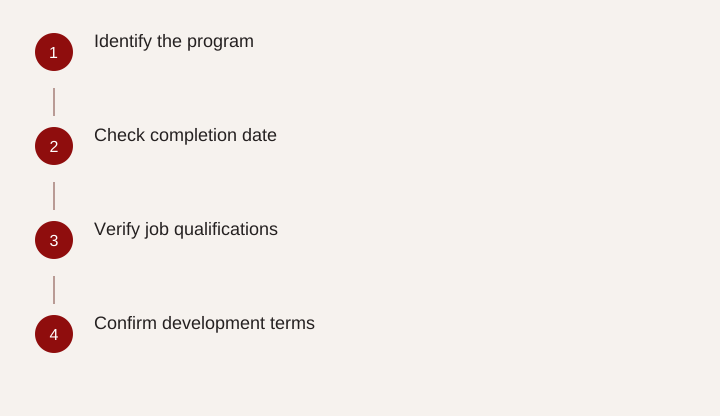
- Identify the program
- Check completion date
- Verify job qualifications
- Confirm development terms
Identify the program named in the vacancy
A posting aimed at early-career applicants is not enough to establish which program rules apply. Read the announcement to determine whether it is a Pathways Internship, a Recent Graduates position or another hiring opportunity. These labels answer different questions about enrollment, completion and appointment.
The OPM Students and Recent Graduates guidance describes the Recent Graduates program as a developmental route for people who completed qualifying education within the applicable window. It is not restricted to people applying immediately after a bachelor's degree. Other qualifying degree and certificate categories may apply.
Save the exact program name and appointment information in your notes. A search result can be abbreviated, and an informal discussion may use “Pathways” loosely. The announcement should guide the application. If its title and detailed language appear inconsistent, identify the inconsistency when contacting the agency rather than assuming the more favorable label controls.
Check the completion window using actual dates
OPM generally describes a two-year window after completion of qualifying education for Recent Graduates eligibility. Certain veterans prevented from applying because of military service obligations may have a longer period, up to six years after completion. Read the applicable conditions instead of assuming every veteran automatically receives the same extension.
Use the completion fact the announcement requests. Attendance, a graduation ceremony, an expected completion date and the date a degree is conferred may not be interchangeable. Your transcript and institutional records should support the date you rely on.
Create a small timeline showing completion, the announcement's closing date and any other relevant deadline. If the dates are close to a boundary, ask the agency a precise question early. Do not wait until the final evening to discover that a transcript lacks the necessary information. The point of the timeline is to establish a documented route, not to calculate eligibility from an approximate memory of graduation season.
Check the position's qualifications separately
Program eligibility does not waive the education, experience or licensing requirements of the actual job. A recent business graduate may fit the program window while a particular professional position requires a different field. Training after appointment does not automatically remove that requirement.
Use the eligibility-versus-qualifications distinction as a reading aid. First confirm that the hiring path applies; then inspect the grade-specific requirements. When an announcement offers alternatives, identify which one your application supports.
A fictional applicant with a recent master's degree in public administration finds two Recent Graduates vacancies. One accepts a relevant graduate education route for administrative work. Another requires specified scientific coursework. The same degree may support the first application and leave a basic requirement unmet in the second. That is not a contradiction in the program. It reflects the separate qualifications of the occupations being filled.
Complete a dated eligibility worksheet
Keep the following facts together before drafting. Use the vacancy's wording rather than replacing it with a summary that omits conditions.
| Field | Your entry | Supporting record |
|---|---|---|
| Program and announcement | Name and announcement number | Saved vacancy |
| Credential | Degree or certificate type and field | Transcript or required evidence |
| Completion date | Exact documented date | Institutional record |
| Applicable window | General route or supported exception | Program and agency instructions |
| Position qualifications | Route claimed at selected grade | Resume and education evidence |
| Outstanding issue | Specific question needing an answer | Agency response |
A completed worksheet should make it possible to explain your eligibility in a few sentences. It also highlights missing documents before you start the application. Keep the sheet private unless the agency requests it; submit the actual required records through the authorized process.
Evaluate development and conversion terms
Read what the appointment offers beyond initial eligibility. OPM describes training, mentorship and an individual development plan within the Recent Graduates framework. Ask the hiring team how these elements are implemented for the specific role.
Conversion is a separate consideration. Check the appointment duration, requirements for successful completion, performance expectations and potential destination position. Do not treat a higher grade shown in a discussion thread as a promised outcome for your own appointment.
Useful questions include who supervises development, how progress is reviewed, what work the employee should be able to perform by completion and what conditions affect conversion. Request clarification of the terms in the announcement or participant agreement. These questions help compare opportunities without pretending that every program office delivers an identical experience or that successful participation alone guarantees permanent employment at a particular grade.
Keep the application and search current
Use current official instructions when preparing the package. Older discussions may contain useful questions but outdated program recommendations. For example, do not assume a historical recommendation to apply to Presidential Management Fellows describes an available intake today.
The USAJOBS early-careers guidance encourages searching by the relevant hiring path and reading required documents and evaluation methods. Keep several appropriate searches rather than depending on one agency or one rumored hiring cycle. Record closing dates and transcript readiness.
After submission, preserve the announcement, worksheet and exact documents sent. If you receive an eligibility notice that seems wrong, compare it with the documented dates and route before requesting clarification. If the program window is not available to you, explore other announcements open to hiring paths you meet. Recent Graduates is a route into federal work, not the only route, and your qualification research remains useful across other suitable opportunities.
Related questions
Can an MBA qualify for Recent Graduates eligibility?
Graduate credentials can fall within the program's qualifying education categories. You must still satisfy the completion window and the specific position's requirements.
Does completing the program guarantee a permanent job?
No. OPM describes conversion as conditional on program completion, performance, position qualifications and applicable requirements.
Sources & further reading
Primary references
- OPM: Students and Recent Graduates
- USAJOBS: Find your future in federal service
- USAJOBS: Eligibility versus qualifications
Community questions behind this guide
These discussions informed the question and language. Personal accounts are not verified facts or professional advice. Read our method.