
THE SHORT ANSWER
The position determines the required investigation and trust decisions. Read the announcement and offer together, use authorized contacts and avoid treating every background check as a security clearance.
What to keep in mind
- Not every federal position requires a security clearance.
- Risk, sensitivity, credentialing and clearance terms describe different requirements.
- Submit accurate information through the agency's approved process and ask about unclear instructions.
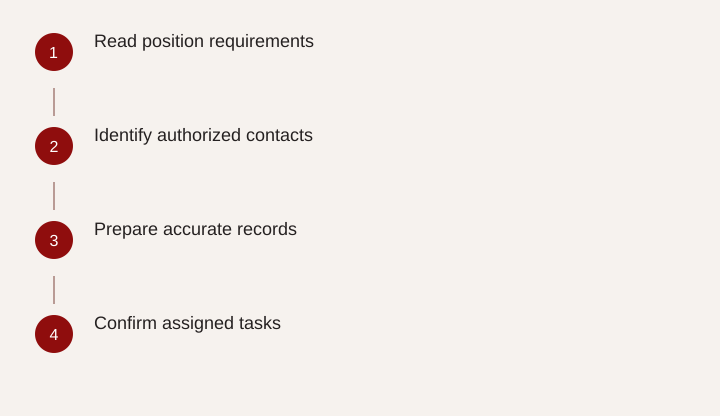
- Read position requirements
- Identify authorized contacts
- Prepare accurate records
- Confirm assigned tasks
Start with the position, not the phrase background check
Applicants often use “background check” and “security clearance” as though they describe the same requirement. They do not. OPM explains that not every federal employee has a security clearance. The required determinations depend on the position. They can concern access credentials, suitability or fitness, national-security responsibilities and, where needed, classified-information access.
This distinction matters when reading an announcement. A position can require an investigation even when a security-clearance field does not identify a clearance level. Do not conclude that no screening will occur because the job does not involve classified work. At the same time, do not describe yourself as holding a clearance merely because you previously passed an employment background check. Use the actual terminology in your agency records and ask an authorized contact when the terms are unclear.
Read risk and sensitivity as position designations
An announcement may contain fields for security clearance, position sensitivity and risk, or trust determination. Read them together with the conditions of employment. OPM's position-designation guidance explains that agencies assess the duties and responsibilities of a position to establish the relevant risk and sensitivity and corresponding investigation level.
These designations are determined by the agency; applicants do not choose a lower level to simplify the process. If the announcement and offer appear inconsistent, ask HR or the security office to clarify which requirements apply to the offered position. Avoid attempting to resolve the discrepancy through a comparison with a different job title. Similar titles can involve different access, systems or responsibilities. Your useful question is what the agency requires for this specific appointment and which actions you need to complete.
Create a requirements-and-contacts worksheet
Keep a small administrative worksheet separate from the sensitive information requested for the investigation. It should record instructions and contacts, not become an unsecured copy of your personal history.
| Item to confirm | Where to look | Question if unclear |
|---|---|---|
| Position requirements | Announcement and written offer | Which designations apply to this appointment? |
| Assigned form or system | Authorized agency invitation | Which instructions and deadline should I follow? |
| Identity or fingerprint task | Agency onboarding message | Where and how is completion confirmed? |
| Correction process | Security-office instructions | How should an inaccurate entry be corrected? |
| Status contact | Named HR or security representative | Is any action outstanding from me? |
Verify unexpected requests through a known agency contact, particularly when they seek sensitive personal information. Do not send a complete investigative questionnaire to a general hiring inbox merely because that address handled the interview. Different offices and systems may have different responsibilities.
Prepare accurate history without guessing at the form
Follow the instructions for the form and system assigned to you. OPM's federal investigation forms page lists different questionnaires for non-sensitive, public-trust and national-security positions. That listing does not mean you should choose a form yourself or send an unsolicited completed version. Wait for the agency's instructions.
Gather records needed to answer the actual questions accurately, such as dates and contact information where requested. Use the form's own time periods and definitions. If you cannot recall a detail, seek records and ask how to handle uncertainty rather than silently inventing a precise date. If you discover an error after submission, contact the responsible office about the correction process. Consistency matters, but correcting an honest mistake is different from repeating it to make every document appear identical. Keep sensitive materials only in an appropriately protected location.
Avoid self-adjudicating your history
A forum cannot reliably determine whether your particular history will result in a favorable trust decision. The agency considers the applicable standards and the information developed through its process. A short online description can omit context, and a stranger's successful outcome does not establish how another case will be handled.
Answer the questions truthfully and within their requested scope. If the agency asks for clarification, provide accurate information through the authorized channel. Do not conceal facts because a commenter says they are harmless, and do not add unrelated sensitive details to routine status emails. This article does not assess any individual's suitability or clearance eligibility. Its practical purpose is to help you understand the process, identify the correct contact and avoid administrative errors that are within your control while the responsible officials perform their review.
Plan around confirmed milestones
Keep “information submitted,” “task completed,” “review pending” and “authorized start” as separate milestones. An appointment-related investigation or determination may involve steps that are not visible to you. Ask whether your submission is complete and whether additional action is required; do not assume silence means either approval or a problem.
A hypothetical status message is: “For the offered position under ABC-123, I completed the assigned questionnaire on October 10 and the requested appointment on October 12. Please let me know whether anything else is needed from me and which contact should handle future status questions.” Avoid including the underlying sensitive answers. Coordinate employment and relocation decisions with HR's confirmed offer and reporting instructions. The offer dependency tracker can help keep those decisions connected to actual milestones instead of another applicant's timeline.
Related questions
Does every federal employee need a security clearance?
No. OPM explains that required trust determinations depend on the position. Credentialing, suitability or fitness, and national-security determinations are distinct considerations.
Can another applicant's background-check timeline predict mine?
No. Requirements and circumstances differ. Ask your agency which tasks remain and whether anything is needed from you.
Sources & further reading
Primary references
- USAJOBS: How does the application process work?
- USAJOBS: How long does federal hiring take?
- USAJOBS: Understanding the announcement overview
- OPM: Does every federal employee have a security clearance?
- OPM Position Designation Tool and System
- OPM Federal Investigation Forms
Community questions behind this guide
These discussions informed the question and language. Personal accounts are not verified facts or professional advice. Read our method.