
THE SHORT ANSWER
A current-supervisor request can create a confidentiality concern. Ask what the agency needs, explain your situation factually and coordinate references without assuming the request guarantees an offer.
What to keep in mind
- Clarify whether the request concerns a reference, employment verification or another process.
- Ask about timing and acceptable alternatives before assuming confidentiality.
- Give references accurate context and never script false answers.
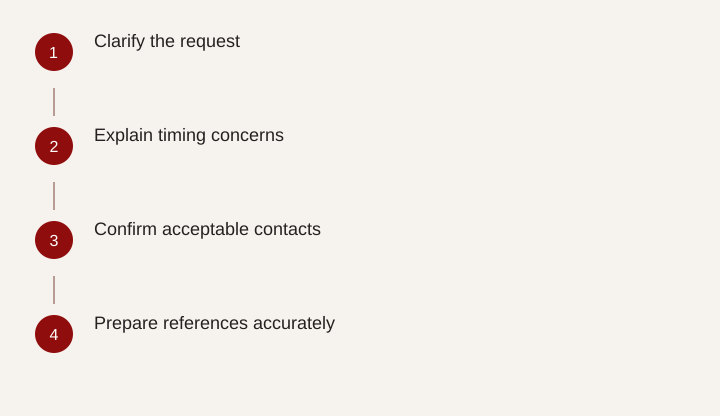
- Clarify the request
- Explain timing concerns
- Confirm acceptable contacts
- Prepare references accurately
Clarify what the agency is requesting
A message asking for your current supervisor's contact information can feel more consequential than an ordinary reference request. Before deciding how to respond, identify the purpose. The hiring team may be seeking a job-related reference, verifying employment or directing you to a separate onboarding or investigative process. Those requests can involve different contacts and instructions.
OPM's reference-checking guidance describes references as a way to gather information about an applicant's past performance and suitability for the work. It does not make a reference request equivalent to an offer. Read the message for the requested number of contacts, relationships, deadline and timing. If it says current supervisor, do not silently substitute a friend or colleague. Ask whether an alternative is acceptable and wait for the agency's instructions on that point.
Explain a confidentiality concern factually
You may reasonably prefer that a current employer learn about your search only when there is a concrete reason. Explain that concern without accusing the agency of mishandling your information or assuming that every request is negotiable. A narrow question is easier to answer: can contact occur later, or can a former supervisor be used at this stage?
A hypothetical message might say: “My current supervisor is not yet aware of my job search. I can provide a former supervisor who directly observed my relevant work. Would that contact be acceptable for this stage, or is a current-supervisor reference required now? Please also confirm when you expect to make contact.” Replace the details with your actual situation. The agency may have requirements that limit flexibility. Its answer should guide your next action; a request for discretion is not itself a guarantee of confidentiality.
Use a reference coordination worksheet
Keep the information accurate and proportionate to the request. Do not send personal details that the agency has not asked for.
| Reference field | What to confirm | Why it matters |
|---|---|---|
| Relationship | Current supervisor, former supervisor or other accepted role | Shows what the person actually observed |
| Work period | Dates when the reference knew your work | Prevents confusion about different positions |
| Contact details | Current, permitted phone and email | Reduces missed outreach |
| Availability | Known absence or preferred contact window | Helps the agency plan |
| Relevant context | Position and competencies under consideration | Allows an informed, truthful response |
| Agency acceptance | Whether the proposed reference meets the request | Avoids an unauthorized substitution |
Where appropriate, ask the person whether they are willing to serve as a reference before listing them. If an official process requires a particular contact regardless of your preference, follow the agency's instructions and clarify any concern through the designated office.
Prepare the reference without coaching dishonesty
Give an agreed reference the announcement or a concise description of the role and remind them of the work they directly observed. You can share your accurate resume and mention projects that relate to the vacancy. This helps the person recall relevant details without asking them to make claims beyond their knowledge.
Do not provide a script that exaggerates your responsibilities, ask the person to pose as a supervisor or conceal the nature of your working relationship. If your title or team changed during the period, explain it so the reference can answer consistently. A reference who can describe a specific contribution is often more useful than a prestigious contact who barely knows your work. The agency decides how to evaluate the information; your role is to provide legitimate contacts and accurate context, not to manufacture a uniformly perfect account.
Keep reference checks separate from other conditions
A favorable reference conversation does not establish that every qualification, security or appointment requirement is complete. The USAJOBS application-process guidance describes several stages between application and appointment. A hiring team can request references while other matters remain unresolved.
Similarly, information needed for an investigation may be requested through a separate authorized process. Do not assume that an informal agreement with an interview coordinator governs every later contact. If confidentiality timing is especially important, ask the office responsible for the particular request what it can and cannot accommodate. Keep sensitive personal explanations out of broad email threads. Provide enough information to state the concern, then use the appropriate channel for any detailed follow-up. Precise communication protects both your understanding and the accuracy of the agency's record.
Respond to delays or unavailable supervisors
If a requested supervisor has retired, moved, become unreachable or cannot provide references under an employer's policy, tell the agency promptly. State the practical problem and propose a legitimate alternative with its relationship clearly identified. Do not wait until the deadline passes while repeatedly calling a number you know is disconnected.
Keep a record of what you sent and any accepted substitution. If the agency asks for additional contacts, confirm their details before forwarding them. After references are complete, return to the actual hiring status rather than treating the outreach as a hidden offer signal. Continue your search and make employment decisions based on confirmed communications. A well-managed reference stage gives the agency useful evidence while making your timing concerns explicit, without promising control over contacts or decisions that belong to the hiring process.
Related questions
Does a current-supervisor reference request mean I got the federal job?
No. It indicates that the agency wants additional information. Treat only the actual offer and its conditions as an offer.
Can I insist that the agency never contact my current supervisor?
You can explain the concern and ask about timing or alternatives, but the agency determines its requirements. Do not assume a confidentiality promise that has not been made.
Sources & further reading
Primary references
Community questions behind this guide
These discussions informed the question and language. Personal accounts are not verified facts or professional advice. Read our method.