
THE SHORT ANSWER
Use your limited question time to learn how the job works and what success requires. Separate operational answers from terms that need HR confirmation.
What to keep in mind
- Prioritize questions that could change your decision about the role.
- Ask for concrete examples of workload, supervision and early expectations.
- Confirm formal pay, appointment and worksite terms through the appropriate office.
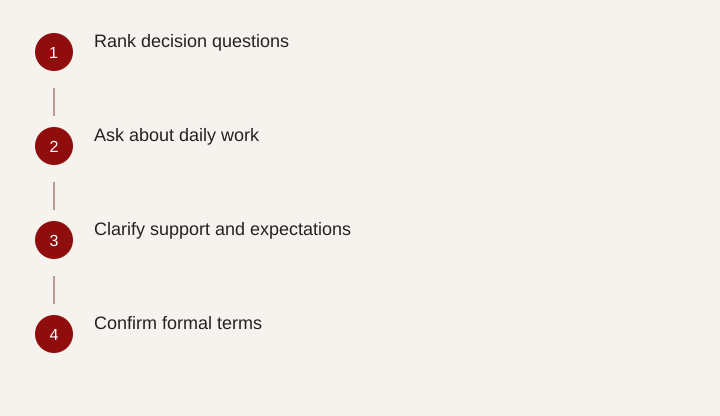
- Rank decision questions
- Ask about daily work
- Clarify support and expectations
- Confirm formal terms
Use your questions to evaluate the actual job
The opportunity to ask questions is more useful when you treat it as a chance to understand the work. A question designed only to sound impressive may produce little information. Begin with the decisions you need to make: whether the duties fit your skills, what support exists, how the workload is organized and whether the worksite arrangement is workable.
OPM's structured-interview guidance describes the interview as an assessment of job-related competencies. Your question period may therefore be brief or tightly managed. Prepare a prioritized list and adapt to the time offered. If the panel has already answered a question, do not ask it again from a script. Ask the most consequential unresolved question first. A thoughtful follow-up to an actual answer is often more informative than a long sequence of generic questions.
Ask what successful work looks like
A useful opening question is, “What would you want the person in this role to accomplish during the first several months?” It invites concrete priorities without requiring the panel to promise a particular assignment. Follow up by asking how progress is reviewed and which tasks usually take a new employee the longest to learn.
Listen for the relationship between the advertised duties and the examples given. A role described broadly as program analysis might emphasize recurring reporting, stakeholder coordination or a particular technical task. None is inherently better; the issue is fit. Ask what proportion of attention the major responsibilities typically receive, while recognizing that workload can change. If the position has developmental levels, ask how duties and independence differ as the employee progresses. That question is more precise than asking whether there is room to grow.
Choose questions from a decision menu
Use this menu to prepare, then select only the questions relevant to your situation and the remaining interview time.
| Decision area | Question | What to listen for |
|---|---|---|
| Early priorities | Which problems will the new employee address first? | Specific work and realistic sequencing |
| Workload | How are urgent requests balanced with recurring duties? | Prioritization and escalation practices |
| Supervision | How does the supervisor review work during onboarding? | Feedback and decision boundaries |
| Training | What learning or mentoring is available for this role? | Concrete support rather than a general promise |
| Collaboration | Which offices does this position work with most often? | Dependencies and communication demands |
| Worksite | What attendance, travel or schedule expectations apply? | Requirements that need written confirmation |
Write your top three questions in order of importance. Keep one spare in case the discussion answers them early. The menu should support your judgment, not encourage an interrogation. Leave room for the panel to clarify what it considers important.
Ask about difficult conditions without making assumptions
You can investigate workload or turnover concerns in neutral language. “How is work redistributed when someone is absent?” is more answerable than “Is this office understaffed?” “What makes someone successful here?” can be followed by “What tends to be challenging for a new employee?” The second question helps turn a broad answer into practical information.
Avoid implying that you know the office's internal problems from an anonymous discussion. Reddit can suggest questions worth asking, but it is not proof of conditions in the vacancy you are considering. Compare the panel's answer with the announcement and any later offer instructions. If an answer is vague, request an example rather than arguing with it. Record important uncertainties after the interview. An unanswered question is a reason to seek clarification, not evidence that the worst interpretation is true.
Route formal terms to the right contact
The USAJOBS announcement overview guidance identifies fields such as pay, appointment type, work schedule, promotion potential and location. Review those before the interview so you can ask about genuine ambiguity. The hiring manager can explain operational expectations, while HR may need to confirm the appointment's formal terms and applicable rules.
For example, a manager's description of flexible work does not by itself establish an approved remote arrangement or a permanent schedule. Ask which terms will appear in the offer and who can verify them. Similarly, a broad salary range does not state your individual grade, step or rate. If pay is central to your decision, ask the HR contact about the offered terms and any applicable process. Keep these questions direct and professional. Clarification is part of evaluating the position, not an expression of disinterest in the mission.
Turn answers into a short decision record
After the interview, divide your notes into confirmed information, descriptions that may change and unanswered questions. Record who supplied each important answer. This prevents a general comment about future possibilities from becoming a personal assumption about guaranteed promotion, training or work location.
If an offer follows, compare its terms with your notes and request clarification of material differences. You can use the offer comparison worksheet to organize the decision. Do not expect every uncertainty to disappear, but identify which ones you can tolerate and which require an answer before acceptance. Your interview questions have done their job when they help you understand the daily work, the support available and the commitments you would be making. A small set of concrete answers is more valuable than a long list of questions asked only because a template recommended them.
Related questions
How many questions should I ask at a federal interview?
Prepare a short prioritized list and use the time offered by the panel. Ask the most consequential unanswered question first rather than trying to complete a fixed number.
Should I ask the panel to negotiate my pay?
The panel can explain the work, but formal pay-setting questions generally need the HR contact handling the offer. Ask who can confirm the applicable terms.
Sources & further reading
Primary references
Community questions behind this guide
These discussions informed the question and language. Personal accounts are not verified facts or professional advice. Read our method.