
THE SHORT ANSWER
Compare what each offer guarantees at entry before valuing future advancement. A ladder's promotion potential is meaningful, but timing and approval remain subject to applicable requirements.
What to keep in mind
- Compare the actual starting grade, step and pay schedule.
- Separate grade promotion from within-grade step increases.
- Treat future advancement as conditional when checking affordability.
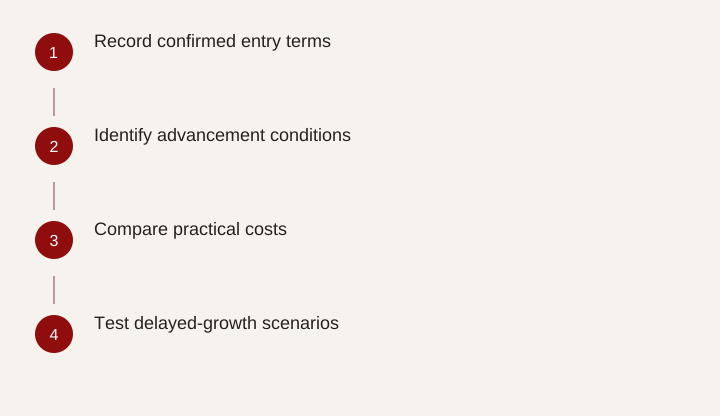
- Record confirmed entry terms
- Identify advancement conditions
- Compare practical costs
- Test delayed-growth scenarios
Compare the entry offers before the future possibilities
A lower starting grade with a higher promotion potential can look more attractive than a fixed-grade offer, especially when online discussions describe rapid progression. Begin with the terms each agency is actually offering today: pay system, grade, step or rate, duty station, appointment type and work schedule. These determine the immediate decision.
OPM's General Schedule overview distinguishes grades from steps and explains that promotion depends on regulations, qualification standards and agency policies. The announcement's highest potential grade is not the same as the grade at which you are being hired. Ask HR to confirm the starting terms in writing. If the salary range covers several grades, locations or steps, do not use its highest number as your expected income. Build the comparison from the individual offer, then examine the possible progression separately.
Understand what the ladder adds
A career ladder can provide a path within the position toward an advertised full-performance level. Its value depends on the work you will learn, the requirements for advancement and the agency's process for reviewing readiness. Ask what changes in duties and independence between levels and how the supervisor evaluates progress.
Avoid converting a general expectation into an unconditional schedule. Ask about qualifications, performance, training and any other applicable requirements. If the agency describes a typical progression, record it as a description of practice rather than a promise for your appointment. A fixed-grade position can still provide valuable experience or lead to later competitive opportunities, but those possibilities should also be labeled as uncertain. Comparing two optimistic stories is less useful than comparing confirmed entry terms plus clearly described routes for future development.
Keep step increases, promotions and conversion separate
A step increase changes pay within a grade. A promotion changes the grade. OPM's GS overview treats these as different processes with different requirements. Do not describe an offer's step progression as though it were a ladder to a higher-grade position, or assume that a grade promotion simply adds a chosen number of dollars to your current salary.
Appointment conversion is another separate issue. If one offer is through a developmental program, ask about the appointment's term and conversion conditions. OPM's students and recent graduates guidance describes program-specific requirements; participation should not be treated as an unconditional permanent-job guarantee. Not every career ladder is a Pathways appointment, and not every developmental appointment has the same terms. The written offer and the applicable program rules need to be read together before comparing long-term prospects.
Use a confirmed-versus-conditional comparison
Build a two-offer worksheet that makes uncertainty visible. A blank or unconfirmed field should remain marked unknown until you receive an answer.
| Decision field | Offer A | Offer B | Evidence or condition |
|---|---|---|---|
| Starting grade, step and rate | Enter confirmed terms | Enter confirmed terms | Written offer and applicable schedule |
| Full-performance grade | Advertised potential | Advertised potential or none | Announcement and HR clarification |
| Progression requirements | List stated conditions | List stated conditions | Agency process, not forum timing |
| Appointment duration | Permanent, term or other stated type | Stated type | Offer and conversion provisions |
| Worksite and travel | Confirmed expectations | Confirmed expectations | Operational and formal instructions |
| Learning and supervision | Specific support described | Specific support described | Interview notes and follow-up |
Then add your own non-negotiable constraints, such as a maximum commute or a minimum affordable take-home amount. Do not assign a precise financial value to an unconfirmed benefit or promotion simply to make the comparison look complete.
Test a delayed-advancement scenario
A useful affordability test asks whether you could accept the starting terms if advancement took longer than you hope. Use your actual household expenses and the pay information the agency confirms. Consider commuting, relocation, childcare and other changes caused by the position. This is a personal planning exercise, not a prediction about the agency.
Create at least two scenarios: confirmed entry terms continuing for a longer period, and the progression the agency describes if its conditions are met. Keep future pay-table changes out of the calculation unless you clearly label them as assumptions. If the offer is workable only under immediate promotion, that is an important decision constraint. Ask the agency to clarify the progression process before accepting, and recognize that clarification may still leave uncertainty. The purpose is to see how much uncertainty your budget can absorb.
Evaluate the work that creates future options
Look beyond the grade labels to the experience each role will build. Which position provides relevant assignments, useful supervision and skills you want to develop? Which duties would you be willing to perform at the entry rate? A higher potential grade has limited personal value if the work or location is unsuitable for you.
Use the interview question menu to resolve operational gaps, then route formal appointment and pay questions to HR. Document the reasons for your choice in a few sentences: confirmed compensation, manageable constraints, valuable work and acceptable uncertainty. Avoid justifying the decision solely with a projected grade several years away. A sound comparison acknowledges both the opportunity in a ladder and the value of a fixed-grade offer whose present terms fit your needs.
Related questions
Is a career-ladder promotion guaranteed after one year?
Do not assume that. Grade advancement depends on applicable regulations, qualification requirements and agency policies. Ask about the position's specific progression requirements.
Does no promotion potential mean my pay can never change?
No. Grade promotion and within-grade step increases are different processes, and pay schedules may change. It does mean you should not assume that the position includes a ladder to a higher grade.
Sources & further reading
Primary references
- OPM General Schedule overview
- OPM: Students and Recent Graduates
- USAJOBS: Understanding the announcement overview
Community questions behind this guide
These discussions informed the question and language. Personal accounts are not verified facts or professional advice. Read our method.