
THE SHORT ANSWER
A master's degree can support an application only through the route the announcement permits. Read basic requirements, substitution rules and grade-specific conditions separately.
What to keep in mind
- Read mandatory education before substitution options.
- Check the degree field and grade-specific language.
- Use transcripts to prove the route you claim.
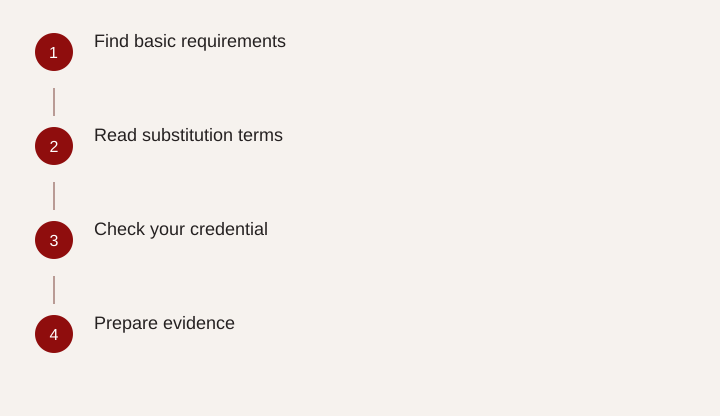
- Find basic requirements
- Read substitution terms
- Check your credential
- Prepare evidence
Read the permitted route, not just the degree name
A master's degree does not create a universal entitlement to a federal grade. It can be relevant when the qualification standard and announcement permit education in place of experience, require that education directly, or allow a stated combination. Start by finding the exact route you intend to use.
The USAJOBS degree guidance explains that education requirements vary by occupation. Some positions require particular fields or coursework, while others allow broader educational backgrounds or experience. The OPM qualification policies provide context for applying those standards.
A phrase such as “master's or equivalent graduate degree” must be read with the surrounding language. The announcement may connect the education to the work of the position or list a separate basic requirement. Do not stop reading at the first sentence that appears favorable. Save the complete qualification section so you can compare the alternatives accurately and identify what evidence each requires.
Separate basic requirements from additional qualifications
A basic requirement may concern a license, professional degree, academic credits or another occupation-specific condition. Additional qualifications may then determine the grade. Meeting the second part does not automatically compensate for failing the first.
Imagine a fictional vacancy requiring specified coursework and, for one grade, allowing graduate education in place of a year of specialized experience. An applicant with an unrelated graduate degree should not assume the advanced credential satisfies the coursework requirement. The questions need separate answers.
Create headings in your notes for basic requirement, grade requirement and permitted substitution. Under each, record the relevant sentence and the evidence you possess. This simple separation is particularly valuable when a long announcement includes several grades, multiple routes and agency-specific explanations. If the text seems contradictory, a focused inquiry to the agency can identify the issue more effectively than a general statement that you have a higher degree than the job appears to require.
Check degree field, credits and completion date
A credential's title may not tell the whole story. The agency may need to evaluate the field, coursework, level of study or completion date. Gather the records that establish the particular fact you are claiming rather than assuming a diploma alone answers every question.
The USAJOBS education guidance explains that transcripts may be requested when education is used to qualify. Read the announcement to determine what is needed at application and what may be required later. If you are still enrolled, distinguish completed coursework from the expected degree.
Do not translate semester credits, quarter credits or foreign education into an equivalence by intuition. Follow the applicable instructions and obtain clarification where necessary. A strong application presents verifiable educational facts in the requested form. It does not ask the reviewer to infer a conferral date from attendance dates or to decide what an unexplained list of courses was intended to prove.
Use an education-route worksheet
The following worksheet keeps the application logic visible. It is especially useful when deciding between experience, education and a permitted combination.
| Item | What to record | Evidence |
|---|---|---|
| Basic requirement | Exact credential or coursework language | Transcript, license or other requested record |
| Grade sought | The qualification route for that grade | Relevant paragraph from the vacancy |
| Education substitution | Whether allowed and any field restriction | Degree and course details |
| Timing condition | When the qualification must be met | Conferral date or permitted completion evidence |
| Combination route | Only the formula actually authorized | Education and experience records |
Leave a field blank if the announcement does not provide that route. Do not create an education-and-experience combination merely because it seems reasonable. Where a formula is supplied, use its definitions and units. If you cannot determine the permitted route, identify the exact sentence that needs clarification before submitting a claim based on an assumption.
Prepare a precise clarification request
A useful request identifies the announcement number, grade, qualification paragraph and educational fact at issue. For example: “The GS level I am applying for lists graduate education as an alternative to specialized experience. I hold a completed degree in this field, and the transcript shows these relevant courses. Does the separate basic requirement require additional coursework?”
That message is more actionable than “I have a master's, why am I not qualified?” It gives the agency a specific interpretation to confirm or correct. Do not send unnecessary personal documents through an unverified channel; use the process the agency directs for supporting records.
If you already received a negative determination, review the package actually submitted before writing. A missing attachment, incomplete transcript or incorrectly selected questionnaire answer may explain the result. A review request should identify existing evidence and the apparent mismatch. It should not assume that a later document will automatically be accepted after the deadline.
Choose a route you can substantiate
Once the requirements are clear, make the application internally consistent. The resume, questionnaire and attached documents should support the same educational route. If you qualify through experience instead, follow the announcement's instructions about whether education documentation is still required.
Keep a reusable education packet with readable records, but inspect it for each vacancy. A transcript adequate for one job may not establish the specific coursework or completion fact needed for another. Record the exact files you submitted.
Finally, treat a degree as one part of the application rather than a promise of referral or selection. An agency may evaluate applicants through additional assessments and comparisons after basic qualification review. A well-documented education route gets the facts in front of the reviewer; the next stages still depend on the announcement and hiring process. This approach avoids both undervaluing a relevant credential and asking it to prove something it does not establish.
Related questions
Can any graduate degree replace specialized experience?
No. The announcement may require a related field, particular coursework or experience without substitution. Read the applicable route in full.
Can I rely on a degree I have not finished?
Check the announcement's timing rules. An expected completion date and a conferred degree are different facts, and postings may treat them differently.
Sources & further reading
Primary references
- OPM: General Schedule Qualification Policies
- USAJOBS: Do I need a college degree?
- USAJOBS: How to supply education
Community questions behind this guide
These discussions informed the question and language. Personal accounts are not verified facts or professional advice. Read our method.