
THE SHORT ANSWER
Reduce avoidable uncertainty by confirming logistics, rehearsing clear answers and planning how to handle pauses and multi-part questions. Judge preparation by evidence and clarity rather than perfect delivery.
What to keep in mind
- Confirm interview logistics and permitted materials before the session.
- Practice answering the full question with concrete examples.
- Use a simple debrief to improve without trying to read the panel's expressions.
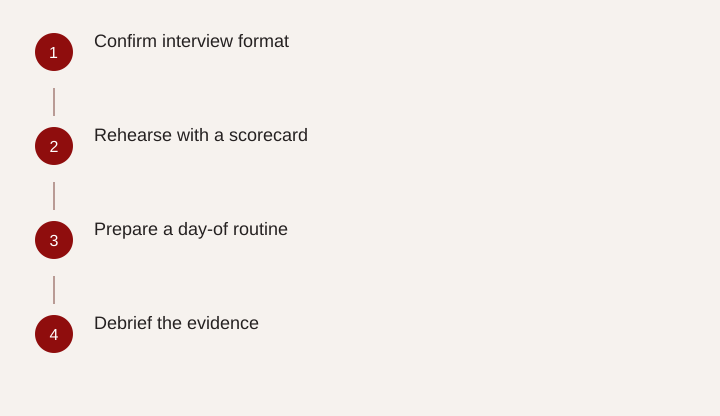
- Confirm interview format
- Rehearse with a scorecard
- Prepare a day-of routine
- Debrief the evidence
Replace avoidable unknowns with a clear plan
A panel interview can feel difficult because several people are evaluating you at once and the format may be unfamiliar. Preparation is most useful when it reduces practical uncertainty: where to connect, how long the interview is scheduled, whether a presentation is required and what materials are permitted. Confirm those details through the invitation or scheduling contact.
OPM's structured-interview guidance explains that some interviews use consistent questions and evaluation standards tied to the job. That can produce a more formal conversation than an applicant expects. A panel member taking notes or moving directly to the next question is not a reliable signal of approval or rejection. Focus on providing understandable evidence. You do not need to create constant rapport at the expense of answering the question, and you do not need to interpret every facial expression.
Rehearse the act of answering, not only the content
Reading sample answers silently is different from speaking a clear answer under time pressure. Practice aloud with a partner or a recording. Use questions based on the announcement's competencies, and ask your partner to vary the wording. Begin with a direct response, then provide the relevant example and result.
For experience questions, the STAR example bank can help you organize evidence. Avoid memorizing a paragraph word for word. A memorized response can become difficult to adapt when the panel asks a related but different question. Rehearse transitions such as “My responsibility in that project was…” or “The decision I made was…” only as ordinary language, not as a performance formula. The goal is to make your role and reasoning easy for someone unfamiliar with your previous workplace to follow.
Use a practice scorecard
A scorecard makes rehearsal feedback specific. It should measure the answer's usefulness rather than whether you looked completely relaxed.
| Check | What a listener should hear | Revision if missing |
|---|---|---|
| Question answered | A response to every requested part | Restate the question's components before practicing again |
| Personal contribution | What you actually did | Replace vague team descriptions with your role |
| Decision process | Why you selected the approach | Add the criteria or tradeoff |
| Outcome | A credible result or lesson | Explain what changed and how you know |
| Clarity | Understandable terms and orderly sequence | Remove jargon and unnecessary background |
Use a simple present, partial or missing mark for each row. Have the listener explain what they understood before offering advice. If their summary differs from your intended point, revise the answer. One careful revision of a weak example can be more useful than rehearsing ten additional questions without feedback.
Prepare for multi-part questions and blank moments
A question may ask for the situation, your approach and what you learned. Listen for each component. If the format permits notes, write a few brief labels rather than a transcript. If you miss a part, ask for repetition or clarification instead of guessing. Follow any stated limits on notes, preparation time or follow-up questions.
A short pause can help you choose the right example. You might say, “Let me think of the most relevant example,” then begin once you have selected it. If you lose your place, return to the question and summarize the action or result rather than starting the entire story again. These are communication techniques, not guarantees about scoring. Use them to preserve clarity. If an accommodation is needed, use the agency's stated process in advance rather than relying on an improvised arrangement during the interview.
Make a simple interview-day run sheet
For a virtual interview, test the platform, audio, camera and connection using permitted practice features. Know how to contact the scheduler if the connection fails. Place the invitation, contact information and allowed materials where you can find them. Close unrelated applications that could interrupt the session or reveal private information.
For an in-person interview, confirm the address, entry instructions, identification requirements and travel time. Allow a sensible margin without arriving so early that you disrupt the office. Review the announcement and your own application, then stop trying to add new stories at the last minute. A hypothetical run sheet might include connection or travel check, materials check, a short review of key examples and a reminder to listen to the full question. Keep it short enough to use. A complicated ritual can create another task to worry about.
Debrief once, using observable evidence
After the interview, record the topics asked, which examples you used, where an answer was incomplete and any promised next steps. Note the contact and expected update if one was provided. The USAJOBS hiring-process overview places interviews within a broader agency selection process, so the end of the conversation is not necessarily the final decision.
Avoid spending hours reconstructing the panel's tone. Instead, identify one or two changes for your next practice session, such as shortening background or explaining a technical term. If a follow-up message is appropriate, keep it concise and follow the agency's instructions. Do not send unsolicited replacement answers to every question you wish you had handled differently. Continue your search and respond to actual requests. A useful debrief improves future performance while allowing this interview to remain one event in a larger application process.
Related questions
Is it acceptable to pause before answering a panel question?
A brief pause to organize your response can help. Follow the interview's format and time constraints, and ask for clarification when a question is unclear.
Does a quiet or expressionless panel mean I performed badly?
No reliable conclusion follows from that alone. Panel members may be listening, taking notes or following a structured format.
Sources & further reading
Primary references
Community questions behind this guide
These discussions informed the question and language. Personal accounts are not verified facts or professional advice. Read our method.