
THE SHORT ANSWER
Referral is a step in consideration, not an interview commitment. Track the agency's actual requests and keep a separate action plan for each application.
What to keep in mind
- Referral does not guarantee an interview or selection.
- A status label cannot establish your probability of receiving an offer.
- Follow up on specific questions while continuing other suitable applications.
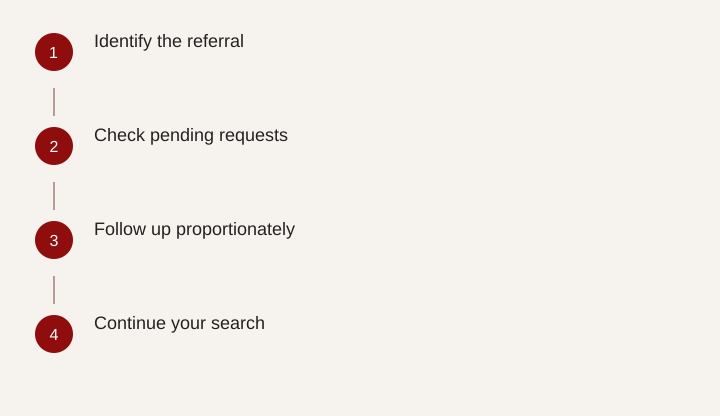
- Identify the referral
- Check pending requests
- Follow up proportionately
- Continue your search
Read referral as a process event
A referral notice can be encouraging after many applications, but it leaves a practical question: what happens next? The answer depends on the agency's selection process. The USAJOBS hiring-process overview separates application review, referral, interviews and selection. Advancing through one stage does not guarantee the next.
Read the full notice and record the announcement number, grade and location to which the referral applies. A multi-grade application can produce more than one result. Do not assume that referral at a lower grade establishes qualification or referral at a higher one. If the message identifies a hiring manager or next contact, save that information. If it simply says referred, record precisely that fact. Avoid adding an imagined rank, interview date or offer probability to a notice that does not provide one.
Keep eligibility, assessment and selection separate
Several favorable messages can arrive during the same application without resolving the hiring decision. You may meet the eligibility requirements, complete an assessment and be referred, yet receive no interview invitation. These events answer different questions. The hiring team still has to decide which candidates to consider further.
For applications using USA Hire, OPM's assessment-results guidance expressly explains that meeting an assessment cut score does not guarantee referral. Referral, in turn, is not a promise of selection. This distinction prevents a common tracking error: treating every positive status as evidence that an offer is almost certain. Keep a separate field for each stage in your application record. If a notice is unclear, ask what it means for this announcement rather than inferring that it carries the meaning of another agency's message.
Use a status-to-action table
The most useful response to a status is an action you can take or deliberately defer. This table is a personal workflow, not a replacement for the agency's instructions.
| What you have | What it establishes | Practical action |
|---|---|---|
| Application receipt | The system recorded a submission | Confirm remaining tasks and documents |
| Referral notice | Application advanced for consideration | Monitor messages and prepare examples |
| Interview invitation | An interview has been requested | Confirm format, date and instructions |
| Reference request | The agency wants additional information | Coordinate accurate contacts |
| Written tentative offer | A conditional offer has been issued | Read conditions and complete assigned steps |
Add a date and contact column to your own version. This makes the record actionable without requiring constant portal checking. A blank interview field is simply an unknown. It is not evidence that the referral was false or that the hiring team has already rejected you.
Check for requests that need your response
Before following up about silence, inspect the email address and phone number used in the application. Review spam folders and voicemail. Open the agency's tracking page through the official application record to check for tasks or messages. An uncompleted assessment or missed scheduling request deserves immediate attention, regardless of a reassuring summary label.
The USAJOBS application-status guidance points applicants to agency information for detailed status. If you discover conflicting messages, compare the dates and the grades or locations involved. A later message may concern only one part of a multi-selection application. Use the status reconciliation worksheet to organize that uncertainty. When everything is complete and no response is requested, preparation and continued applications are more useful than repeatedly refreshing the same page.
Send a follow-up that can be answered
Use the contact and timing the agency provided. If an expected update has passed, a concise message can ask whether the selection process remains active and whether anything is needed from you. For example: “I received a referral notice on October 8 for announcement ABC-123, GS-9 in Denver. I have not received further instructions. Could you confirm whether any action is required from me and whether an update is available?”
This hypothetical template avoids asking the contact to predict a result. Include the announcement identifier and your application identifier if appropriate. Do not attach sensitive documents or resend the entire resume without a reason. If the agency explains that selection is ongoing, record the answer and any suggested follow-up point. Sending the same inquiry every day does not create new information and can distract from opportunities where you have a deadline to meet.
Use the waiting period without overcommitting
A referral is a reasonable prompt to prepare interview examples that match the announcement's competencies. Build a short example bank, research the agency's public mission and clarify your own worksite and salary constraints. These activities remain useful even if this vacancy never produces an interview.
Continue applying to other suitable positions. Avoid treating one referral as a reason to resign, relocate or stop pursuing alternatives. If you need to make a decision about another offer, tell the federal contact the actual deadline and ask whether the agency can share an update. The agency may be unable to accelerate or predict its process. Your decision should rest on confirmed options and your circumstances, not on a favorable status label alone. Maintaining several well-matched applications is a practical response to uncertainty, without turning the process into indiscriminate mass submission.
Related questions
Does referred mean I will get an interview?
No. Referral means your application advanced for consideration under that hiring process. The hiring agency decides whom to interview and select.
How long after referral should I expect an interview?
There is no universal interval. Use any timing the agency provides and ask a focused status question when an expected update has passed.
Sources & further reading
Primary references
- USAJOBS: How does the application process work?
- USAJOBS: Application and job status
- USA Hire: Assessment results and referral
Community questions behind this guide
These discussions informed the question and language. Personal accounts are not verified facts or professional advice. Read our method.