
THE SHORT ANSWER
Conflicting labels may describe different vacancies, grades, locations or stages. Build a dated record and ask the agency to clarify the specific discrepancy.
What to keep in mind
- Separate the vacancy's status from your personal application result.
- Compare announcement numbers, grades and timestamps before concluding that messages conflict.
- Ask the agency which result is current and whether you owe any action.
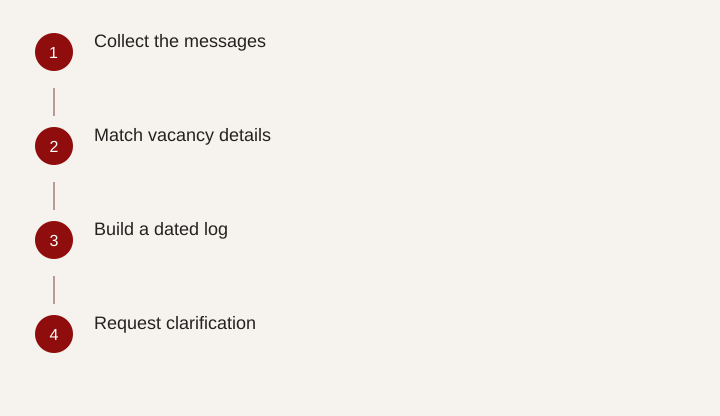
- Collect the messages
- Match vacancy details
- Build a dated log
- Request clarification
Distinguish the job listing from your result
A vacancy can be closed to new applications while existing applicants remain under consideration. A personal application can also carry a different status from the overall announcement. Confusion begins when these two kinds of labels are treated as the same event. Read the words around the status, not just the prominent badge.
The USAJOBS status guidance explains how to track an application and directs applicants to the hiring agency for detailed information. Record whether the label appears on the vacancy page, your application list, an agency portal or an email notice. Those locations can communicate different things. “Closed” on the announcement does not, by itself, establish that you were not selected. Likewise, a general hiring-complete label should be checked against the agency's application-specific message before you infer what happened to your record.
Match every identifier before comparing messages
Federal job titles are often reused, and applicants may apply to several similar announcements. Compare the agency, announcement number, control number if provided, grade, location and hiring path. A notice for a public announcement can be distinct from a notice for a parallel announcement restricted to another applicant group.
Then check the date and time. An older email can remain in your inbox after a later determination. A message might also cover only one grade or location in a broader application. In a hypothetical example, an applicant receives referral at GS-7 and non-referral at GS-9. That is not inherently contradictory. The messages concern different levels. Preserve their exact wording rather than compressing both into “referred, then rejected.” Precise records can resolve apparent conflicts before you need to contact anyone.
Build a short status reconciliation log
Use one row for each observed message. The purpose is to identify the unresolved question, not to create a theory about why the agency's systems differ.
| Date observed | Source | Scope | Exact result | Open question |
|---|---|---|---|---|
| October 8 | Email notice | ABC-123, GS-7 | Referred | None stated |
| October 9 | Email notice | ABC-123, GS-9 | Not referred | Different grade; no conflict established |
| October 12 | Agency portal | ABC-123, scope unclear | Review complete | Does this cover both grades? |
These entries are illustrative. Use your actual dates and labels. Keep screenshots or saved messages where permitted, removing unrelated personal information before sharing them. Add any response deadline in a separate column. If a notice requests action, do not postpone that action merely because another screen has an ambiguous status.
If several announcements are open at once, give each its own log. Record a telephone clarification immediately after the call, including the office and the substance of the answer. When the clarification affects a deadline or interview arrangement, request written confirmation so you can follow the instructions accurately.
Ask for the smallest useful clarification
A focused inquiry gives the contact enough context to answer without reconstructing your entire search. For example: “For announcement ABC-123, I received a GS-7 referral notice on October 8. The agency portal now shows Review Complete without a grade-specific result. Could you confirm my current application status at GS-7 and whether I need to take any action?”
Use the announcement's listed agency contact or the support channel indicated for that issue. The USAJOBS application-process overview makes clear that the hiring agency conducts the selection process; a general website support team may be unable to explain a hiring determination. If your problem is technical access, describe that separately from a question about selection. One message that distinguishes the two issues is more useful than a broad statement that the website is wrong.
Treat requests and decisions differently
An interview invitation, document request or assessment deadline requires a response according to its instructions. A summary label may require only monitoring. Prioritize concrete requests while you seek clarification of ambiguous statuses. If you cannot complete a requested action because of a system problem, report the obstacle and preserve the timestamp.
A non-selection or ineligibility notice deserves careful reading because it may explain the reason or identify a review procedure. Do not assume that a contradictory generic badge cancels an explicit decision. Ask the agency to resolve the discrepancy. If the issue is a qualifications determination, use the focused review-request method and the evidence actually submitted. A status inquiry asks what the record currently says; a review request asks the agency to examine a particular determination. Keeping those purposes clear improves both messages.
Close the loop in your own records
When the agency responds, enter the date, the person's role or office, the confirmed status and any next action. Retain the response with the original messages. If the contact cannot provide a timeline, mark timing as unknown instead of filling the gap with another applicant's experience. Set your own reasonable reminder based on any guidance given.
Keep applying to appropriate roles while the discrepancy is unresolved. The uncertainty affects this application; it need not suspend your entire search. If another employer needs an answer, explain your real deadline to the federal contact without suggesting that an uncertain portal status is an offer. Good tracking cannot make the agency decide sooner, but it can prevent missed tasks, duplicate inquiries and major decisions based on a misread label. That is the practical benefit of a disciplined status log.
Related questions
Does a closed announcement mean I was rejected?
A closing date describes the application window. It does not by itself tell you the agency's decision on your individual application.
Which should I trust when USAJOBS and the agency portal disagree?
Compare the exact records and contact the hiring agency for application-specific clarification. Do not assume either label supplies the complete current picture.
Sources & further reading
Primary references
Community questions behind this guide
These discussions informed the question and language. Personal accounts are not verified facts or professional advice. Read our method.