
THE SHORT ANSWER
Prepare flexible examples rather than memorized speeches. A strong STAR answer makes the situation brief, identifies your responsibility and explains the actions that produced a credible result.
What to keep in mind
- Choose examples that demonstrate the announcement's competencies.
- Make your personal actions clear within team accomplishments.
- Practice adapting an example to the question actually asked.
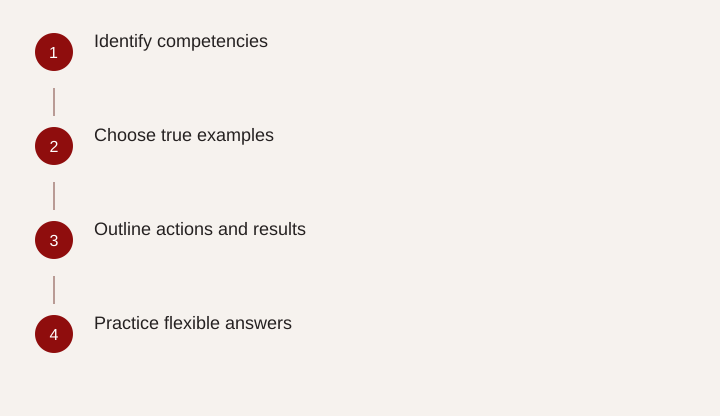
- Identify competencies
- Choose true examples
- Outline actions and results
- Practice flexible answers
Build an example bank around the job
An interview example should show the ability the question asks about. A polished story about teamwork does little if the panel asked how you evaluated conflicting data. Start with the announcement's duties and competencies, then identify real situations in which you demonstrated the relevant behavior.
OPM's structured-interview guidance describes interviews organized around job-related competencies and consistent evaluation. You cannot know the exact questions in advance, but you can prepare evidence that fits the work. List several likely themes, such as analysis, communication, prioritization, customer service or judgment, only where the announcement supports them. Choose examples with enough detail to explain your role. An impressive project name is less useful than a modest assignment whose decisions and results you can describe accurately. Keep confidential or sensitive details out of the preparation material.
Use STAR to expose your reasoning
STAR stands for situation, task, action and result. Treat it as a clarity tool. State enough context to make the problem understandable, explain what you were responsible for, describe the actions you took and close with the outcome. Most of the useful evidence is often in the action: how you chose an approach, checked information, involved others or adjusted when something failed.
Avoid spending the entire answer on the situation. A long account of a disorganized office can leave no time to explain what you did. Equally, “we solved it” hides your contribution. Use “we” for the team context and “I” for actions that were yours. If your role was limited, say so. You can demonstrate sound judgment through a supporting role without claiming authority or credit that belonged to someone else.
Create a six-example planning grid
A small bank gives you options when a question requires a different angle. The following grid is an example of preparation structure; replace the suggested themes with those relevant to your position.
| Example slot | Evidence to capture | Useful follow-up detail |
|---|---|---|
| Analysis | Problem, information checked, conclusion | How you handled conflicting evidence |
| Prioritization | Competing tasks and decision criteria | What you delayed and communicated |
| Communication | Audience, difficult message, approach | How you checked understanding |
| Collaboration | Your role and the shared goal | How you handled disagreement |
| Service | Need, constraints and response | How you maintained standards |
| Learning | Mistake or unfamiliar task and adjustment | What changed in your later work |
For each row, note a one-sentence situation, your task, three action points and the result. Add the date or context privately so you can distinguish similar projects. Do not force six different stories if you have fewer strong examples; one authentic example can support several competencies when you explain the relevant aspect.
Study a hypothetical answer's structure
Consider a fictional records assistant asked to describe finding and correcting an error. The situation might be a monthly report with inconsistent totals. The task is to identify the discrepancy before the report deadline. The actions could include tracing entries to source records, comparing categories, consulting the colleague who maintained one dataset and documenting a correction. The result is a corrected report and a repeatable reconciliation step.
The value lies in the decisions, not in making the story sound dramatic. A candidate using a real version of this example would explain what they personally checked, what required approval and how they verified the correction. They would use a numerical result only if they could substantiate it. “The report was corrected before submission” can be a credible result without inventing a percentage improvement. Label practice examples as hypothetical and never present someone else's experience as your own.
Prepare for questions that challenge the story
A panel may ask what you would do differently, how you handled resistance or how you know the outcome improved. Prepare those details for yourself. If the original approach failed, an honest account of recognizing the problem and adjusting can demonstrate learning. Do not rewrite every example into a flawless success.
Check the limits of each story. An example about explaining a policy does not automatically prove that you developed the policy. An example about entering data does not automatically establish that you designed the analysis. Accurate boundaries make follow-up answers easier. Also prepare a concise explanation of unfamiliar industry terms so a reviewer outside your former organization can understand the work. Practicing aloud often reveals jargon and missing steps that are invisible when you reread your own notes.
Practice adaptation instead of recitation
Ask a practice partner to vary the question while you use the same bank. A prioritization example might be asked as a deadline question, a conflict question or a judgment question. Begin by answering the question that was asked, then select the relevant details. If the example does not fit, use a better one rather than forcing the prepared speech into the slot.
Record a practice answer if that helps you review clarity. Check whether a listener can identify your responsibility, decisions and result without asking for basic context. Shorten unnecessary background and preserve the action sequence. Follow the actual interview's rules about notes and materials. A compact example bank is preparation, not a script to read regardless of the conversation. It gives you evidence to draw on while leaving enough attention to listen carefully and respond directly.
Related questions
Must every federal interview answer follow STAR?
No. STAR is a useful organizing method for experience questions. Follow the actual question; technical or hypothetical questions may require a different structure.
Can I use examples from school or volunteer work?
When relevant to the competency and appropriate to the question, those examples can demonstrate skills. Identify the context honestly and do not portray them as paid professional duties.
Sources & further reading
Primary references
Community questions behind this guide
These discussions informed the question and language. Personal accounts are not verified facts or professional advice. Read our method.