
THE SHORT ANSWER
Manage the hiring wait by tracking completed requirements, outstanding owners and confirmed dates. A conditional offer and a final start arrangement carry different levels of certainty.
What to keep in mind
- Distinguish verbal interest, a written tentative offer and final instructions.
- Ask which requirement remains open rather than demanding a universal timeline.
- Avoid irreversible plans based on an unconfirmed start date.
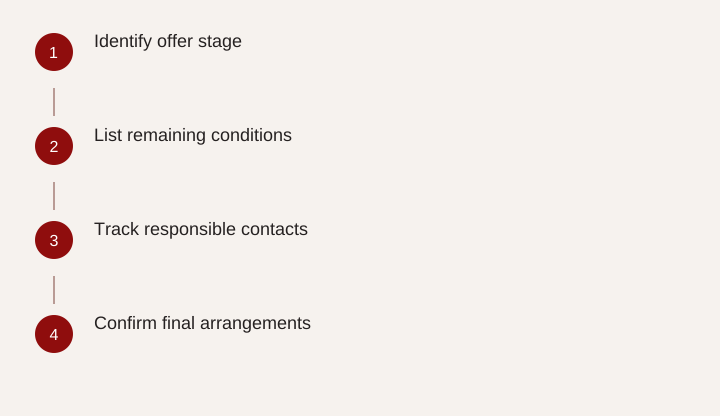
- Identify offer stage
- List remaining conditions
- Track responsible contacts
- Confirm final arrangements
Name the stage before estimating the wait
Federal hiring conversations use several phrases loosely: selected, tentative offer, final offer and start date. Before making plans, identify what you actually received. A positive interview comment or verbal expression of interest is different from a written tentative offer with conditions. A proposed entry-on-duty date is different from confirmed reporting instructions.
The USAJOBS hiring-process overview describes selection and pre-employment steps as parts of the broader process. Read each message for the issuing office, acceptance deadline, conditions and requested tasks. If a hiring manager says an offer is coming, ask when HR expects to contact you and continue monitoring the official channel. Do not fill in missing terms from the original salary range or from another candidate's experience. Your written communications are the starting point for a reliable timeline.
Understand why a tentative offer still has work attached
A tentative job offer, often shortened to TJO, allows the agency and applicant to proceed while required matters remain unresolved. OPM's tentative-offer process description identifies HR and security involvement and the solicitation or verification of supporting information. The details vary with the position and the applicant's circumstances.
Read the offer's conditions rather than assuming every applicant completes the same sequence. Possible requests can involve employment forms, education verification, credentials, fingerprints or position-specific screening. Complete only the tasks assigned through legitimate agency channels. Keep your own submission dates and confirmations. An item you uploaded may still require review or correction, so distinguish “sent by me” from “accepted by the responsible office.” That distinction helps explain a delay without assuming that someone has lost the application or that the offer is about to become final.
Track dependencies instead of counting days alone
A calendar shows elapsed time; a dependency sheet shows what must happen next. Use the second to make your follow-up useful.
| Requirement | Your action | Responsible contact | Current evidence |
|---|---|---|---|
| Offer response | Accept or decline by the stated deadline | HR contact | Response confirmation |
| Requested documents | Submit complete, readable records | HR or assigned reviewer | Receipt and any correction request |
| Security-related step | Follow the assigned instructions | Authorized security contact | Task completion message |
| Pay or date question | State the unresolved issue | HR | Written clarification |
| Reporting arrangement | Confirm location, date and contact | HR and onboarding contact | Final instructions |
This is a planning template, not a universal sequence. Add only requirements that apply to your offer. If an office cannot disclose internal details, record its stated status without pressing for protected information. The sheet should help you act, not speculate about unseen adjudication.
Make follow-up specific and proportionate
Ask the contact whether your package is complete, which applicant action remains outstanding and when another update would be appropriate. A hypothetical message is: “I accepted the tentative offer for ABC-123 on October 8 and completed the tasks listed below. Could you confirm whether anything further is needed from me? My proposed start date remains unconfirmed, so I would also appreciate guidance on when it may be finalized.”
The USAJOBS hiring-time guidance cautions that hiring time varies. A published process target is not a personal deadline or a promise that every stage will finish within that period. If you have a lease decision, another offer or a required notice period, state the actual deadline. Ask what the agency can confirm now. It may be able to provide information without being able to accelerate the process.
Keep housing and employment decisions tied to confirmed facts
The consequences of a delayed start differ by applicant. Someone moving across the country may face deposits, travel costs and a period without income. Someone changing agencies has a different coordination problem from a private-sector employee giving notice. List the commitments you are considering and identify which can wait until final arrangements are confirmed.
Ask HR what stage the agency requires before you take a particular transition step. For a federal agency move, read the transfer coordination guide before treating it as an ordinary resignation. For relocation, separate authorized benefits from expenses you plan to pay yourself. Do not assume reimbursement because relocation is necessary for you. Use the offer's written terms. These precautions are practical planning choices; they cannot remove every hiring or personal risk, but they make your exposure visible.
Review the final package as a fresh document
When a final offer arrives, compare the position, grade, step, pay basis, duty station, appointment terms and start date with what you understand. Resolve material discrepancies before acting on them. Check where and when to report, which identification or records to bring and whom to contact if travel or access problems arise.
A final offer does not eliminate the need to read remaining instructions. Preserve the complete correspondence and the versions of forms you are permitted to retain. Update your transition checklist and notify the relevant people through the appropriate channels. If a final date changes, ask for the revised arrangement in writing and revisit any dependent plans. The purpose of tracking the hiring wait is not to predict the agency's internal clock. It is to keep your actions timely and your commitments grounded in confirmed information.
Related questions
How long does it take to get a final federal offer after a TJO?
There is no universal interval. Timing depends on the position, agency and outstanding requirements. Ask the agency which steps remain and whether it can provide an estimate.
Does accepting a tentative offer mean I can start work?
No. Read its conditions and wait for the agency's final offer and reporting instructions. Ask HR to confirm the authorized start date.
Sources & further reading
Primary references
- USAJOBS: How does the application process work?
- USAJOBS: How long does federal hiring take?
- OPM hiring-process analysis: tentative offer and acceptance
Community questions behind this guide
These discussions informed the question and language. Personal accounts are not verified facts or professional advice. Read our method.