
THE SHORT ANSWER
Before leaving one federal agency for another, have both HR offices coordinate the move and confirm its personnel treatment. OPM says a resignation is not required merely to take a job in another agency.
What to keep in mind
- Do not assume an agency move requires an ordinary resignation.
- Have HR confirm the appointment action, release date and entry-on-duty date.
- Retain the records needed to verify service, pay and benefits after the move.
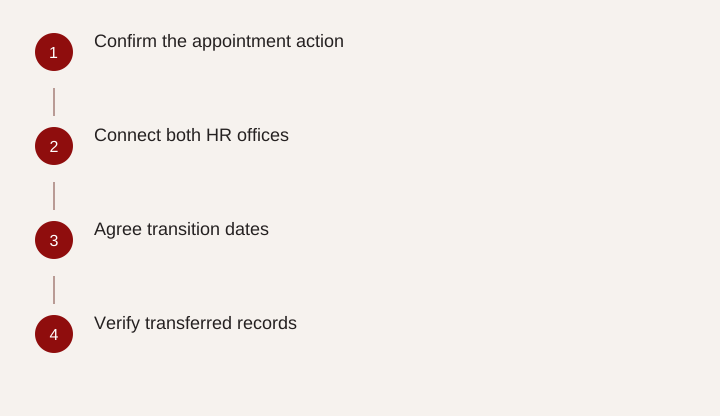
- Confirm the appointment action
- Connect both HR offices
- Agree transition dates
- Verify transferred records
Tell HR that you are a current federal employee
A move between federal agencies can look like an ordinary job change from the applicant's perspective: accept an offer, leave one employer and start with another. The personnel process can be different. OPM's agency-move FAQ says that you do not have to resign from your current federal job to take a job in another agency; the gaining agency should coordinate the transfer with the current agency.
Make your current federal employment clear to the gaining HR contact early. Provide the records the agency requests through its approved channel. Do not assume a hiring manager has passed every detail to HR. An appointment's service, authority and circumstances can affect how the move is processed. Ask the office handling the action to confirm the correct treatment before submitting a resignation or choosing dates independently.
Confirm the action behind the word transfer
People use “transfer” broadly to describe moving to another office or agency. The actual personnel action may depend on the positions and appointments involved. OPM's details and transfers guidance distinguishes these staffing concepts. A temporary detail, an agency change and a new appointment are not interchangeable simply because each involves different work.
Ask the gaining HR specialist: “How will this move be processed, and what information do you need from my current HR office?” Include your current appointment information accurately. If the move involves a different service, a temporary appointment or a special hiring authority, request clarification of any resulting conditions. Do not rely on a coworker's experience with a different appointment. The goal is not to become your own personnel specialist; it is to identify the responsible office and ensure it is working from the correct facts.
Use a two-office handoff checklist
A short handoff record helps prevent conflicting assumptions about who is arranging the move. Share only the information appropriate for each office.
| Handoff item | Who should confirm it | Your record |
|---|---|---|
| Personnel action and appointment terms | Gaining HR | Written explanation or offer terms |
| Current-agency HR contact | Losing agency | Name, office and official contact route |
| Release and entry-on-duty dates | Both HR offices | Coordinated dates |
| Personnel and payroll records | Relevant servicing offices | Requested documents and transfer status |
| Equipment and access return | Current supervisor or exit office | Separate operational checklist |
| First-day reporting | Gaining agency | Location, time and contact |
Distinguish operational checkout from the personnel action. Returning a laptop or completing a local exit checklist does not explain how your employment record is being processed. If a form appears to characterize the action as a resignation and that conflicts with HR's explanation, pause and ask the responsible office to reconcile the wording.
Coordinate dates before making commitments
Give the gaining agency your realistic availability, including any required transition work or travel. Have both HR offices coordinate the official release and entry-on-duty dates. OPM's FAQ specifically emphasizes coordination to avoid a break in service. Do not assume that a personally convenient gap has no consequences for your records or benefits.
If one office proposes a date that differs from the other office's understanding, send a concise clarification request to the appropriate contacts. For example: “The gaining agency's proposed entry-on-duty date is October 26, while my current office has discussed a different release date. Please confirm the coordinated dates and whether any action is needed from me.” This is a hypothetical example, not a recommended universal schedule. Once the dates are confirmed, align travel, leave and household arrangements with the actual instructions.
Prepare records without assuming every balance moves automatically
Keep permitted copies of the personnel and pay records you may need to verify the transition. Ask HR which SF-50s, service records or other documents it needs. For an explanation of selecting the relevant records, use the SF-50 application guide. Protect documents that contain personal identifiers and transmit them only through the authorized process.
Ask the servicing offices how pay, leave, benefits and any outstanding obligations will be handled in your circumstances. Avoid relying on a generic assertion that everything transfers unchanged. A move may involve different pay systems, work schedules or appointment terms, and corrections can take time. Record the answers and the office responsible for unresolved items. You are checking continuity and accuracy, not trying to settle payroll questions through an informal exchange with the hiring manager.
Verify the move after you report
Once you start, review the personnel documentation and pay information made available to you. Check the effective date, position, grade or pay system, duty station and appointment details against the confirmed offer. Verify relevant leave or benefit records through the appropriate office rather than assuming a first paycheck proves that every record is correct.
Report discrepancies promptly with the source documents that establish the issue. A focused message should state the field, what the record shows, what you understand it should show and the supporting record. Keep the inquiry separate from unrelated onboarding questions. Continue following the new agency's orientation and training instructions while administrative corrections are handled. A well-coordinated transfer includes both the handoff before entry and a practical verification afterward, reducing the chance that a small records error remains unnoticed for months.
Related questions
Do I need to resign to take a job at another federal agency?
OPM says no: the new agency should coordinate the transfer with the current agency. Confirm the personnel action and timing with both HR offices for your specific move.
Can I set my own last day and start date?
Discuss your availability, but have the agencies coordinate and confirm the official dates. Personal plans should follow the confirmed personnel action.
Sources & further reading
Primary references
Community questions behind this guide
These discussions informed the question and language. Personal accounts are not verified facts or professional advice. Read our method.