
THE SHORT ANSWER
Start with confirmed opportunities from schools and identifiable sponsors. Use directories to discover possibilities, then verify each listing at its source and prioritize by fit and required effort.
What to keep in mind
- A directory listing is a lead, not a verified award offer.
- Check eligibility and the current application cycle before drafting an essay.
- Track renewal and outside-award rules as well as the initial amount.
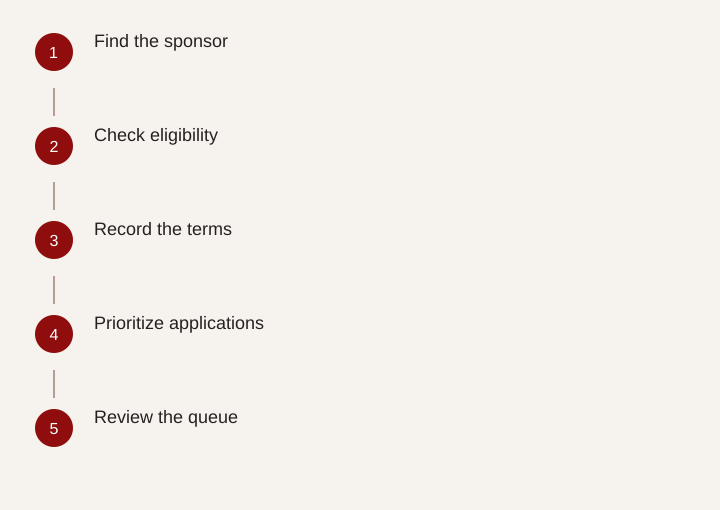
- Find the sponsor
- Check eligibility
- Record the terms
- Prioritize applications
- Review the queue
Begin with sources close to the decision
Start at the colleges you are considering or attending. Find their official financial-aid and scholarship pages, then look for department, program or local sponsor opportunities that match your circumstances. A school's official information can clarify whether one application covers several awards or whether separate applications are required.
Directories and search engines can help discover additional possibilities, but treat each listing as a lead. Follow it to the sponsor's current page before entering personal information or spending hours on an essay. An old award name may remain in a directory after its deadline, eligibility or application route has changed.
The Federal Trade Commission's scholarship guidance recommends talking with a school counselor or financial-aid office and warns about guaranteed awards and payment demands. Use those offices as sources of clarification, not as an assumption that every student will receive enough funding.
Check eligibility before estimating your chances
Read the actual conditions: education level, enrollment, field of study, location, membership, academic criteria and any other stated requirement. Record the wording rather than replacing it with a broad label such as “for Latino students” or “for first-gen applicants.” A particular award may define those terms or add conditions that a directory omits.
If a condition is ambiguous, contact the sponsor through a verified route. Ask a focused question and save the response. Do not infer eligibility from another applicant's experience or assume that a program at a Hispanic-serving institution is limited to one identity group.
Avoid inventing a percentage chance of winning. Without reliable information about the applicant pool and selection process, such a number creates false precision. You can still make a practical decision based on eligibility, relevance, effort and the value of the opportunity.
Confirm the current cycle and sponsor
Look for the application year's dates, the sponsor's identity, a current contact and a clear submission route. A copyright date at the bottom of a website does not establish that an award is open. Likewise, a polished design or a .org address does not replace sponsor verification.
Check whether the application is hosted by the sponsor or by an identified service acting for it. If the route seems inconsistent, contact the sponsor through its independently located official website. Do not use only the phone number in an unsolicited message claiming you have been selected.
Never pay an application or processing fee to receive a scholarship award. The FTC distinguishes legitimate paid information services from promises of guaranteed scholarships; paying for a list does not guarantee funding and may duplicate information available through free sources. Understand exactly what any service sells before considering it.
Build a shortlist table that supports decisions
| Field | What to enter |
|---|---|
| Award and sponsor | Verified official name and source URL |
| Current cycle | Open date, deadline and year |
| Eligibility | Conditions you meet and unresolved questions |
| Required work | Essay, references, documents or interview |
| Award terms | Amount or range as officially stated |
| Renewal | Duration and conditions for later years |
| School interaction | Outside-award reporting or aid questions to ask |
| Next action | One task, owner and date |
Keep only a manageable active queue. Archive expired or ineligible leads with a brief reason so you do not rediscover and reconsider them repeatedly. Mark unresolved opportunities separately from confirmed applications. That prevents uncertainty from looking like progress.
Prioritize fit and effort honestly
Compare the work required with how well your experience matches the stated criteria. An application asking for a specific community project may be a better use of time if you can describe relevant work accurately. A large advertised amount should not automatically outrank an opportunity whose requirements you understand and can meet.
Reuse factual records such as activity dates or course information, but tailor each response to the actual prompt. A generic essay may fail to answer a narrowly framed question. Do not invent hardship, leadership or heritage experiences because they appear to fit a selection theme.
Create a weekly routine: verify a small number of new leads, complete the next task on active applications and check upcoming deadlines. Keep time for schoolwork and other responsibilities. Scholarship research can expand endlessly if you never decide which leads deserve action.
For an application that needs a recommendation, work backward from the sponsor’s submission deadline. Confirm whether the referee submits directly and whether their deadline differs from yours. Put the request date and expected response in the shortlist, so an otherwise suitable opportunity does not fail because a required document was left to the final evening.
Read beyond the first award amount
Ask whether the award is renewable, which conditions apply and whether it is paid to the school or handled another way. Verify the sponsor's instructions rather than assuming that all scholarships operate alike. Keep copies of submitted materials and award communications through an appropriate private storage method.
If you receive an award, contact the school's financial-aid office about reporting and the effect on your package. Federal Student Aid's offer-comparison guidance emphasizes comparing actual costs and types of aid. An advertised scholarship amount alone does not describe your complete financial situation.
A useful shortlist ends in a decision: apply, ask for clarification, save for a later cycle or discard. The goal is not to accumulate the largest number of links. It is to spend your application time on real, current opportunities whose requirements and terms you understand.
Related questions
Should I apply to every scholarship I find?
Start with opportunities whose eligibility, sponsor and current cycle you can verify. A focused queue is easier to manage than many unsuitable listings.
Does an award automatically reduce my final bill by its advertised amount?
Ask the school how outside awards interact with the student’s aid package and billing; do not assume the effect.
Sources & further reading
Primary references
Community questions behind this guide
These discussions informed the question and language. Personal accounts are not verified facts or professional advice. Read our method.