
THE SHORT ANSWER
Accepted credit is not always credit that advances your intended degree. Check the receiving campus, major and applicable requirements, then document how each important course will be used.
What to keep in mind
- Course titles alone do not establish equivalency.
- Separate elective credit, general education and major requirements.
- Get unresolved decisions from the office authorized to make them.
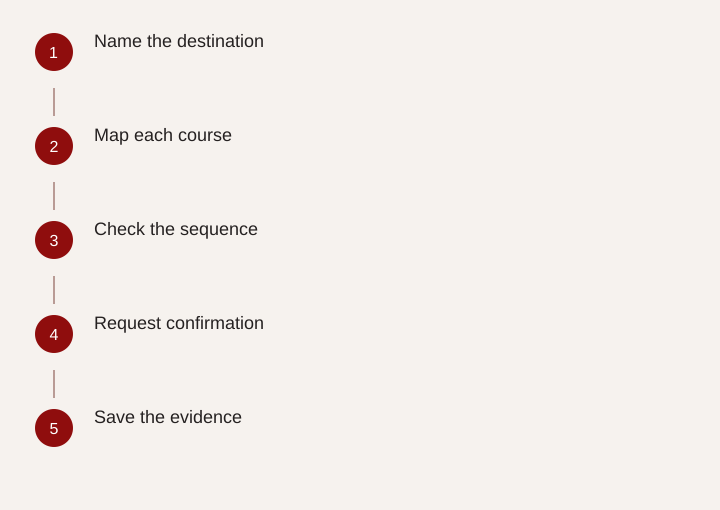
- Name the destination
- Map each course
- Check the sequence
- Request confirmation
- Save the evidence
Identify the exact destination before mapping credit
A transfer plan needs a receiving institution, campus, major and applicable set of requirements. “Transfer to a university” is too broad to determine which courses will count toward the degree you want. Different destinations may use the same course differently.
Begin with the receiving school's official transfer information and the department requirements for your intended program. Ask which catalog year or policy applies and whether an evaluation is preliminary or final. Do not assume that a general admissions answer settles every major requirement.
If you are still choosing between destinations, make separate columns for each. A course may be useful at both, at one or as general credit only. Seeing those differences early can prevent a schedule that preserves one option while unintentionally closing another.
Distinguish three kinds of progress
A course can be accepted for units, satisfy a general education requirement or fulfill major preparation. These outcomes can overlap, but they are not identical. A transcript showing many accepted credits does not automatically mean you are close to completing a particular degree.
The UC transfer glossary explains that articulation is specific to the originating college, receiving campus and major. It cautions against relying on the course title alone. Use the same careful distinction when evaluating another institution's process.
Ask how the receiving school will display the result in the degree audit. If a course appears as an elective while you expected a requirement to be satisfied, identify the review procedure. Do not register for later courses on the assumption that the discrepancy will automatically correct itself.
Use official tools within their scope
For California community-college students planning a UC transfer, UC's planning-tools page identifies ASSIST and UC TAP. ASSIST helps identify coursework that meets transfer requirements, while TAP helps organize progress. Check the relevant institutions, agreement and academic year.
These tools should not be presented as a universal US transfer system. A student moving between private universities, across states or from another country may need a different evaluation process. Ask the destination which official resource governs that route and what documents are required.
Save the agreement or evaluation you relied on, with its date. Online information can change, and a later adviser may need to understand which version informed your course choice. A saved record supports clarification; it does not override the institution's applicable rules.
Map courses before making a commitment
| Originating course | Receiving use | Evidence | Unresolved action |
|---|---|---|---|
| Course code and title | Elective units | Official evaluation or agreement | None, if confirmed |
| Course code and title | General education category | Applicable rule and year | Confirm any condition |
| Course sequence | Major preparation | Department or articulation decision | Check whether the full sequence is required |
| Course under review | Unknown | Submitted syllabus and request | Await authorized decision |
The rows above are a template, not a claim about any real course. Fill them with your records. Include credits or units and whether the destination evaluates the individual course or a complete sequence. A partly completed sequence may not receive the use you expected, so ask before splitting it across institutions.
Keep pending decisions visible. “Probably equivalent” belongs in the unresolved column until the appropriate office confirms it. A friend's successful transfer last year can suggest a question, but it does not establish how your own record will be evaluated.
Check prerequisites and time to completion
Even when credits are accepted, a missing prerequisite can delay later work. Ask which remaining courses must be taken in order and when they are offered. A required class available once a year can affect the timeline more than the total number of units suggests.
Discuss the proposed schedule with both transfer advising and the receiving department as appropriate. Ask whether there are residency requirements, program-specific rules or other conditions that affect completion. Use the institution's actual language and source rather than assuming these rules are identical everywhere.
Then connect the academic plan to cost. An additional term can change housing, transport and other expenses. Do not claim a two-year completion timeline solely because you have completed two years elsewhere. Build the timeline from confirmed requirements and label assumptions about future offerings.
Request written clarification for important gaps
An original message could read: “I am considering transfer to [campus and major]. The current evaluation lists [course] as elective credit, while the program requires [requirement]. Can your office determine whether this course satisfies that requirement, or identify the authorized review process? I can provide the syllabus and other requested records.”
Keep the response, submitted documents and any conditions together. If one office refers you to another, track who owns the final decision and the expected timing. A referral does not necessarily mean the question has been resolved.
Before committing to the new college or next term's classes, review the unresolved column again. Some uncertainty may remain, but it should be visible enough to inform your decision. A good transfer plan does not promise that every credit will work perfectly. It shows which credits advance your intended degree, which do not and what evidence supports each conclusion.
Related questions
Does transferable mean it satisfies my major?
Not necessarily. A course may transfer as elective credit while a particular major requirement remains unmet.
Does ASSIST apply to every transfer in the United States?
No. It is used for specific California articulation information. Other destinations have their own official processes.
Sources & further reading
Primary references
Community questions behind this guide
These discussions informed the question and language. Personal accounts are not verified facts or professional advice. Read our method.