
THE SHORT ANSWER
Employee stories work best when contributors understand the purpose, audience and editorial process. Start with those decisions before arranging a group photograph or asking anyone to explain their heritage.
What to keep in mind
- Do not infer identity or willingness to participate from appearance or a surname.
- Explain where a story or image will appear before collecting it.
- Review captions for factual accuracy and stereotyping.
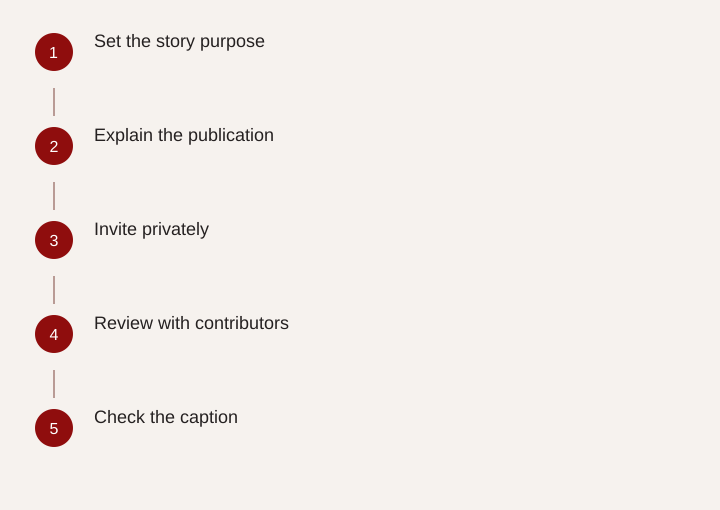
- Set the story purpose
- Explain the publication
- Invite privately
- Review with contributors
- Check the caption
Decide what the post is trying to communicate
Before asking for a photograph, write the post's central idea without mentioning how diverse the company looks. Perhaps the story concerns a documented apprenticeship project, an employee's chosen community activity or a public resource staff found useful. If there is no idea beyond displaying workers from one ethnic group, reconsider the format.
A group photograph can reinforce an unintended message when it shows people only in the most stereotyped roles. The solution is not to invent a more flattering story. It is to choose accurate content with a real purpose and contributors who want to participate. An informational post about a museum resource may be more appropriate than an employee spotlight when there is no voluntary story to tell.
The Smithsonian's identity exhibit describes varied and layered Latino identities. That context should discourage assumptions about what a person will call themselves, what language they speak or which family experience they should discuss.
Define the publication before the invitation
List the channels: internal newsletter, public website, social media, print brochure or a combination. Explain whether the material may be reused later, whether names and job titles will appear, and who will edit it. A contributor cannot make a meaningful choice if the request is merely “Can we take a quick photo?” while the intended campaign remains unstated.
Use the organization's established photo, privacy and communications procedures. This article offers an editorial workflow, not a legal determination that a particular form is sufficient. If the process is unclear, obtain an answer from the responsible staff before collecting material. That is easier than trying to reconstruct what everyone understood after publication.
For a recording or interview, explain its purpose before starting. The Smithsonian oral-history guidance specifically advises against recording without the person's knowledge. A workplace story deserves at least that level of clarity, plus any applicable institutional requirements.
Invite without assigning an identity
Make the invitation private, optional and specific. Do not send a public list of people you believe are Hispanic and ask them to report for a photo. A surname, appearance or language used with a customer is not an appropriate basis for deciding someone's preferred identity label.
An original invitation could read: “We are developing an optional story about how colleagues connect with community learning. It would appear on these two channels, with your name only if agreed through our process. If this interests you, I can share the questions and timeline. There is no expectation to participate.” The actual wording should match the project, not promise anonymity or withdrawal options that cannot be delivered.
Let people decline without giving a reason. Do not keep returning with a softer version of the same request after a clear refusal. If too few people volunteer for the planned format, change the format rather than increasing pressure.
Ask questions that leave room for an individual answer
Replace “What do all Hispanic families value?” with “Is there a community practice or experience you would like to discuss?” Replace “How has your background made you hardworking?” with a question about a specific project or interest. The first versions invite stereotypes; the second versions allow people to choose what is relevant.
Send a short question list in advance. Explain that a person can skip a question, and distinguish an informal conversation from material intended for quotation. Avoid requesting private family details merely because they would make an emotionally powerful post. A contributor may want to discuss professional work without turning it into a personal origin story.
Record factual details carefully. Check names, dates, job titles and the spelling of any organizations mentioned. If a person refers to a broader historical claim, verify it independently or make clear that the statement is a personal recollection rather than established fact.
Use a prepublication review sheet
| Review point | Ask before publication |
|---|---|
| Purpose | Does the story say something useful beyond displaying identity? |
| Participation | Was the specific use explained through the applicable process? |
| Labels | Did the contributor choose or confirm the identity wording? |
| Quotation | Are the words accurate and fairly contextualized? |
| Image | Does the crop or grouping create an unintended implication? |
| Caption | Are roles, names and facts correct? |
| Distribution | Do the final channels match what was explained? |
| Reuse | Is future use addressed rather than silently assumed? |
For a hypothetical example, imagine a volunteer who wants to discuss a public library reading group. A caption could describe the books discussed and the contributor's interest in the group. It should not suddenly claim that the person represents every Latino employee or that the employer sponsors the library program unless those facts are established.
Make review practical and handle changes honestly
Build time for contributors to check quotations, names and sensitive details. Tell them what kind of review you are requesting and the response date. An open-ended promise of final control can create confusion if the organization's editorial process does not actually provide it. Clear boundaries are more respectful than vague reassurance.
If the concept changes significantly, explain the change before using the material. A story agreed for an internal newsletter should not quietly become a public recruitment advertisement. Likewise, do not assume that material collected for one year's campaign automatically belongs in every future campaign.
After publication, keep the approved copy, relevant permissions and source notes in the appropriate organizational location. Respond promptly to factual corrections. If a contributor raises a concern, involve the responsible communications or privacy staff and explain the available options accurately. The goal is an accountable editorial process in which people understand how their contributions are used.
Related questions
Is joining a group photo the same as agreeing to a public heritage post?
Do not assume it is. Explain the intended use and follow the employer’s applicable permission process.
Can a contributor review their quoted words?
Build a review step into the process where feasible, and be clear about what can be changed and by when.
Sources & further reading
Primary references
Community questions behind this guide
These discussions informed the question and language. Personal accounts are not verified facts or professional advice. Read our method.