
THE SHORT ANSWER
Start with an event purpose and an organizer who owns the work. Invite participation without assigning cultural authority or public visibility to employees based on their identity.
What to keep in mind
- Make attendance and personal storytelling separate choices.
- Give logistics and research an explicit owner.
- Check the workplace’s current event process before using organizational resources.
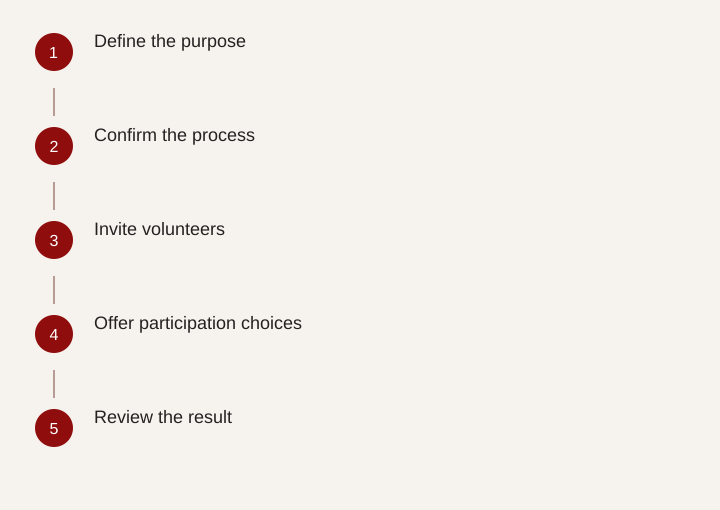
- Define the purpose
- Confirm the process
- Invite volunteers
- Offer participation choices
- Review the result
Define a purpose before asking people to participate
A useful heritage event starts with a sentence about what participants will learn or do. “Discuss two sources about a local Latino community” gives the organizer a task. “Celebrate our Hispanic employees” may unintentionally turn colleagues into the event's content before anyone has agreed to that role.
Choose a scope that fits the time and resources available. A short facilitated discussion, a visit to a public exhibit or a source-based lunch session can work. The heritage portal hosted by the Library of Congress explains the September 15–October 15 observance, but it does not determine a particular employer's event policy. Confirm the current process for scheduling, using funds, inviting speakers and sending internal announcements.
For a government workplace or any organization with changing program rules, use the actual current instructions rather than an old event page. A historical example can inspire a format; it cannot establish present authorization.
Separate three different invitations
Attending an event, helping organize it and sharing a personal story are different requests. Do not bundle them into one vague invitation that makes a colleague feel they have agreed to more than they intended. Someone may enjoy the discussion while having no desire to describe their family or appear in a photograph.
An original invitation might say: “We are planning an optional discussion about the attached museum sources. Everyone is welcome. If you would like to help choose questions or suggest a public resource, you can contact the organizer privately. No personal story or photograph is expected.” Adjust the wording to your actual workplace process and avoid promising conditions the organizer cannot control.
A private invitation to a colleague can be equally simple: “This topic may interest you, but there is no expectation to participate or advise us.” Ask once and accept the answer. Silence is not a commitment, and declining does not require an explanation.
Keep responsibility with the organizer
Make a list of tasks: research, room booking, accessibility arrangements, speaker contact, discussion facilitation and follow-up. Assign each one. Do not leave the research and emotional labor implicit while the formal organizer handles only the calendar invitation.
The Smithsonian's Latino identity exhibit emphasizes the diversity of Latino experiences. That is a strong reason not to appoint one employee as the representative of a broad population. Expertise is specific. A person may know their own experience deeply without being a historian, translator or event planner.
If a volunteer contributes, define a bounded task and realistic preparation time. “Choose one question about this source” is clearer than “Make sure the event is culturally appropriate.” Where the organization brings in a speaker or facilitator, follow its normal procurement and compensation process rather than assuming heritage work should be free.
Offer more than one way to take part
Public speaking is not the only meaningful participation. Attendees can read a short source beforehand, submit a question privately, write a reflection or simply listen. A person should not have to identify their ethnicity to enter the room, nor explain why they prefer a quiet format.
Plan the event around materials available to everyone. Provide readable text, explain unfamiliar terms and consider captions or a transcript when using media. Avoid making Spanish fluency a condition of understanding the session. If the program uses another language, explain how participants can follow the content and arrange appropriate support within the event's resources.
For stories or recordings, discuss the purpose and sharing plan before collecting anything. The Smithsonian oral-history guidance stresses explaining the project and not recording without the interviewee's knowledge. Workplace procedures may require additional steps; the organizer should establish those separately.
Use an organizer worksheet
| Decision | Practical question | Evidence that it is resolved |
|---|---|---|
| Purpose | What will people understand or practice? | One clear learning objective |
| Process | Which current rules apply? | Named contact and confirmed procedure |
| Ownership | Who researches and facilitates? | Task list with realistic time |
| Participation | Can people attend without sharing identity? | Invitation states the choices |
| Content | Which public sources support the session? | Short source list and discussion questions |
| Access | Can people use the materials in the planned format? | Captions, readable text or alternatives |
| Follow-up | What useful resource remains afterward? | Source sheet or optional next activity |
Consider a hypothetical thirty-minute lunch discussion. The organizer provides two museum excerpts, gives a five-minute introduction and facilitates fifteen minutes of questions. The final ten minutes let people connect the sources to a local exhibit or reading. Nobody must share a family story, and the result is a source sheet attendees can use later.
Evaluate the experience without measuring identity performance
Ask whether the session was clear, useful and manageable. Which question helped people learn? Was the format accessible? Did anyone feel pressured into a role? Gather feedback in a way that does not require public criticism of the event organizer.
Avoid judging success by how many employees from a particular group appeared in a photo or spoke aloud. Those measures reward visibility rather than learning and can create pressure in the next event. A small, well-prepared discussion can be successful even when most participants listen.
If the feedback supports continuing, choose a modest next step: improve the source sheet, host another discussion or share information about a public event. Keep each activity purposeful. A heritage month can open a conversation, but the quality of everyday working relationships depends on what happens throughout the year.
Related questions
Should I ask the only Latino employee to lead?
Do not assume that role. You can make a private, optional invitation while retaining responsibility for the planning yourself.
Does an opt-in invitation settle workplace policy questions?
No. Verify the organization’s current approval, scheduling and communications rules separately.
Sources & further reading
Primary references
Community questions behind this guide
These discussions informed the question and language. Personal accounts are not verified facts or professional advice. Read our method.