THE SHORT ANSWER
A broad ethnic label cannot tell you whether a particular garment is appropriate for a school event. Investigate the garment and the activity, then choose a contribution you can explain accurately.
What to keep in mind
- Identify the specific garment and context rather than treating a region as one culture.
- Do not make a colleague responsible for approving every cultural choice.
- Give students ways to participate without buying clothing or disclosing ancestry.
- Identify the garment
- Research its context
- Check the activity
- Choose a contribution
Begin with the specific object
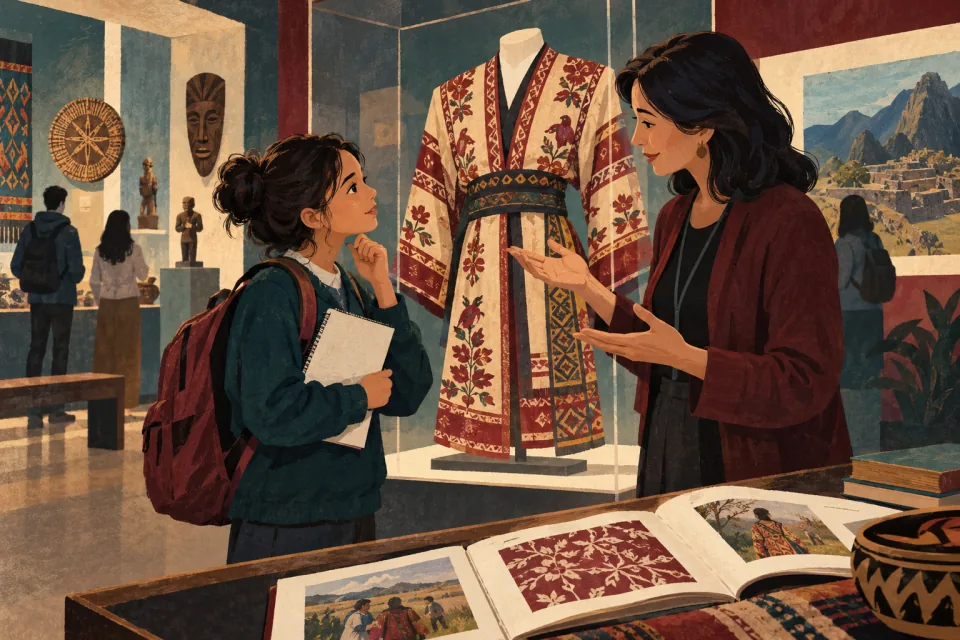
A question such as “Can a non-Hispanic teacher wear this?” leaves out information that matters: what the garment is, where it came from, how it is normally used and what the school activity asks people to do. A floral embroidered shirt, for example, cannot be assigned a precise community or meaning simply because it resembles something seen online.
Start with what you actually know. You may know where you acquired it and what its label says, but not who made it or whether the design has a specific regional significance. Keep those gaps visible. Do not convert a visual resemblance into a confident cultural label just to make the outfit fit an event theme.
The Smithsonian's Latino identity exhibit emphasizes that Latino experiences and expressions are diverse. That is a reason to narrow the question, not to seek a universal verdict about everything described as Hispanic clothing.
Research use and context, not only appearance
Look for a museum record, a maker's explanation, a documented community source or a reliable account of the garment's use. Useful questions include whether it is everyday clothing, performance clothing, ceremonial dress or a modern commercial design. Also ask whether the image you are comparing it with describes a specific place and period.
A shopping listing may identify a style, but its sales language is not necessarily reliable cultural documentation. A social-media photograph may show how one person wears an item without explaining its history. Compare sources and be willing to say that the provenance remains uncertain.
Do not reduce research to collecting approving comments. Different people can reasonably have different views about a specific use. What you need is enough context to understand the choice you are making and explain it honestly in the educational setting.
Ask knowledgeable people a bounded question
If you consult a colleague or community member, ask whether they want to discuss the specific question. Avoid putting the only Hispanic teacher on the spot with “Is this okay for all of you?” Their identity does not create an obligation to provide cultural review, and their answer cannot represent every community.
A more useful request is: “I am trying to identify this garment before deciding whether it belongs in the activity. Do you know a source or maker who could help? It is completely fine if this is outside your knowledge.” This gives the person a manageable way to help or decline.
The Smithsonian folklore guide treats community members as people with particular knowledge and experience. Apply that principle: listen to the expertise someone actually offers rather than treating them as a general approval authority.
Examine what the school activity communicates
Even a well-understood garment can become awkward in a poorly designed activity. Ask whether students are being invited to learn about a particular tradition or merely to dress as a broad ethnic category. The latter can encourage caricature, flatten differences and make students feel that their everyday identity is a costume.
A stronger activity asks students to examine a documented object, its maker and its use. Clothing can be part of that inquiry, but so can a photograph, a book, a song discussed with context or an account of a community practice. The learning objective should survive even if nobody wears anything special.
Check the practical expectations as well. A themed clothing day can create an unspoken purchase requirement or pressure students to explain their family background. Offer equivalent participation options and make clear that ordinary school clothing is acceptable under the school's actual event plan.
Use a context worksheet before deciding
| Question | What a useful answer looks like |
|---|---|
| What is the item? | A documented name or an honest description |
| What is known about its origin? | A maker, place, label or collection record |
| How is it used? | Specific evidence rather than a general guess |
| What remains uncertain? | Questions still requiring research |
| What is the educational purpose? | A learning point connected to the activity |
| Who might be asked to explain it? | A volunteer with relevant knowledge, not an assigned representative |
| What are the alternatives? | Contributions that meet the objective without the garment |
Consider a hypothetical teacher who owns an embroidered blouse but cannot identify its source. Instead of presenting it as “traditional clothing of Latin America,” the teacher could contribute a documented museum image and lead a discussion about how researchers identify objects. The uncertainty becomes a reason for careful inquiry rather than for a fabricated explanation.
Another teacher may have purchased a garment directly from a maker who explains its context and intended use. That information supports a more specific introduction, while still leaving room to consider the school's activity and the maker's stated expectations.
Choose an alternative that still contributes
If you decide against wearing the item, you have not failed to participate. You might prepare a source-based display, read a short text with its context, help with event logistics or invite students to investigate a particular artist's work. These are substantial contributions when they connect to the learning goal.
For student choice, offer three parallel routes: investigate a documented object, analyze a public source or explain a voluntarily shared family practice. Apply the same expectations for evidence and clarity. Do not reward a student for having access to expensive clothing or an available relative who can participate.
After the event, ask what students learned and which parts created confusion. If the conversation centered entirely on whether an outfit looked authentic, reconsider the activity's design. A successful heritage lesson helps students ask better questions about people, objects and history. Clothing may contribute to that work, but it should not carry the entire educational purpose.
Related questions
Can one person give permission on behalf of a culture?
No person can settle every community’s view. A knowledgeable person can explain a particular context, which helps you make a better-informed decision.
What if I cannot establish a garment’s origin?
Do not invent a label. Choose another contribution or describe the uncertainty without presenting the garment as representative.
Sources & further reading
Primary references
Community questions behind this guide
These discussions informed the question and language. Personal accounts are not verified facts or professional advice. Read our method.