THE SHORT ANSWER
A booth cannot represent an entire continent. Narrow the scope, show visitors a documented source and give them a short task that leads to one clear learning outcome.
What to keep in mind
- Name the booth’s limits rather than claiming to represent everyone.
- Build an activity around evidence visitors can examine.
- Design a short interaction that works without prior knowledge.
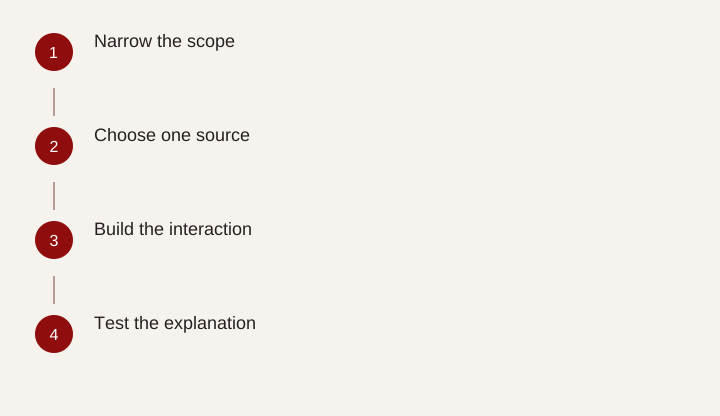
- Narrow the scope
- Choose one source
- Build the interaction
- Test the explanation
Replace the continent-sized assignment
If someone asks you to run a “South America booth,” begin by narrowing the assignment. A continent contains many countries, languages, communities and histories. A table cannot represent them all accurately. Keep the broad label only as a navigation aid and give the activity a specific subtitle, such as an exploration of one documented craft, neighborhood or musical tradition.
Choose a question that a visitor can begin answering in five minutes. “What can this object tell us about how people share knowledge?” offers a task. “Discover South American culture” promises far more than a brief activity can deliver. A precise question also helps you reject unrelated decorations that consume preparation time without supporting learning.
The Smithsonian's Latino identity exhibit stresses the diversity within broad labels. State your selection's limits openly: this is one example from a particular place, not a model of how everyone in the region lives.
Select a source visitors can actually use
Choose an object image, short recording, map, photograph or written excerpt with a clear source record. The item should reward close attention even when a visitor knows little about the subject. Avoid an object that needs ten minutes of historical explanation before anyone can understand the activity.
Read the source description carefully. Record the creator, place, date and any uncertainty. Check reproduction conditions before making a display copy. If the source includes a personal account, explain whose perspective it records instead of presenting it as the definitive voice of a whole country.
The Smithsonian Folklife education resources include community-research methods and an exhibition kit for classrooms, libraries and cultural centers. These offer a useful model: the booth can be a small exhibit with a question and evidence, rather than a collection of symbols assembled because they look festive.
Design a five-minute interaction
Structure the visitor's experience in three moves: notice, consider and respond. First ask them to identify a detail. Then provide a short piece of context. Finally invite an interpretation or a question. This sequence works better than starting with a quiz that rewards prior knowledge and embarrasses visitors who are new to the subject.
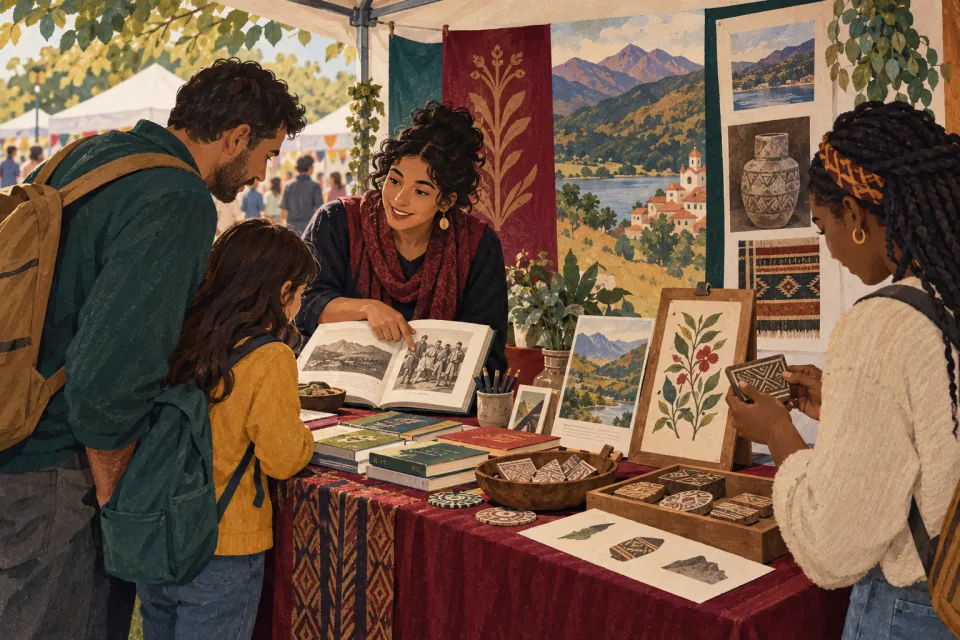
Here is a hypothetical activity format. A visitor examines two documented images of a public gathering from different times. They choose one detail that changed and one that stayed similar. The facilitator then shares the captions and asks what additional source would help explain the difference. The activity teaches comparison without pretending that the images alone establish why the change occurred.
Prepare a shorter version for a crowded event. A visitor who has one minute can still make one observation and take a source card. People who want more can read the extended caption or follow a link later.
Make the display accessible and specific
Keep text readable from the distance where visitors will stand. Place the main question at the top and the essential context beside the object, not in a dense paragraph at the bottom. If using audio, provide a transcript or an equivalent way to engage with the material. Do not assume that every visitor reads Spanish or English comfortably.
Explain unfamiliar terms when they first appear. A map should identify the particular location discussed, while making clear that national borders do not tell the full story of a community. Avoid flag collections that imply one language, race or tradition corresponds neatly to each country.
If children participate, provide an interaction that does not require disclosing ancestry or family history. “What do you notice?” is available to everyone. “Tell us where your people are really from” changes the activity into an identity test and can make the booth less welcoming.
Fill out a booth planning canvas
| Element | Planning prompt | A workable answer |
|---|---|---|
| Scope | Which exact community or subject? | One documented place and period |
| Question | What can visitors investigate? | A question the source can partly answer |
| Source | What will they examine? | One or two clearly credited items |
| Action | What will they do? | Compare, sort observations or ask a question |
| Context | What must you explain? | A short caption and one limitation |
| Access | What alternatives are needed? | Readable text, transcript or seated interaction |
| Takeaway | What remains after the visit? | A source card with an optional next step |
The Library of Congress Mexican American source set explicitly notes its own limits. You can use the same honest habit even when your booth concerns another place: say what the selection covers and what it cannot establish.
Rehearse with someone unfamiliar with the topic
Ask a colleague or friend to try the activity without your full explanation. Watch where they hesitate. Can they find the question? Do they know what to do? Does the source support the conclusion the activity seems to encourage? Revise the display based on those observations.
Prepare a response for questions you cannot answer: “I do not know from these sources. Here is the collection record we used, and that is a good question for further research.” This is more educational than improvising a confident cultural fact. Keep a note of recurring questions for a later resource sheet.
After the event, assess learning rather than counting only visitors. Ask people to name one detail they discovered or one question they now have. If the dominant response is simply that the booth looked colorful, the interaction may need a clearer inquiry. A small, accurate encounter with evidence can give visitors a meaningful starting point without claiming to summarize a whole continent.
Related questions
Is a South America booth too broad?
It usually needs a narrower focus. Use the regional label for navigation, then identify the particular community, place or subject the activity examines.
Can food be included?
Yes, when its specific context is explained and the event’s practical requirements are addressed. Food alone should not be expected to explain a whole culture.
Sources & further reading
Primary references
Community questions behind this guide
These discussions informed the question and language. Personal accounts are not verified facts or professional advice. Read our method.