
THE SHORT ANSWER
Ask how you would use each important service during a real week. A named center or attractive mission statement is only the beginning of evaluating whether support will be available when you need it.
What to keep in mind
- Investigate the services relevant to your own schedule and major.
- Ask about staff, access rules and capacity, not only whether a program exists.
- Compare current evidence with cost and academic fit.
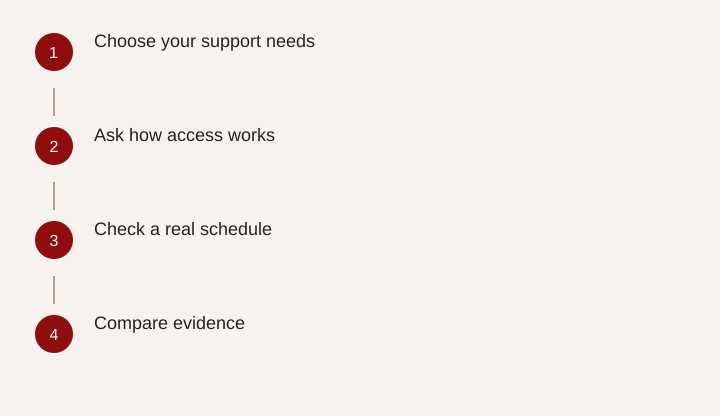
- Choose your support needs
- Ask how access works
- Check a real schedule
- Compare evidence
Define what support would mean for you
Before a campus visit, list the situations in which you might need help. You may want tutoring in a demanding major, guidance on transfer credit, a place to meet first-generation peers or appointments outside work hours. A general question about whether the campus supports Latino students may produce an equally general answer.
Choose three priorities and build questions around them. If you commute, ask about hours and meeting formats. If you are entering a sequence-heavy major, ask about advising and course planning. If you want community, ask what newcomers actually do at recurring activities.
The Department of Education's published HSI eligibility description concerns an institutional category. It is not a service directory. Your visit should investigate the operational details that the label itself cannot provide.
Ask who runs the service and how students enter
For each center or program, identify the responsible staff, contact route and intake process. Ask whether students can walk in, need an appointment or must complete an application. Find out whether the service is open to all students or has specific eligibility conditions.
A service described as peer-led may be valuable, but ask what training and staff support the peer leaders receive. Do not assume that a club or volunteer team can provide the same continuity as a staffed academic office. Conversely, a staffed office still needs a usable appointment process.
For programs such as TRIO Student Support Services, consult the official program description and the campus's current information. Verify eligibility and capacity rather than assuming that an identity label guarantees a place. Ask what alternatives exist if a program is full or does not apply to you.
Test access against a real week
Imagine a typical schedule with classes, travel and work. When would you attend tutoring? Could you reach an adviser before registration closes? Does a cultural center's event calendar overlap with the hours you can actually be on campus?
Ask whether remote appointments or daytime activities are available, and confirm the terms rather than interpreting “flexible” optimistically. If a service requires repeated attendance, find out the expected commitment. A program can be excellent but impractical for a student whose work schedule conflicts with every meeting.
Look at the current calendar, not only a highlight reel of past events. If the website lists no recent activity, ask whether the program is operating and how students receive updates. A quiet page may reflect poor communication rather than an inactive service, but the distinction needs an answer.
Bring a campus-visit interview sheet
| Support area | Questions to ask | Evidence to take away |
|---|---|---|
| Academic advising | Who advises my major, and when can new students book? | Current contact and booking process |
| Tutoring | Which courses are covered, and what are the hours? | Schedule and access conditions |
| Community space | What recurring activities welcome new students? | Current calendar and named host |
| Mentoring | How are students matched and supported? | Program description and expectations |
| First-gen support | Who is eligible, and is there a capacity limit? | Application process and alternatives |
| Continuity | Is the service confirmed for my entry term? | Current written information |
UC Davis's first-generation resource page shows the kind of named, linked support information to seek. Your school may organize services differently. The goal is not to demand the same program names, but to identify who can help and how that help is reached.
Ask students about specific experiences
Instead of “Is this college welcoming?” try “When you needed help choosing classes, how did you get an appointment?” or “Have you attended this group's meetings as a commuter?” These questions invite practical accounts that you can compare with the official description.
Listen for the circumstances behind the answer. A student in another major or living on campus may have different access from you. One enthusiastic account does not establish universal quality, and one frustrating experience does not prove that every service fails. Both can identify questions worth checking.
If a student reports that a center is often closed or appointments are unavailable, ask the office about current staffing and booking times. Record the discrepancy neutrally. You are gathering decision evidence, not asking students to resolve institutional policy or making a public judgment from an informal conversation.
Compare evidence rather than impressions alone
After the visit, mark each priority as confirmed, partly answered or unresolved. Note the source and date. A promise made during a tour may need confirmation from the office that actually operates the service, especially when it concerns eligibility, future availability or financial support.
Then compare support with academic fit and cost. A strong community program can matter substantially, but it should not hide a major that does not fit your goals or an unaffordable plan. Likewise, a less polished tour may still reveal dependable services with clear access.
A useful follow-up message could say: “During the visit I heard that evening tutoring may be available. Could you confirm the current schedule for the courses in my first-year plan and whether it is expected to operate in my entry term?” Specific answers allow a stronger decision than an HSI label or a general promise of inclusion on its own.
Related questions
Should I ask whether a center is funded?
Ask how the service is staffed and whether it is confirmed for your entry term. Avoid assuming a historical grant guarantees current operation.
Can student testimonials replace official information?
They can reveal useful practical questions, but should be compared with current policies and service details.
Sources & further reading
Primary references
- Title V: Developing Hispanic-Serving Institutions Program
- UC Davis Resources for First Gen Students
- Student Support Services Program (84.042A)
Community questions behind this guide
These discussions informed the question and language. Personal accounts are not verified facts or professional advice. Read our method.