THE SHORT ANSWER
Choose one topic, invite a willing participant and explain what will happen to the recording. A focused first interview can preserve meaningful detail while leaving room for privacy, uncertainty and future conversations.
What to keep in mind
- Ask separately about participating, recording and public sharing.
- Use open questions and follow the speaker’s pace.
- Preserve context and distinguish memory from independently verified history.
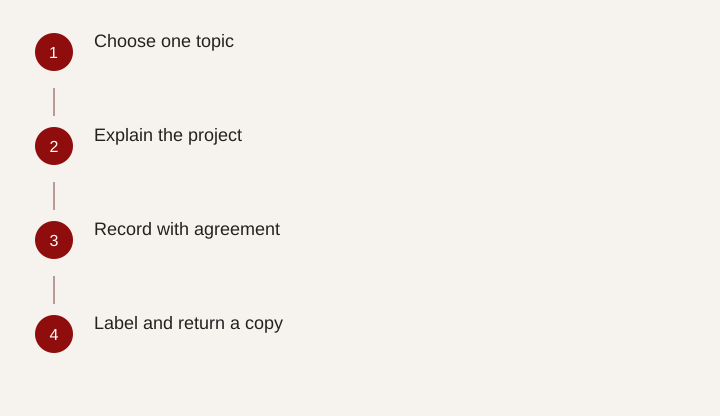
- Choose one topic
- Explain the project
- Record with agreement
- Label and return a copy
Make the first interview smaller than a life story
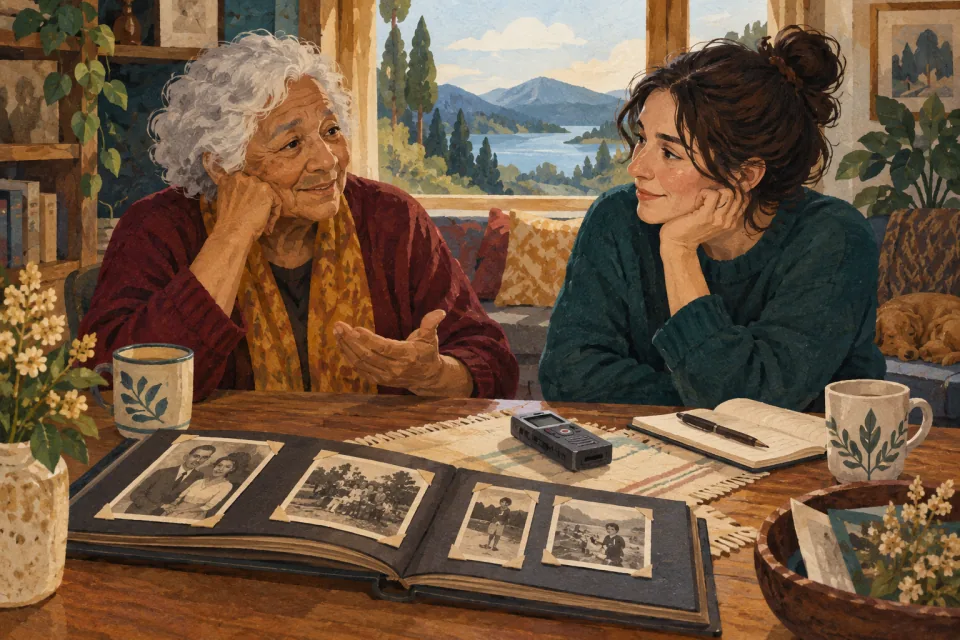
Start with a topic the person wants to discuss: a neighborhood, a skill, a family gathering, a job or an object they have kept. “Tell me everything about your life” can be overwhelming. “How did you learn to make this?” gives the conversation somewhere concrete to begin.
Choose someone who is willing, and explain why you are interested. Do not assume that a relative owes you an account of migration, conflict or loss. A first conversation about an ordinary practice can be rich in detail without demanding the most painful story in the family. The interviewee should help shape the scope.
The Smithsonian Folklife and Oral History Interviewing Guide treats family and community members as sources of knowledge and tradition. Expertise may concern a childhood game or a work technique as much as a major historical event.
Explain recording, storage and sharing separately
Before starting, describe the project in plain language. Say whether you hope to record audio, take notes, make a transcript, share a copy with relatives or publish an excerpt. These are distinct choices. Agreement to have a conversation should not be treated as unlimited permission to place it online.
Use the relevant release or permission process if the interview belongs to a school, museum or organization. For a personal project, make a clear written note of what has been discussed and what remains undecided. Do not promise withdrawal from every future copy if you cannot realistically provide it. Explain the limits before sharing begins.
The Smithsonian interview guidance advises against recording without the person's knowledge. It also recommends explaining the project's purpose. Keep that conversation separate from the technical moment of pressing the record button.
Prepare questions that invite detail
Use questions beginning with what, how or when, and follow an interesting answer rather than rushing through a list. “What happened next?” often reveals more than a new topic. Ask for examples when a broad statement needs clarification, but do not cross-examine a relative as though they must prove every memory on demand.
Here are ten original prompts you can adapt: What would you like someone to understand about this place? How did you learn this skill? Who helped you at the beginning? What tools or objects mattered? What did a typical day look like? What changed over time? Which part do people misunderstand? What do you remember noticing as a child? Is there a photograph that helps explain it? What question should I have asked?
Avoid building the desired answer into the question. “How difficult was it?” assumes difficulty. “What was the experience like?” leaves more room. If the person introduces a difficult subject, ask whether they want to continue rather than treating the disclosure as an opportunity to collect dramatic material.
Use a flexible thirty-minute plan
| Stage | Approximate time | Your task |
|---|---|---|
| Introduction | Five minutes | Confirm topic, recording and sharing choices |
| Opening memory | Five minutes | Ask about a familiar object, place or activity |
| Main conversation | Fifteen minutes | Follow details and ask clarifying questions |
| Closing | Five minutes | Ask what was missed and explain the next step |
This is an editorial planning example, not a rule about how long an interview should last. Shorten it when the person is tired or the setting is distracting. A second willing conversation is better than pushing through a first one that has become uncomfortable.
Test the recorder beforehand, then play a short sample back. Put the microphone where both voices are audible and reduce background noise when possible. Keep a notebook for names, unfamiliar words and follow-up questions. Do not repeatedly interrupt a meaningful story to repair every spelling detail; confirm those details afterward.
Let language support the conversation
Ask which language or combination feels most comfortable. A family member may shift between languages to explain an object, a joke or a remembered phrase. You do not need to make the conversation linguistically uniform. Preserve meaningful original terms and add explanations with the speaker's help when possible.
If you understand more than you can say, prepare a few simple prompts and a way to request clarification. You can ask, “Could you explain that word another way?” or “May I repeat what I understood?” The goal is understanding the person's experience, not proving your heritage through perfect pronunciation.
When a translator or another relative helps, explain their role and ask the interviewee whether the arrangement is comfortable. Note in the project record where translation or interpretation occurred. Do not silently replace a person's phrasing with a smoother version that changes the meaning.
Preserve the record and return something useful
Label the file with the interview date, a chosen identifier and the topic. Keep a separate note identifying the participant according to the agreed privacy plan. Make a backup in an appropriate location and avoid leaving the only copy on a phone that might be replaced or lost.
Write a short summary and mark useful timestamps before attempting a full transcript. Confirm names and dates where possible, but distinguish corrections from the original recording. Personal memory offers a perspective; it is not independent verification of every historical claim. If you research a disputed detail, keep the additional source alongside the account rather than silently rewriting the speaker.
Return a copy or a summary in a format the person can use. Ask whether the selected excerpt represents what they intended before broader sharing. The project should leave the participant with something meaningful too: a recording, photographs with identified names or a clearer record for the family. That reciprocity matters more than producing a polished archive as quickly as possible.
Related questions
Do I need professional equipment?
A reliable recorder or phone can be enough for a small personal project. Test the sound, keep notes and make a backup.
What if we do not share the same strongest language?
Discuss a comfortable format, allow pauses or mixed-language responses, and avoid turning the interview into a fluency test.
Sources & further reading
Primary references
- The Smithsonian Folklife and Oral History Interviewing Guide
- The Interview: Smithsonian Oral History Guide
Community questions behind this guide
These discussions informed the question and language. Personal accounts are not verified facts or professional advice. Read our method.