
THE SHORT ANSWER
A recent incident does not automatically make every older event timely. Build a chronology that lets the counselor or adviser examine each issue and its dates separately.
What to keep in mind
- Separate discrete decisions from recurring conduct and background.
- Keep event, notice, effective and reporting dates distinct.
- Ask about timing for each issue instead of assuming one recent event revives all earlier claims.
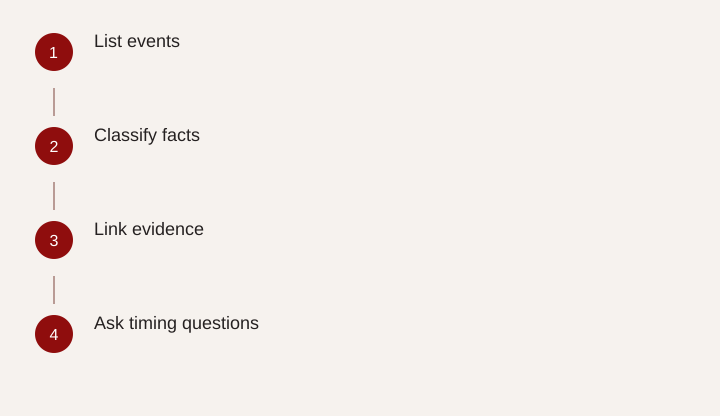
- List events
- Classify facts
- Link evidence
- Ask timing questions
Separate the history from the procedural question
When a workplace problem has continued for years, a chronology can become both emotionally difficult and administratively confusing. You may want the reviewer to understand the full pattern, while the process asks when a particular action occurred. Both needs can be addressed by organizing the file carefully.
Start with a complete working list, then distinguish recent events, older background and process steps. Do not remove an event merely because it is old, but do not present every event as automatically timely. A new disagreement does not necessarily reopen an earlier personnel decision.
The federal EEO overview describes the general counselor-contact requirement. Its existence makes date organization important; it does not mean you should decide complex timeliness questions alone. Give the counselor or qualified adviser a record that shows what happened and what remains uncertain.
Use more than one date column
A personnel decision may be made, communicated and implemented on different dates. You may discover relevant information later still. Record those dates separately when you know them, and identify the source for each.
For a hypothetical example, a promotion decision is announced on March 4, a new assignment begins on March 18 and an employee receives a written explanation on March 25. Those are not interchangeable dates. A reviewer needs the actual sequence to assess which event and timing rule matter.
Do the same for recurring conduct. Record individual incidents where possible rather than using “ongoing since last year” as the only description. If you cannot remember exact dates, use an approximate period and explain how you know it. A meeting invitation or project milestone may help you reconstruct timing without inventing precision.
Build a chronology with useful categories
The categories below organize facts; they do not decide which legal theory applies. A reviewer may classify events differently after examining the record.
| Column | What it captures |
|---|---|
| Event | Specific conduct or decision, described neutrally. |
| Dates | Occurrence, notice, effective date and later discovery if relevant. |
| Working category | Personnel action, recurring conduct, background or process step. |
| Possible connection | Why discrimination or retaliation may be relevant. |
| Evidence | Witness, authorized record or contemporaneous note. |
| Uncertainty | Missing date, disputed wording or unresolved explanation. |
| Timing question | What you need the counselor or adviser to clarify. |
Put procedural events in the same sequence but mark them clearly: first contact, counseling meeting, notice received and formal submission. This shows what you did without confusing an internal report with the underlying employment event.
Explain patterns without erasing differences
A pattern may involve similar comments, repeated exclusions or a series of decisions. Describe what connects the events: the same speaker, similar language, the same type of assignment or a recurring response after protected activity. Do not merely state that the pattern is obvious.
At the same time, preserve differences. A comment by a coworker and a promotion decision by a different official may have distinct significance. Identify what information connects them, if any. If the connection is your interpretation, label it.
The EEOC's general timing page illustrates the difference between separate discriminatory events and harassment timing, while expressly directing federal employees to a different process. Use it to understand why event types matter, not to import the private-sector filing period into your federal chronology.
If you kept earlier notes, distinguish them from a reconstruction made now. A contemporaneous note may contain fewer details than you remember today; preserve that difference rather than silently expanding the old entry. You can add a separate present-day explanation and identify its date. This makes the record easier to evaluate if someone later asks when a particular detail first appeared.
Prepare a concise narrative from the table
The narrative should explain the core concern in a few paragraphs, with the table available for detail. Lead with the event or conduct you are raising now. Then explain relevant earlier context and identify the evidence that may show a connection.
For example: “I am raising the reassignment communicated on [date]. I am concerned it was connected to [basis or activity] because [specific facts]. Earlier incidents in the attached chronology may provide context. I am not assuming that each earlier event is independently timely, and I would like guidance on how the issues should be identified.”
This approach is candid without surrendering the concern. It also prevents the reviewer from having to infer which action you are actually challenging. Avoid a narrative so broad that the current event disappears beneath several years of unrelated conflicts or evaluations.
Ask targeted timing and scope questions
Bring questions tied to particular rows: Which event is being treated as the claim? Which date matters for the contact requirement? Is an older event background or a separate issue? How should new related conduct be submitted? Does a pending grievance or another proceeding affect the route?
The federal processing resource describes multiple stages with different requirements. Do not assume a counselor's discussion of the history means every possible claim has been accepted for investigation.
Continue maintaining the chronology after contact, but preserve versions so later additions are identifiable. Keep restricted records in authorized systems and identify their location rather than moving them without permission. A careful chronology lets the reviewer evaluate a long history while still seeing the procedural details that can determine what happens next.
Related questions
Should I leave older incidents out entirely?
Not necessarily. They may provide context. Label them as older background and ask how they relate to the issues being raised, rather than assuming they are all timely claims.
Can I estimate dates I do not remember?
Yes, if clearly labeled as approximate. Explain the basis for the estimate and update the record if a document later supplies a reliable date.
Sources & further reading
Primary references
- Overview of Federal Sector EEO Complaint Process
- Facts About Federal Sector EEO Complaint Processing Regulations
- Time Limits for Filing a Charge
Community questions behind this guide
These discussions informed the question and language. Personal accounts are not verified facts or professional advice. Read our method.