
THE SHORT ANSWER
Read the rating scale literally and connect each selected answer to a real example. Strong self-assessment depends on accurate evidence, not automatic top ratings or unnecessary modesty.
What to keep in mind
- Interpret each question and its own rating scale before choosing an answer.
- Distinguish training, assisted work, independent work and leadership.
- Make the resume substantiate important claims without exaggerating your role.
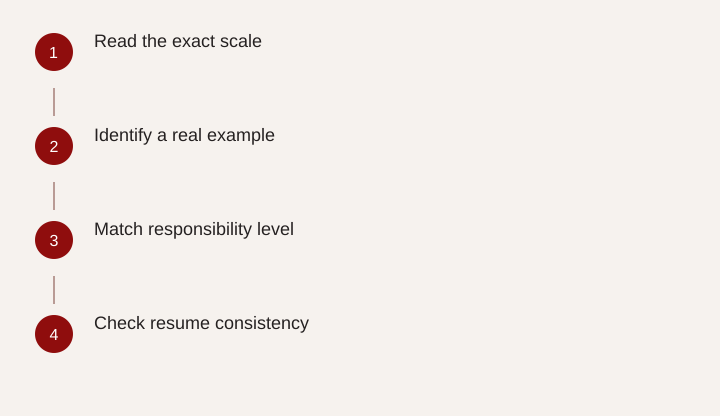
- Read the exact scale
- Identify a real example
- Match responsibility level
- Check resume consistency
Treat every scale as a definition
Federal application discussions often present a false choice: exaggerate every rating or lose to applicants who do. A more useful approach is to read exactly what the agency asks and select the strongest response your experience supports. Questionnaires can distinguish education, supervised performance, independent performance and responsibility for advising others. Those distinctions describe different evidence.
The USAJOBS application-process overview explains that agencies review applications against the job's requirements. Your questionnaire belongs to that same package. It does not replace the resume or supporting documents. Before selecting a response, read all answer choices, including qualifiers such as regularly, independently or complex. Do not reuse a rating simply because the next question looks similar. One question may concern performing a task, while another asks about planning or evaluating it.
Separate the task from the job title
Applicants moving between sectors may recognize the work but not the agency's terminology. Break the question into an action, an object and a level of responsibility. For example, reviewing records for accuracy is different from authorizing an exception to policy. Both may occur in the same office, but they require different examples.
Translate unfamiliar terms carefully using the announcement and official occupational information. Do not assume that a similar-sounding private-sector activity is equivalent. A hypothetical customer-service employee might have resolved billing discrepancies independently but referred contract changes to a supervisor. That person could support independent discrepancy resolution without claiming independent contracting authority. The OPM qualification policies emphasize relevant qualifying experience. The accurate connection is what you did and how it matches the required work, rather than whether your previous title resembles the federal title.
Build a rating-to-evidence worksheet
For the important competencies, write a short evidence row before answering. This makes both overstatement and unnecessary understatement easier to see.
| Question component | Evidence prompt | Hypothetical entry |
|---|---|---|
| Task | What action did I personally perform? | Compared invoice records with approved purchase records |
| Frequency and period | When and how often? | Weekly during a documented employment period |
| Independence | What required review or approval? | Resolved routine mismatches; escalated disputed charges |
| Complexity | What made the work difficult? | Missing documentation across several departments |
| Resume support | Where is the example described? | Accounts assistant entry, second bullet |
The example is fictional and illustrates the method. Your evidence can come from qualifying work outside federal service when the announcement permits it. Record limitations as well as strengths. “Escalated disputed charges” establishes a boundary and can make the account more credible than a vague claim to have handled everything.
Do not confuse assistance with independent responsibility
Working alongside an expert can build substantial skills, but proximity does not establish that you personally owned the expert's decisions. Ask who selected the approach, who checked the work and who had authority to finalize it. If a supervisor reviewed every case before release, describe that arrangement accurately. If you independently completed routine cases but needed help for unusual ones, preserve that distinction.
The opposite error is treating any supervision as proof that you never worked independently. Most employees have managers. A manager's general oversight is different from needing step-by-step instruction to perform each task. Use the wording of the actual scale to decide which description fits. When examples span different levels, choose the answer that satisfies the question's conditions, including any frequency or breadth requirement, rather than relying on a single exceptional assignment.
Check the resume against your strongest answers
A questionnaire can expose missing resume evidence. If you accurately claim independent analysis but your resume says only “assisted the department,” the package leaves an avoidable question. Revise the resume, while permitted before submission, to identify your specific analysis, scope and result. Keep the statement truthful and consistent with your dates and role.
The official federal resume guidance asks applicants to show how their experience meets the requirements. With the current page limit, this means selecting relevant evidence carefully, not pasting every questionnaire statement into the resume. Use a few concrete descriptions that support several closely related competencies. Do not copy a top-rating definition as though it were an accomplishment. “Served as an expert” is a conclusion; an example of advising colleagues on a documented procedure explains what that conclusion would rest on.
Resolve uncertainty before the final click
For an unclear question, first reread the complete announcement, preview questionnaire if available and relevant instructions. A narrow agency inquiry can help when a technical term or eligibility instruction is genuinely ambiguous. The agency may not advise you which personal rating to select, so ask about the meaning of the requirement rather than asking it to score your background.
Before submitting, compare your answers with your resume and required documents. Correct contradictions involving dates, education, licenses or responsibility levels. Save the completed package when the system permits. If you later discover an error, use the agency's stated correction process instead of assuming a general profile edit changes the submitted application. The strongest honest application presents substantial experience plainly, acknowledges its boundaries and gives reviewers enough evidence to evaluate the claims. That approach also leaves you prepared to discuss the same work in an interview.
Related questions
Should I select the highest rating for every federal questionnaire question?
No. Select the response supported by your actual experience under that question's scale. Unsupported top ratings can conflict with your submitted evidence.
Does completing a class mean I performed the task independently at work?
Not necessarily. Training and independent work are different levels when the questionnaire distinguishes them. Use the level that accurately describes what you did.
Sources & further reading
Primary references
- USAJOBS: How does the application process work?
- OPM applicant guidance on the two-page resume limit
- OPM: General Schedule Qualification Policies
Community questions behind this guide
These discussions informed the question and language. Personal accounts are not verified facts or professional advice. Read our method.