
THE SHORT ANSWER
Use current USAJOBS guidance as a starting point, then check the announcement for additional information. Compact formatting should preserve the facts needed to evaluate experience.
What to keep in mind
- Announcement instructions control the application package.
- Hours and dates help establish the experience claimed.
- Profile fields and submitted resume requirements are not interchangeable.
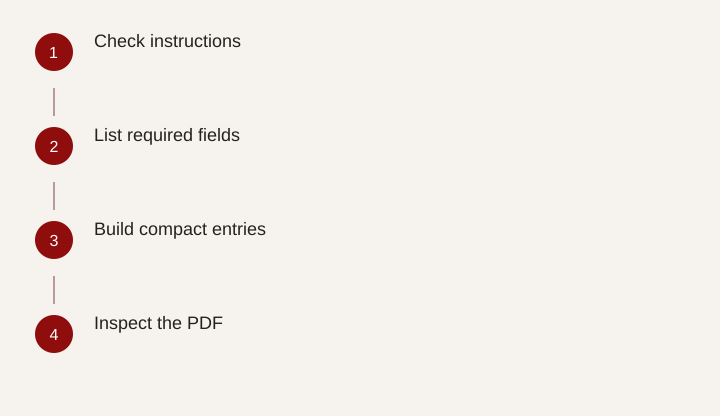
- Check instructions
- List required fields
- Build compact entries
- Inspect the PDF
Begin with the announcement and current guidance
A compact federal resume still needs enough information to establish the experience you claim. The safest starting point is the current OPM applicant resume guidance, followed by the specific announcement's Required Documents, Qualifications and How to Apply sections. Keep a short list of any additional instructions the agency provides.
General guidance currently identifies employer name, job title, start and end dates with month and year, weekly hours, relevant descriptions, and federal series and grade where applicable. It also describes contact information and relevant education or credentials. A particular vacancy may request more, so an online template is not a substitute for reading it.
The two-page requirement makes prioritization necessary. Remove decorative or repetitive content before removing facts that affect qualification review. A resume with clean visual spacing but missing dates can be harder to evaluate than a simpler document containing the required information. The objective is both legibility and sufficient evidence.
Separate three different information requests
Applicants often encounter a USAJOBS profile, a resume and an agency application questionnaire during the same session. These are connected, but they do not always ask for identical information. A field stored in your profile is not necessarily a requirement to print that field on every resume.
Conversely, an optional profile field does not override a vacancy that specifically requests the information in the submitted document. Review the final output from a resume builder rather than assuming that its interface answers every question about the application package. Agency systems may also request information again during the handoff.
Create three columns in your notes: required on the resume, requested elsewhere in the application, and not requested. Put uncertain items in a separate question list. This simple distinction reduces wasted space and prevents an applicant from treating a background-history requirement as a command to include every historical detail in the two-page resume.
Keep dates and hours attached to the role
Month and year dates help the agency evaluate the duration of experience. Weekly hours help explain whether work was full time, part time or variable. Keep those facts close to the relevant role, where the reader can connect them to its duties.
Do not silently round several short periods into one continuous employment span. If a seasonal position ended and restarted, use a structure that shows the actual periods. If hours changed substantially, describe the relevant pattern accurately. A compressed heading should not create a false impression of uninterrupted full-time work.
Federal series and grade belong with federal roles where applicable. A private-sector applicant should not invent a GS grade for a corporate job merely to make the entry look federal. Describe the actual title and responsibilities, then use the announcement to demonstrate the equivalent experience requested. Equivalence is a qualification question, not a decorative label to assign yourself.
Use a compact work-entry template
The following example is fictional and shows organization rather than required wording. Replace it with your facts and any additional fields the announcement requests.
| Line | Example content | Purpose |
|---|---|---|
| Role | Program Assistant | Example Organization | Identifies the work and employer |
| Time | June 2022 to August 2025 | 30 hours per week | Shows the period and schedule |
| Evidence | Reviewed expenditure records and resolved coding discrepancies with submitting staff | Describes relevant personal work |
| Further detail | Prepared documented correction recommendations for supervisor approval | Clarifies responsibility and output |
A federal example could place the actual series and grade beside the title. A vacancy requesting supervisor details may require another short line. Use tabs or simple alignment carefully; complicated columns can wrap unpredictably when exported. Keep each entry understandable in plain reading order. The template is successful when it saves space without requiring the reader to hunt across the page.
Choose optional content deliberately
A professional summary can be useful when it quickly explains a career transition or a rare combination of relevant qualifications. It is less useful when it repeats the job title, lists unsupported adjectives or consumes the space needed for a required work example.
References, supervisor information, salary and employer address generate conflicting advice because announcements and systems differ. Check the actual instructions rather than treating either “always include” or “never include” as universally correct. If an item is required, include it accurately. If it is not required, ask what evaluative purpose it serves before giving it scarce resume space.
Use accomplishments to explain relevant work, not to force every duty into a dramatic success story. A service role can demonstrate careful case handling, accurate records or consistent resolution of problems without a fabricated savings figure. The specialized-experience worksheet helps identify which details contribute evidence and which merely decorate the description.
Inspect the final document as a reviewer would
If the application accepts PDF files, that format can help preserve your layout and page count. Check the accepted file types and the announcement's instructions. Save the file, reopen it and inspect both pages. Check for missing characters, clipped lines, accidental third pages and headings stranded at the bottom.
Confirm that the file is legible at an ordinary viewing size. Extremely small text or nearly absent margins may make a document technically shorter while preventing a practical review. OPM's agency guidance explicitly addresses legibility, so treat readability as part of compliance rather than an optional design preference.
Finally, compare the exported document with your required-field list and the version attached in the agency system. Retain a copy of the exact submitted file. If you later prepare for an interview or ask about a qualification finding, that copy provides a reliable record; the editable resume on your computer may already have changed for another application.
Related questions
Is salary always required on a federal resume?
Do not assume one universal rule. Current general guidance and a particular announcement may request different information; check the vacancy you are applying to.
Can I omit weekly hours to save space?
Current USAJOBS resume guidance includes weekly hours for relevant work experience. Preserve required information before cutting optional material.
Sources & further reading
Primary references
Community questions behind this guide
These discussions informed the question and language. Personal accounts are not verified facts or professional advice. Read our method.